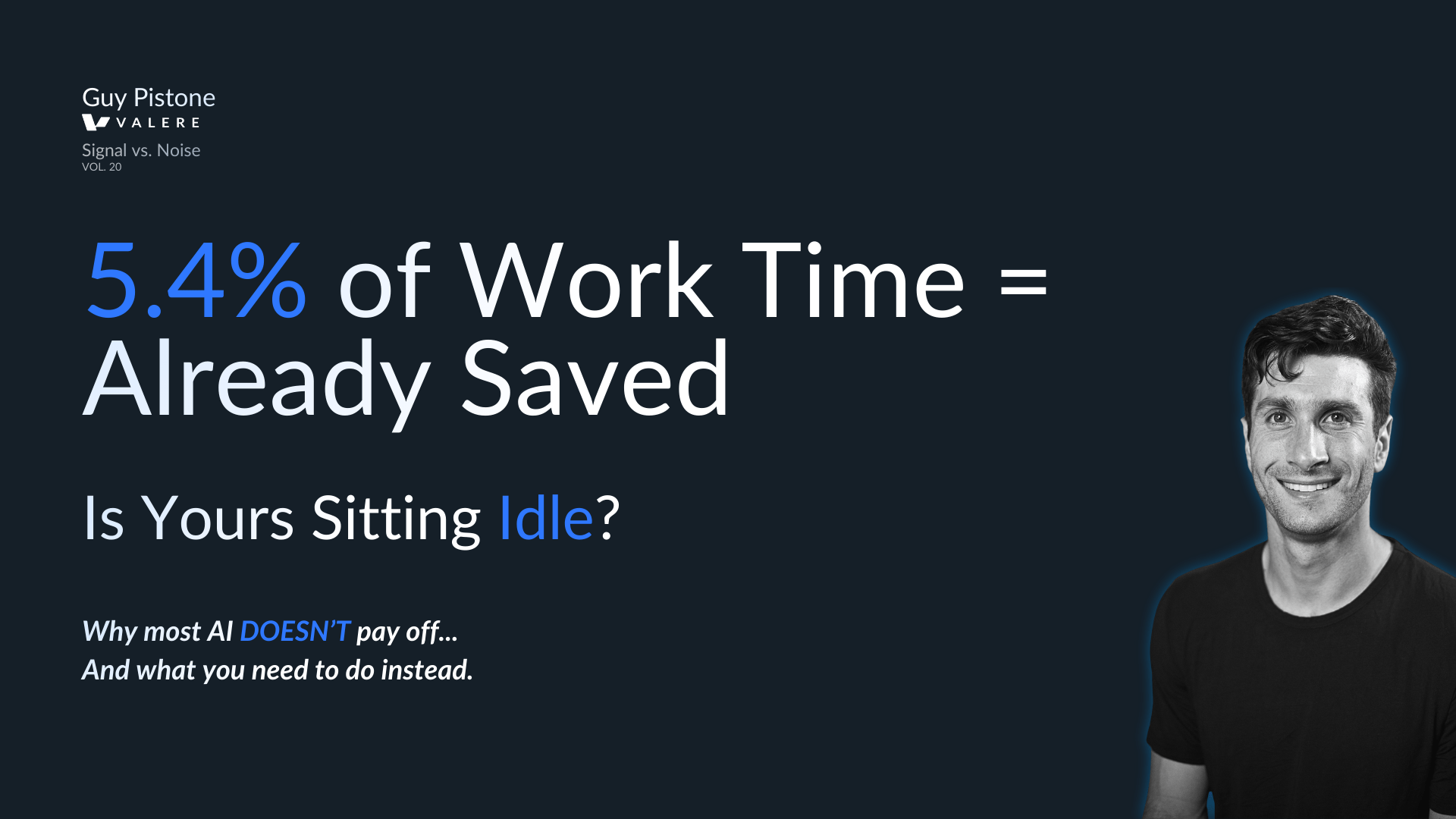
5.4% of your team’s week is already back, and it’s thanks to one thing: AI.
If you’re using it right.
AI saves hours. But most companies still waste them. PwC says AI is buying time.
Most execs are still buying noise. TL;DR? Time to reclaim your strategy.
Today is December 2nd. There are 29 days left in the year.
If you’re still unclear on the difference between buying AI and buying time . . .
This is the moment to fix that.
The Myth vs. The Move
“AI is a differentiator. If you just implement it, the results will come. Buy the tool. Get the outcome.”
Can you guess which one that is?
If you guessed MYTH . . .
You nailed it.
Leaving our MOVE to be:
“AI isn’t the differentiator. Execution is (execution that gives your team time back).”
Right now, most orgs are measuring AI by the wrong metrics:
- Adoption rates
- Model accuracy
- Dashboard screenshots
Meanwhile, the smartest operators are measuring:
- Time saved per process ⏱️
- Hours redirected from low-leverage work 📉
- Cycles eliminated across workflows 🔁
“AI that doesn’t buy back time is just expensive complexity.”
3 Reasons AI Without Time ROI = Expensive Complexity
I didn’t start Valere for glory, and I don’t build AI for the buzz. We’re on a mission.
In doing so, we build AI to make teams faster and freer to focus on what actually moves the business. The only AI that matters is the kind that gives time back to your org, consistently.
That means:
- AI that removes bottlenecks.
- AI that cuts hours from your ops.
- AI that earns its place on the balance sheet.
So, if you’re asking:
“Is our AI strategy working?”
Start here:
1. Usage ≠ Impact – GenAI users report saving 2.2 hours per week.
- That’s 5.4% of their workweek. St. Louis Fed (2025)
But most orgs never feel it because the time gets lost in broken workflows and unclear ownership. AI must be integrated into how teams work. not just layered on top.
2. Complexity Scales Faster Than ROI – due to process misalignment (largely), 46% of AI pilots never make it to production.
- That’s not a model problem; it’s a workflow problem. MIT Sloan’s 2025
When AI creates more overhead than it removes, it becomes anti-productive.
3. Time Is the Compounding Metric – Industries using AI effectively see up to 4x productivity gains per employee.
- Not from flash, and redeploying it with intention. (PwC’s 2025 Jobs Barometer)
Time is the only ROI that compounds inside an org.
Make Time Count
So the question isn’t:
“Did we adopt AI this year?”
The real question is:
“Did we buy back time?” And if we did… did we use it to build something that lasts?
The winning orgs aren’t the ones with the most AI tools.
They’re the ones who own the most focused time.
2026 will be shaped by one thing… How you use the time AI gives you.
Guy Pistone, CEO @ Valere
We build AI that actually works. For teams that actually do.
P.S. 💬 Want Help?
I know what it’s like to have knowledge and no clear path to execution. If you’re serious about turning AI into real operational leverage, and not just another expense, that’s exactly what we do at Valere.
We help companies design, implement, and scale AI that actually saves time, reduces cost, and compounds efficiency.
👉 Let’s talk: https://bit.ly/AIStrategy2026
Resources
- St. Louis Fed (2025): Generative AI Already Saving Time at Work https://www.stlouisfed.org/open-vault/2025/oct/generative-ai-productivity-future-work
- MIT Sloan (2025): 46% of AI Pilots Never Reach Production https://sloanreview.mit.edu/article/why-most-ai-projects-fail-and-what-to-do-about-it
- PwC Global AI Jobs Barometer (2025): AI Exposure Drives 4x Productivity Growth https://www.pwc.com/gx/en/news-room/press-releases/2025/ai-linked-to-a-fourfold-increase-in-productivity-growth.html