TL;DR: 3 Key Takeaways
- AI adoption has roughly doubled year over year while EBIT impact remains in the single digits, and the gap between the two is almost entirely a workforce capability problem.
- Off-the-shelf training fails because it teaches AI as a subject, while contextual role-specific enablement built around real workflows and real deliverables actually converts tools into outcomes.
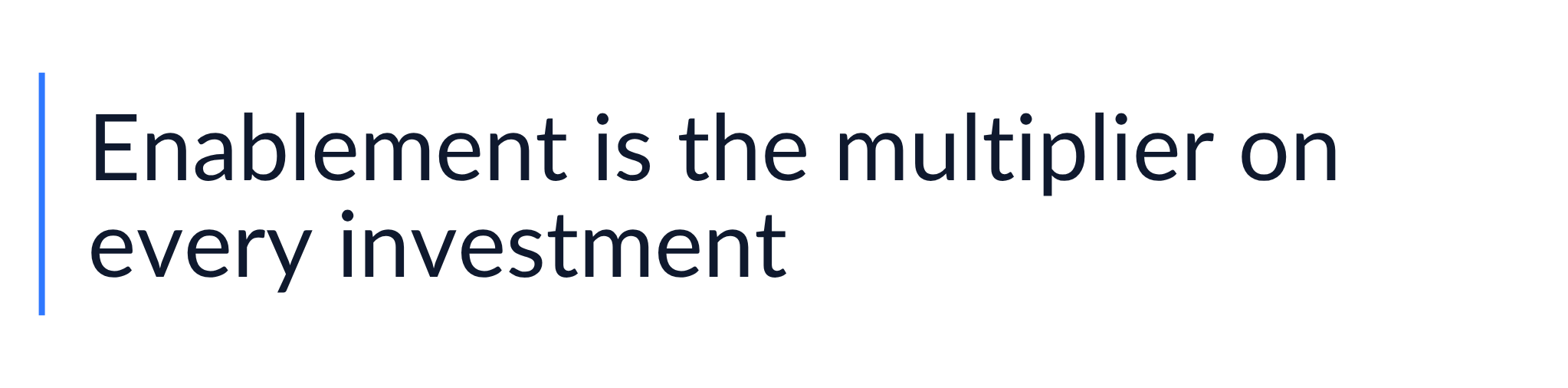
- Enablement is the multiplier on every AI investment, meaning the conversion rate between dollars spent on tools and dollars returned in value, and it belongs in the transformation budget rather than the L&D line item.
The Paradox Every PE Operator Is Living Right Now
AI adoption across portfolio companies has roughly doubled year over year. EBITDA contribution has not.
McKinsey’s State of AI research puts organizational adoption at around 72% of companies using AI in at least one business function, nearly double the prior year. Yet when the same organizations report on material EBIT contribution, the number collapses to single digits for generative AI specifically. BCG’s Build for the Future research places only 4 to 10% of companies in the top tier of AI performers. Gartner estimates 60 to 85% of AI projects never reach production. Root causes skew heavily toward organizational and human factors rather than model performance.
The Tension Every Operator Feels
Every PE sponsor and portco CEO I talk to is trying to reconcile the same tension. Licenses are deployed. Pilots are running. The board deck shows green on the AI workstream. Margin impact is nowhere to be found.
Our teams at Valere have delivered a few hundred deployments across manufacturing, financial services, higher education, government contracting, and SaaS. The gap between AI availability and AI value is not a model problem, and it is not an infrastructure problem. It is a workforce problem.

Why the Gap Exists
When researchers ask operators what actually blocks AI value capture, the answers come back strikingly non-technical. McKinsey, Deloitte, PwC, and the World Economic Forum all put skills and talent gaps at the top of every list. Deloitte’s State of Generative AI in the Enterprise research finds organizational and cultural readiness lagging meaningfully behind technical readiness. Employees report simultaneously high interest and high anxiety about AI in their roles.
Pilot Purgatory in Plain Terms
Harvard Business Review has a name for the downstream result: pilot purgatory. It describes the cycle of proofs of concept that never graduate into infrastructure because no one built the human layer around them.
The mechanism is straightforward once you watch it play out. AI capability only becomes AI value when a human being, embedded in a specific workflow with specific context, knows how to deploy it against a specific problem. Access is not adoption. Adoption is not usage. Usage is not value.
Enablement is the bridge. Across hundreds of portfolio deployments, we see it drive the single most consequential lever in enterprise AI transformation. It is also the one PE operators most consistently underfund.
The Skills Gap Is Active, Not Latent
This is not a 2027 problem waiting to materialize. It is already priced into your portcos today.
The World Economic Forum’s Future of Jobs Report lists AI literacy, analytical thinking, and technological fluency among the fastest-growing skills through 2027. LinkedIn data shows AI skill demand growing multiple times faster than the supply of workers with those skills. Microsoft’s Work Trend Index captures the sharpest symptom. Roughly three-quarters of knowledge workers now use AI at work. A comparable proportion bring their own tools. That means unsanctioned software running without training, governance, or oversight. Salesforce research confirms the demand side. Most workers feel underprepared to use AI in their roles, and only a minority report any employer-provided training.
Shadow AI Is Already in the Portfolio
Shadow AI is not a hypothetical. It is happening in the portfolio right now. The questions are whether people use it well, and whether the organization carries the risk unknowingly. Data exposure, regulatory compliance, and quality control now sit near the top of emerging concerns for CISOs and Chief Risk Officers.
LinkedIn and Burning Glass data suggest a measurable wage premium for AI-fluent workers. Employees show growing willingness to leave roles that do not offer AI skill development. Enablement has become a retention variable alongside everything else it is.
Why Off-the-Shelf Training Does Not Solve This
The instinct when facing a skills gap is to buy content. The market has responded with horizontal platforms, video libraries, and completion-tracking dashboards. Learning science has understood for decades why this model underperforms, and the AI context makes it worse.
The Learning Science Problem
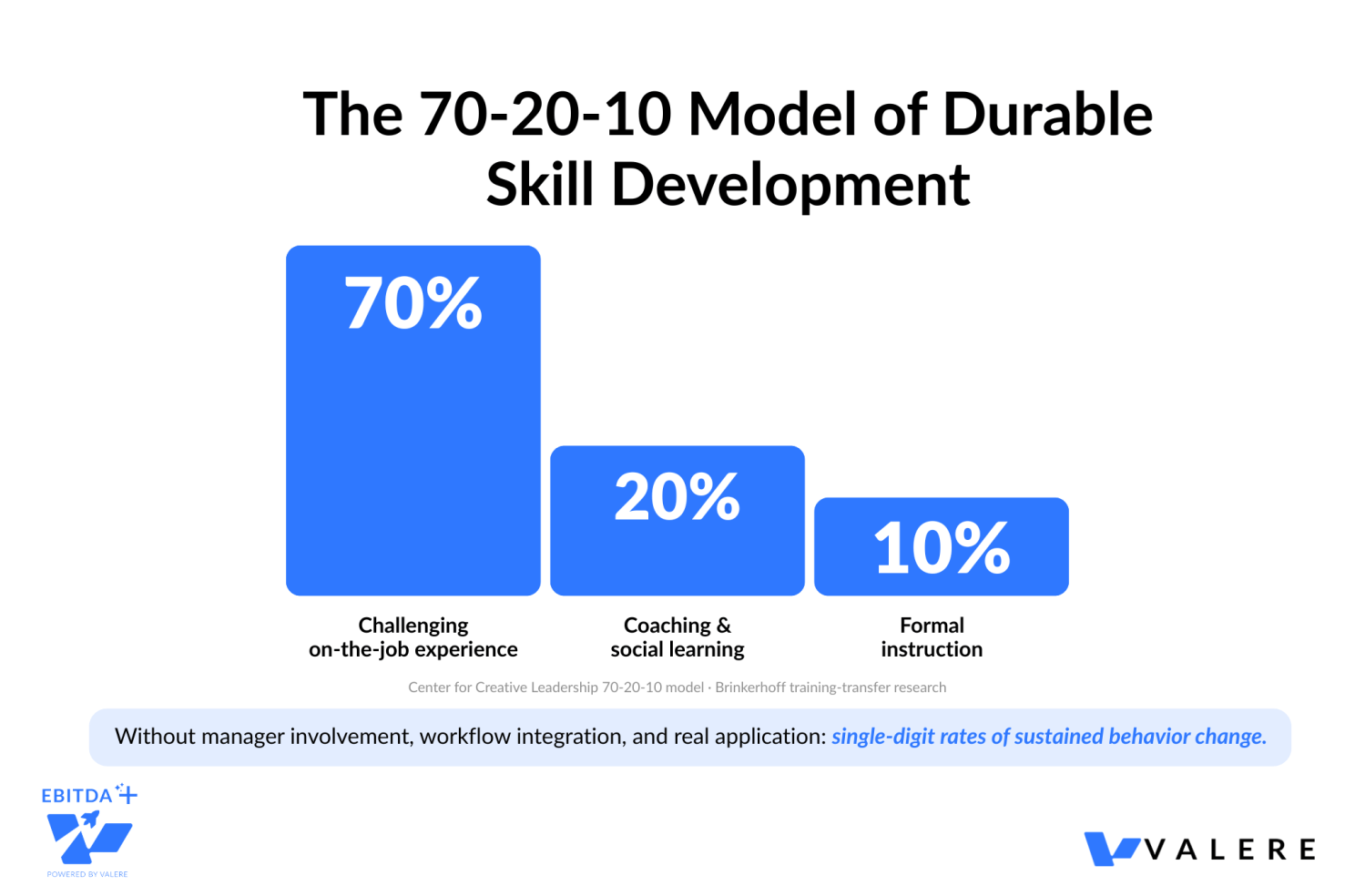
The forgetting curve tells us learners lose most new information within 24 to 48 hours without contextual reinforcement. Passive video is particularly vulnerable. The 70-20-10 model from the Center for Creative Leadership holds that roughly 70% of durable skill development comes from challenging on-the-job experience. Another 20% comes from coaching and social learning. Only 10% comes from formal instruction. Programs that live entirely in that 10% reliably fail to change behavior. Brinkerhoff’s training-transfer research shows that without manager involvement, workflow integration, and real application, training investments produce single-digit rates of sustained behavior change.
AI as a Subject vs. AI as a Tool
The specific failure mode for generic AI training is that it teaches AI as a subject rather than as a tool applied to a specific task. A marketing analyst who sits through a three-hour LLM fundamentals course still does not know whether, when, or how to use an LLM against their Monday morning campaign brief. That gap, between abstract capability and applied competence, is where portfolio companies win or lose value.
The enablement market is bifurcating around exactly this distinction. Content platforms scale AI literacy broadly but shallowly. Practitioner-led enablement goes narrow and deep, with fewer people, more context, real deliverables, and measurable outcomes. For organizations carrying P&L expectations on their AI investment, our delivery data and the underlying research favor the second track.
What Valere Learning Looks Like in Practice
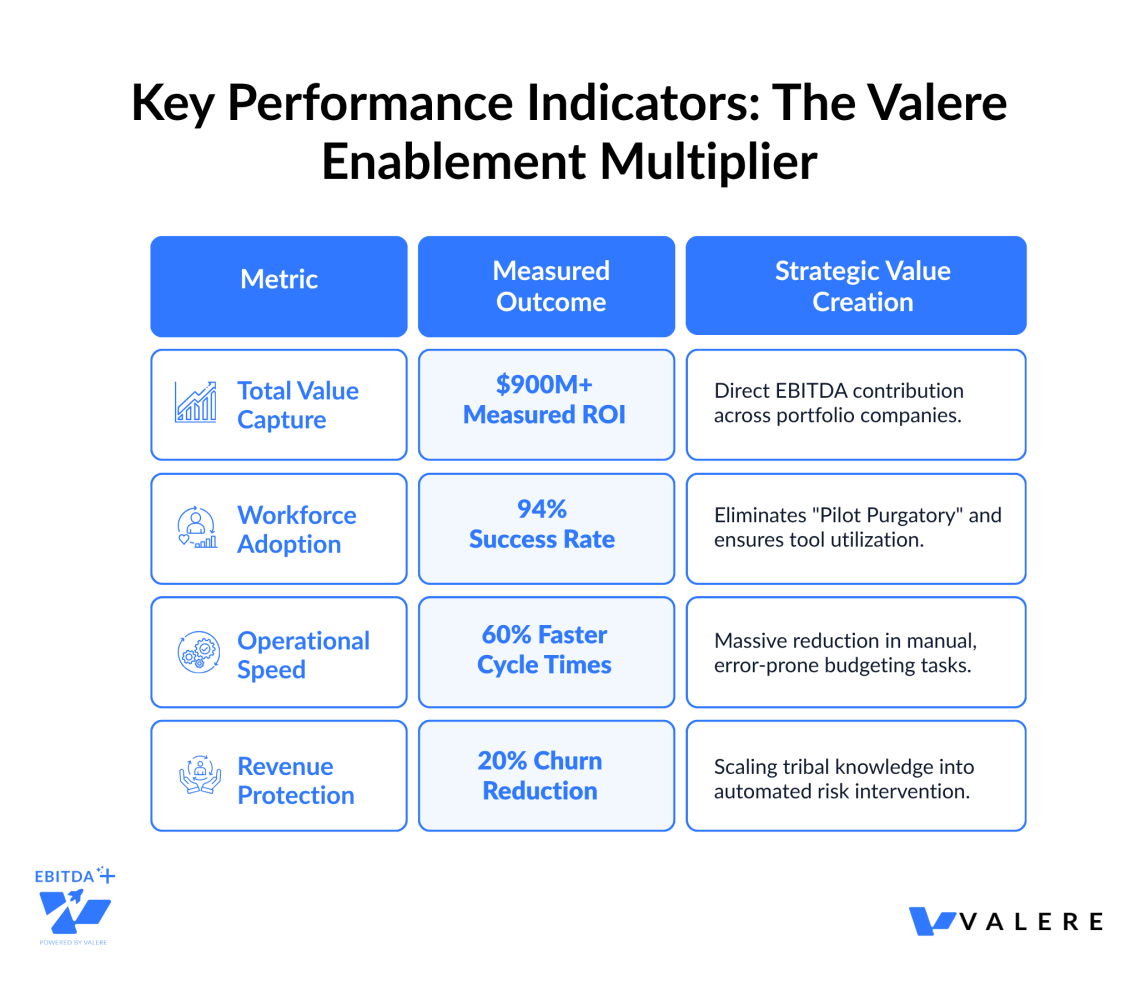
Valere Learning sits inside the broader Valere Evolve ecosystem. The logic is practical rather than clever. If employees are going to operate AI-first systems, they should train on the exact systems being deployed, not on AI in the abstract. That approach drives the outcomes we track most closely, including a 94% workforce adoption rate on deployed systems and more than $900M in measured client ROI to date.
The Three Forms the Work Takes
In-person and virtual workshops. We scope these to an organization’s real tools, team composition, and workflows. They ground in discovery and stakeholder alignment rather than generic product overviews. The goal is organizational change, not individual skill lift.
AI use case enablement bootcamps. This is where we go deepest. Participants configure, prompt, test, and deploy real workflows during the training itself. We scope bootcamps around a defined set of client-specific use cases. People leave with both working knowledge and working implementations.
On-demand courses and learning content. These include video walkthroughs, documentation, SOPs, and structured course libraries designed to scale alongside the user base. This is how AI literacy spreads horizontally once the depth work has established a foundation.
A Bootcamp in Action
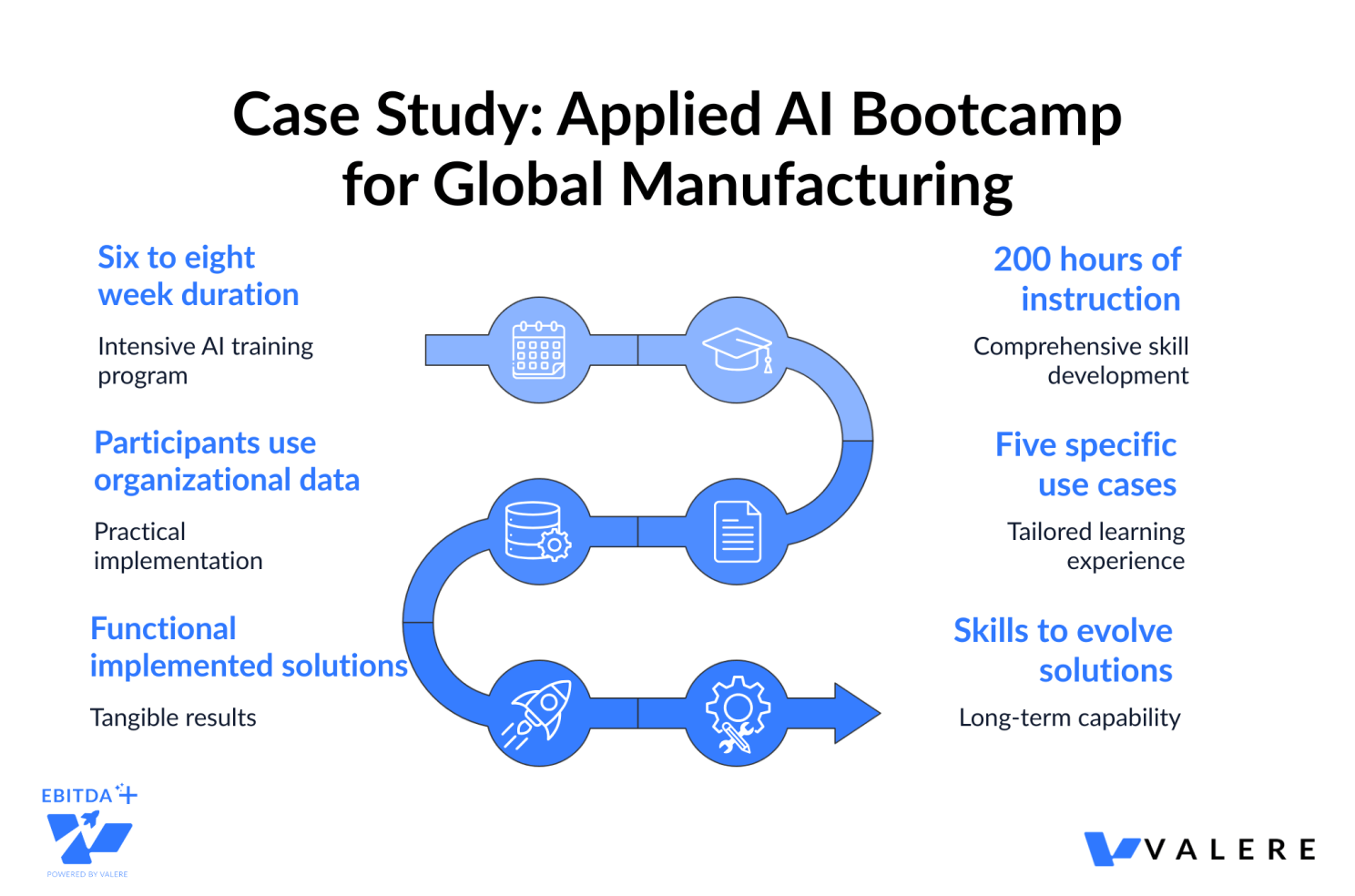
A global manufacturing and industrial supplier asked us to build Microsoft Copilot and Power Platform capability across Purchasing, Credit, Finance, and Service operations. The off-the-shelf version would have been a generic Copilot curriculum and a completion certificate.
Instead, we ran a six to eight week, 200-hour bootcamp structured around five specific use cases their teams already ran. Participants used their own organizational data to configure live workflows and Copilot Agents during the training itself. They walked out with functional implemented solutions plus the skills to evolve those solutions on their own. That is the difference between AI as a topic and AI as an applied tool. It is usually the difference between an investment that compounds and one that stalls.
What Makes the Difference in Delivery
A few patterns have held up consistently across hundreds of portfolio engagements.
Real Deployment Experience Compounds
Every workshop and bootcamp we run draws on a library of live deployments across very different organizational contexts. Participants learn from implementations that have survived contact with production, not from theory. It is the most useful question to ask any enablement partner: who has actually shipped?
Role Specificity Matters as Much as Format
A global investing infrastructure platform engaged us to deploy Amazon WorkSpaces for 1,200+ users, scaling to 5,000+. We embedded with the technical team and built training materials as the environment itself took shape. We contextualized content for two distinct audiences. IT administrators managed lifecycle workflows. End-users accessed virtual desktops across a compliance-sensitive global footprint. One curriculum could not have served both groups well. Two purpose-built ones did.
Contextual Design Around Human Judgment
In our work with a private research university’s alumni advancement team, we embedded AI directly into the workflows staff already ran. That included an Outlook plugin that generates pre-meeting donor briefings and a CRM sidebar widget for profile generation. We chose that path rather than asking staff to adopt a separate system. Every AI output routes through mandatory human-in-the-loop approval gates. Agents draft. Humans decide.
The same principle shows up in higher-stakes environments. For a government contracting business, we deployed an AI system that monitors federal portals and scores contract win probabilities. The real value sits in the Human-in-the-Loop Iteration dashboard. Sales teams make collaborative bid or no-bid decisions, refine scoring weights, and feed their ground-truth judgments back into the system for continuous learning.
Outcome Over Completion
Completion rates correlate weakly with value creation. That is the honest problem with most training industry reporting.
A SaaS company in the automotive space came to us needing to reduce customer churn. The intelligence to do it sat as tribal knowledge inside their Customer Success team. We used Dactic to interview the CS team and extract their undocumented understanding of churn signals. We used Conducto to generate automated risk scores. Then we built a custom dashboard where CS reps could review those scores, add qualitative context, and run intervention playbooks. The deployment mattered. Teaching the team how to actually work the system drove the 20% reduction in early-stage churn.
A similar pattern showed up with an architecture firm losing weeks per cycle to a manual, error-prone budgeting process. We built an AI-powered platform to automate it. The more instructive part was what came after: role-specific training for the finance team and for the department heads who would own their own financial planning going forward. The technology existed the day the code shipped. The value only existed once the people knew how to operate it. From there, the firm cut its budget cycle by 60% with material gains in forecast accuracy.
Post-Engagement Continuity
This one gets underestimated consistently. A large enterprise IT organization engaged us for a Microsoft 365 Copilot and ServiceNow integration. We could have shipped the technology and sent a user guide. Instead we structured the post-launch phase as its own enablement workstream. That included admin and end-user documentation, a formal knowledge transfer session with their IT team, and a defined hypercare period for issue triage.
The difference between an internal team that uses a system and one that owns and evolves it comes down almost entirely to what happens in the 90 days after go-live. We treat those 90 days as part of the deliverable.
Enablement Is the Multiplier
Here is the frame that tends to resonate with PE operating partners and portco CFOs. The ROI case for structured AI enablement is usually stronger than the ROI case for most individual AI tool purchases. Enablement is the multiplier on every tool purchase.
Why the Math Works
Productivity studies on generative AI, including Brynjolfsson, Li, and Raymond’s work in customer support, consistently show that productivity gains are largest for less experienced workers. The gains unlock specifically when employees know how to prompt, verify, and integrate AI outputs. The tool alone is not sufficient. The skill is the multiplier. Deloitte and Accenture workforce research estimates that organizations with mature learning and reskilling functions capture meaningfully higher returns from digital and AI investments. Some studies place the difference in AI value capture at multiples rather than percentages.
The Multiplier in Practice
The multiplier effect is clearest when a small team is asked to do the work of a much larger one. A B2B marketing platform we partnered with needed to orchestrate email outreach to over 250,000 contacts with a three-person team. We deployed Conducto and built a custom dashboard giving the team full visibility and control over performance, approvals, and ongoing learning. Three people managed 210 to 300 inboxes autonomously, without adding headcount. The AI did the orchestration. The enablement did the scaling.
The reframe worth making at the portfolio level: AI enablement is not a training line item. It is the conversion rate between AI investment and AI return.
Principles for Portfolio Operators
A few things have held up consistently across our work with PE sponsors and their portfolio companies.
Fund enablement from transformation budgets, not L&D budgets. The scale required to produce real AI value capture typically runs an order of magnitude beyond what traditional training budgets support. The returns justify the reclassification.
Treat enablement as part of the AI stack. Which AI tools should we deploy, and how will our people use them, are the same question. Answering one without the other is how the adoption and value paradox happens in the first place.
Favor contextual, role-specific programs over horizontal curriculum. Horizontal literacy has a floor-setting role. Transformation value comes from workflow-specific depth. An underwriter, a purchasing analyst, and a tier-1 support agent each need different things.
Measure deployed solutions, not completed courses. The program is working if people are shipping AI-powered workflows, not if they are logging hours in an LMS.
Build for continuity. One-time engagements produce one-time results. The organizations pulling durable value out of AI treat enablement as a permanent capability rather than a project.
The Solution Is Only as Good as the People Using It
The central finding across the enablement research is simple enough to say in one line. Organizations that invest in the people layer of AI transformation at the same depth and rigor as they invest in the technology layer produce AI value at scale. The ones that do not, do not.
For any PE sponsor or portfolio CEO approaching AI with P&L expectations attached, workforce enablement is not optional infrastructure. It is the mechanism that converts AI investment into outcomes. Every credible study of AI value capture returns to this point from a different angle. Our own delivery data across a few hundred deployments says the same thing.
The solution is only as good as the people’s ability to use it.
Ready to Turn AI Investment Into Measurable Value?
Ready to build AI systems your workforce actually uses? Valere works with Private Equity firms and portfolio companies to design, build, and scale AI deployments that convert into measurable outcomes. Whether you are evaluating adoption across existing AI investments, preparing a workforce for transformation, or rolling out new systems at scale, Valere brings the delivery experience, enablement methodology, and partnership model to turn AI potential into P&L performance.
- A Workforce AI Readiness Assessment identifying where your current AI deployments are underperforming due to gaps in role-specific training, workflow integration, and post-launch continuity
- A clear path from isolated pilots and shadow AI use to governed, role-contextual enablement programs that integrate with your real workflows, close the skills gap your teams are actually experiencing, and compound adoption with every system you deploy
- A personalized value creation roadmap moving your organization from disconnected AI experiments to a durable enablement capability, complete with human in the loop governance, embedded learning content, and the operating model required to sustain AI fluency across the business
Start building your AI enablement foundation: https://www.valere.io/
About Valere
Valere is an award-winning AI value creation & delivery partner, providing end-to-end AI transformation & custom software solutions that transform companies into AI-first organizations through building, learning, and scaling. As an expert-vetted, top 1% agency on Upwork, Clutch, G2, and AWS, Valere serves as the trusted AI value creation partner for PE firms, mid-market companies, and Fortune 500 enterprises alike seeking comprehensive AI transformation that drives measurable ROI. With over 220 dedicated professionals and domain experts, we specialize in end-to-end AI-native solutions using our proven crawl-walk-run methodology, guiding organizations through every stage of their AI journey—from initial assessment and strategy to full-scale implementation and optimization.
About Alex
Alex Turgeon is President of Valere, serving as an embedded AI/ML strategic partner for private equity firms and their portfolio companies. He and his team operate as a vertically integrated AI solution provider throughout the PE value chain, delivering enterprise-grade solutions that enable greater operational control, cost reduction, and efficiency gains across the investment lifecycle. Connect with Alex to discuss how your organization can begin its transformation to the agent era.
Build Something Meaningful with Valere.
Frequently Asked Questions
How do portfolio companies typically close the AI skills gap?
The most effective programs pair hands-on workflow training with the actual AI systems being deployed, rather than relying on generic literacy courses. The Center for Creative Leadership’s 70-20-10 model suggests roughly 70% of durable skill development comes from on-the-job experience. That is why content-only approaches rarely move the needle. Practitioner-led bootcamps, role-specific workshops, and embedded enablement during rollout tend to produce measurably higher adoption than horizontal curriculum. The question worth asking any partner is whether their program produces deployed solutions or just completed courses.
What does workforce AI enablement actually include?
Effective enablement generally spans three layers. First, facilitated workshops scoped to real tools and workflows. Second, deeper bootcamps where participants configure and deploy live AI use cases during training itself. Third, on-demand content for ongoing self-service learning. It also tends to include post-launch documentation, knowledge transfer, and a hypercare period in the 90 days after go-live. The thread across all of it is that enablement builds around specific systems and specific roles, rather than AI as an abstract topic.
Why do so many AI pilots fail to reach production?
Gartner estimates 60 to 85% of AI projects never make it into production. Reasons cluster on the organizational side: unclear workflow integration, missing change management, lack of role-specific training, and no continuity plan after initial launch. Harvard Business Review refers to this as pilot purgatory. The technology is usually ready well before the workforce is. That is why enablement strategy matters at least as much as model selection.
How should enablement be budgeted in a portfolio company?
Traditional L&D budgets generally fit compliance training and skill refreshers, not the scale required to turn AI tools into P&L impact. Organizations capturing real returns tend to fund enablement from transformation or digital investment budgets, alongside the tooling itself. Deloitte and Accenture workforce research suggests companies with mature learning functions capture multiples more value from AI investments than peers without them.
What is the difference between shadow AI and sanctioned AI use?
Shadow AI describes employees using AI tools on the job without formal training, governance, or oversight. Microsoft’s Work Trend Index suggests roughly three-quarters of knowledge workers now use AI at work, with a comparable proportion bringing their own tools. The risks cluster around data exposure, compliance exposure, and uneven output quality. Sanctioned AI use involves tools deployed with training, access controls, human-in-the-loop governance, and documented workflows. The gap between the two comes down to whether an organization has invested in enablement.
How is AI enablement ROI typically measured?
Completion rates are the traditional training metric, but they correlate weakly with value creation. More useful measures include the number of deployed AI workflows per team, time-to-first-value for newly trained employees, productivity deltas on specific tasks, and business KPIs tied directly to the AI use case. Those KPIs include reduced churn, faster cycle times, and headcount leverage on repetitive work. Brynjolfsson, Li, and Raymond’s research on generative AI in customer support shows productivity gains are largest for less experienced workers, and only when employees know how to prompt, verify, and integrate outputs.
What size company benefits most from structured AI enablement?
Mid-market companies and PE-backed portfolio companies with 200 to 5,000 employees tend to see the clearest ROI from structured enablement. They have enough organizational complexity that shadow AI and uneven adoption create real margin drag, but not so much bureaucracy that enablement rollouts get stuck in committee. Our delivery data suggests the compounding effect is sharpest when enablement arrives alongside a defined AI use case rather than as a standalone literacy program.
How long does it take to see measurable results from AI enablement?
For well-scoped bootcamp engagements tied to specific workflows, participants typically ship functional AI-powered implementations within six to eight weeks. Business KPIs tend to move within the first one to two quarters after go-live. Across engagements, time-to-first-value depends less on the training itself and more on whether the enablement was scoped to a real use case with an owner, a deadline, and a measurable outcome from the start.