TL;DR: 3 Key Takeaways
- Most enterprise AI spend sits idle because buying tools and running courses skips the step that matters: applying AI to the work.
- The judgment work AI cannot automate decides your ROI, and you win it only when people adopt AI inside their own jobs.
- The Personal Chef Model turns enablement from a cost into an outcome-based partnership that activates AI you already own and lifts EBITDA.
You Bought the AI Tool. Now What?
By now, most companies have bought AI in some form. Seats, licenses, a copilot rollout, a pilot or twelve. Look honestly at the return, though, and much of that spend still sits on the balance sheet as unrealized potential. That gap, between what you paid for and what moves margin, is the biggest source of stranded technology spend I see. It shows up across nearly every enterprise we work with.
More tools will not close it, and neither will another course. It closes when you change the operating model for the people AI cannot replace. I call that change the “Personal Chef Model.” It moves enablement from a cost you write off to value you can measure.
I previously made the economic case for the shift from selling tools to delivering outcomes. The numbers did most of the work. Public software valuation multiples compressed from a high of 18.6x down to around 6.1x. The middle of the market thinned out. AI-native architecture became the clearest route to either an aggressive growth engine or a defensive margin fortress. AI-native companies hit $30M in ARR about five times faster than the traditional path, roughly 20 months against 100. Their architecture fits the agentic era from day one, and the speed follows from that.
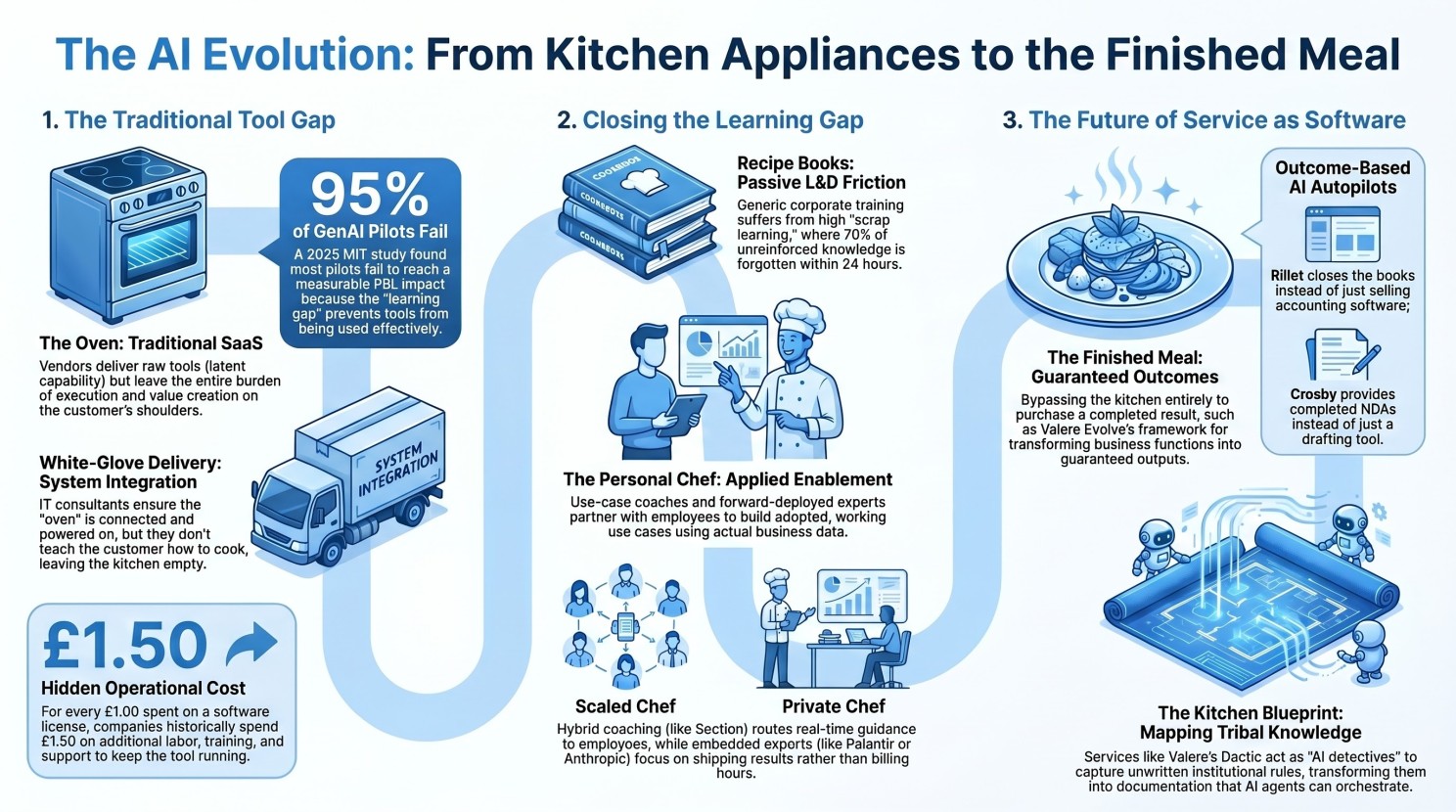
The Oven and Its Hidden Costs
The mechanism behind that shift was the oven. Traditional SaaS sold you a license, the oven itself. It often threw in an integrator to install the software, confirm it connected, and walk away. Owning a high-end oven does not make you a baker, though. The do-it-yourself burden was heavy and mostly hidden. You supplied the data and paid staff to run the interfaces. You hired consultants to train them and kept IT on hand for repairs. Every $1.00 of license fee came with about $1.50 of supporting labor and overhead. The capital bought potential, and tool fatigue set in.
Buying the Finished Meal
Service as Software ends that arrangement. You buy the finished meal. Agents handle the analysis and operations behind the scenes. You pay for finished output, like invoices processed or campaigns delivered. The overhead of implementation, onboarding, and training falls away. The prize is far bigger than software ever was. Professional services spend runs about six times the software budget. That is why the durable winners are Autopilots, which deliver the outcome straight to the buyer. Copilots sit beside a human inside an existing workflow, so they end up fighting over the smaller, more commoditized software dollar.
Two Kinds of Work
One boundary from that piece carries straight into this installment. I split the world into intelligence work and judgment work. Intelligence work is rule-based, structured, and learnable, which makes it a clean fit for autonomous agents. Judgment work runs on pattern recognition, instinct, and the unwritten rules people follow under genuine uncertainty. Current systems still cannot handle it on their own. The Autopilot story is about absorbing the first kind. This installment is about the second, the side that quietly decides your AI ROI.
Why Judgment Work Decides Your ROI
Judgment work is where most of your salary expense and your competitive edge both live. For that work, AI plays a supporting role. It hands your people a sharper instrument to learn, a Copilot in the truest sense. The person still owns the result. So what you buy is a workforce that does the same job faster, at higher quality, without supervision. Whether that lands in EBITDA or evaporates comes down to one thing: do your people adopt AI in their own roles? Most companies are still chasing it with the oven-selling playbook.
The P&L Problem Hiding in Plain Sight
The pattern is familiar. First the company buys the oven, rolling out seats and counting deployment as progress. Then it becomes clear an installed oven does not cook on its own, so the company buys cookbooks. These are the AI fluency courses, broad curricula, and use-case boot camps. They teach generally useful technique to a room of people who then go home and cook alone.
A cookbook can teach you why a sauce breaks. It cannot stand in your kitchen at 6 p.m. when the sauce breaks. That moment is the last mile, and it is where adoption quietly dies. The course wraps up and the employee goes back to a messy, time-starved schedule. Connecting the lessons to the work that pays them mostly does not happen.
The Hidden Cost You Still Carry
Look at what that does to the economics. You have now paid for the license, the oven, and the training, the cookbook. Yet you still carry the biggest hidden cost of all: the self-directed application that never materializes. You bought the capability twice and saw the result once, if that. The old $1.50 of hidden labor did not vanish when we moved to AI. It moved, from integration overhead to unspent human follow-through. You pay for the cooking school and order takeout anyway. On the P&L, that reads as margin leaking out with a training invoice attached.
What the Research Shows
This is more than anecdote. MIT research on AI in business looked at enterprise generative AI pilots. Around 95% produced no measurable bottom-line impact, even with wide tool access. The handful that worked shared a trait: someone wove the capability deeply into the workflow and owned it.
BCG frames the same finding as a simple ratio. Successful AI transformation runs roughly 10% algorithms, 20% technology, and 70% people and process. Technology is the smallest piece. Most of the value comes from the people and process layer, so that is where you win or lose your return. That layer is exactly where a cookbook falls short and a chef earns its keep.
The Personal Chef Model
The Chef in Your Kitchen
This is where the thesis extends. Service as Software made this shift for intelligence work, and enablement now has to make it for judgment work. The bridge is a different relationship with the kitchen. The old vendor handed you an oven and left you to figure out the cooking. The course provider handed you a cookbook and sent you off to practice alone. A personal chef works differently. The chef comes into your kitchen and cooks with your ingredients: your workflows, your data, your goals, your constraints. And the chef stays until your people can make the dish themselves.
Why It Stays Service as Software
The contrast with catering matters here. A caterer feeds you once and leaves, which suits the intelligence work you never want to touch again. A personal chef cooks alongside your team so the skill transfers. For judgment work, that transfer is the whole outcome. The payoff shows up a quarter later, when your people improvise with no one else in the room.
This keeps the model in Service as Software territory rather than open-ended consulting. Catering sells the finished output. The personal chef sells capability you can measure: adoption rates and behavior that sticks after the engagement ends. The philosophy carries over, the deliverable changes, and the work it suits changes with it. There is nothing generic about the engagement. An experienced practitioner learns your role, your tools, and your specific challenges. Then they get into the weeds with your people on their own use cases, while the work is happening. Once they see it work, it feels possible, and once it feels possible, they keep doing it. That repetition is what turns into operating leverage.
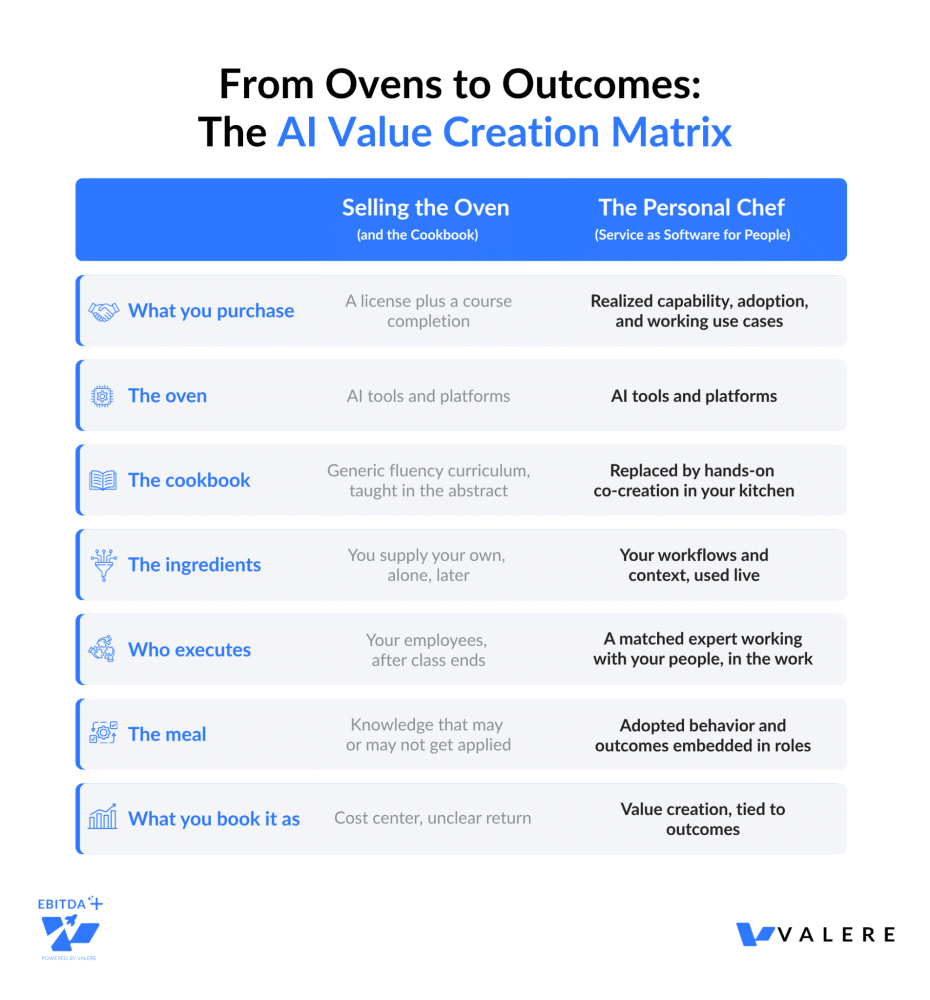
The shape matches Part One. We have just moved it to the judgment layer, where the outcome you want is a workforce that can cook for itself.
Why Enablement Belongs in the EBITDA Conversation
Activating a Sunk Asset
If you run the numbers, this is the section that matters. Companies have long mis-booked enablement. It sits in the L&D budget as opex with no clear line to return. It is the cookbook you pay for and never cook from. The Personal Chef Model puts it in a different category. Tie enablement to your use cases and measure it on adoption and outcomes. Now it becomes the mechanism that converts AI you already own into margin you can see.
Think about the asset you are unlocking. The money for the tools is already spent and sunk. Every month your people run those tools at half capacity, you pay full carrying cost for a fraction of the return. The chef closes the distance between what you bought and what you capture. The gain belongs to an idle AI investment finally earning its keep, with enablement as the trigger. That is the plus in EBITDA+: durable operating leverage that appears once people put the tools to work.
Aligning the Incentives
It also changes the incentives. A genuine partnership ties payment to adoption and measurable results. The alignment is the point. A cookbook vendor collects whether or not you ever cook. A chef on an outcome-based model earns only when your people deliver. Once you bolt the provider’s upside to your P&L, every dollar of enablement spend pulls toward an outcome you can point to. The winners on both sides of the table will learn to price the meal.
Keep Reading. Join Valere Evolve.
You have the diagnosis. The recipe is members-only.
Everything above explains why your AI spend is stalling. Everything below is how you fix it: the complete Personal Chef Model, the one-table paradigm shift, the math that moves enablement from L&D cost to reported EBITDA, and the scaling playbook with the three tensions that decide whether it works.
Create a free Valere Evolve account to unlock the full playbook:
- The full Personal Chef Model, and how it cooks with your real workflows
- The one-table paradigm shift you can screenshot and bring to your next leadership meeting
- The EBITDA math behind treating enablement as operating leverage, not opex
- The scaling architecture, plus the three tensions that make or break the model
- Every future installment of EBITDA+ in your inbox before it goes public
[Join Valere Evolve to unlock the full report ]
Already a member? Sign in to continue reading.
About Valere
Valere is an award-winning AI value creation & delivery partner, providing end-to-end AI transformation & custom software solutions that transform companies into AI-first organizations through building, learning, and scaling. As an expert-vetted, top 1% agency on Upwork, Clutch, G2, and AWS, Valere serves as the trusted AI value creation partner for PE firms, mid-market companies, and Fortune 500 enterprises alike seeking comprehensive AI transformation that drives measurable ROI. With over 220 dedicated professionals and domain experts, we specialize in end-to-end AI-native solutions using our proven crawl-walk-run methodology, guiding organizations through every stage of their AI journey—from initial assessment and strategy to full-scale implementation and optimization.
About Alex
Alex Turgeon is President of Valere, serving as an embedded AI/ML strategic partner for private equity firms and their portfolio companies. He and his team operate as a vertically integrated AI solution provider throughout the PE value chain, delivering enterprise-grade solutions that enable greater operational control, cost reduction, and efficiency gains across the investment lifecycle. Connect with Alex to discuss how your organization can begin its transformation to the agent era.
Build Something Meaningful with Valere.
Frequently Asked Questions
What is the Personal Chef Model for AI enablement? The Personal Chef Model is an outcome-based approach to AI workforce enablement. An expert works inside your team’s everyday workflows, using your data, goals, and constraints. Together you embed working AI use cases while the work is happening. Adoption is the deliverable, which turns enablement into value creation tied to measurable outcomes.
Why do most enterprise AI initiatives fail to deliver ROI? Adoption is usually where these efforts break down, more than the technology. MIT research found that roughly 95% of enterprise generative AI pilots produced no measurable bottom-line impact. BCG attributes successful AI transformation to about 10% algorithms, 20% technology, and 70% people and process. Companies deploy the tools and deliver the courses. Yet the last mile, applying AI to specific workflows, rarely happens, so the spend stays stranded as unrealized potential.
What is the difference between Service as Software and traditional SaaS? Traditional SaaS sells the tool, a license you operate yourself. Historically it carried about $1.50 of hidden labor for every $1.00 of license fee. Service as Software sells the outcome instead. AI agents handle the work behind the scenes, and you pay for finished output, like invoices processed or campaigns delivered. The implementation, onboarding, and training overhead drops away.
Is AI workforce training a cost or an investment? It depends on the model. Generic training in the L&D budget is opex with no clear line to return. It is the cookbook you pay for and never cook from. Tie enablement to your use cases and measure it on usage, adoption, and outcomes. Now it activates AI you have already paid for and turns sunk spend into EBITDA you can report.
What is the difference between intelligence work and judgment work in AI? Intelligence work is rule-based, structured, and learnable. It covers tasks like contract drafting, compliance reviews, financial modeling, and accounts payable, a clean fit for autonomous AI agents. Judgment work relies on pattern recognition, instinct, and unwritten rules under genuine uncertainty. So the person stays responsible for the outcome and AI acts as a Copilot. That second category is the work the Personal Chef Model enables.
How do you measure the ROI of AI enablement? Through outcome-based metrics: usage, adoption, and business results tracked across teams. The provider’s compensation tracks the results they deliver. The harder discipline is attribution, tying a measurable business result back to the engagement. That is the work that earns a renewal.