TL;DR: 3 Key Takeaways
- Enterprise technology is shifting from selling software tools to delivering guaranteed business outcomes, a model called Service as Software.
- The bigger prize is the professional services budget, roughly six times the software budget, and Autopilot providers win it by delivering outcomes directly.
- Success in the agentic era comes down to architecture: formalized institutional knowledge and strong orchestration that keep execution auditable and secure.
The End of Tool Delivery
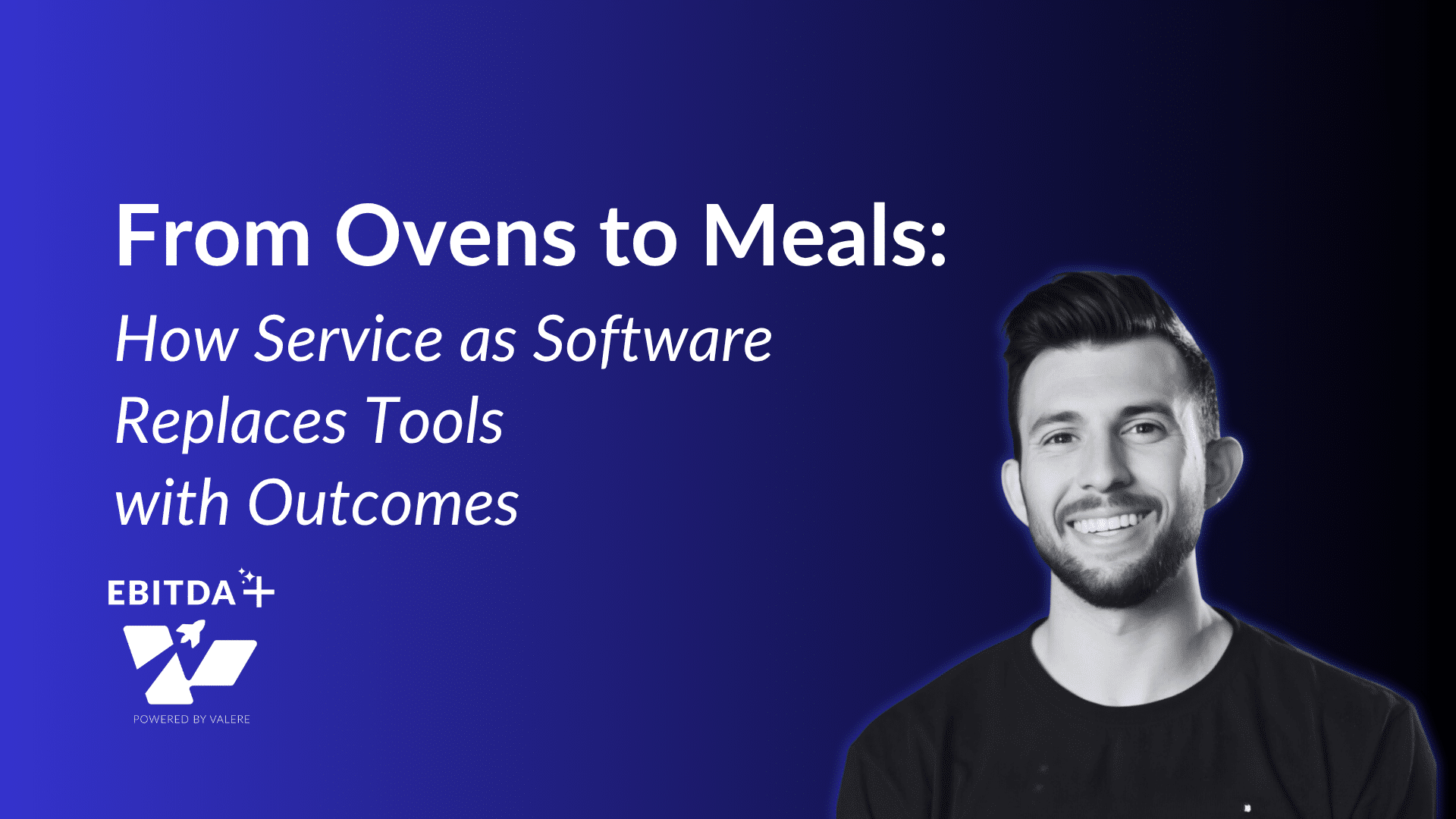
For more than two decades, the Software as a Service model shaped how enterprises ran. It centered on seat licensing, digital tools, and platforms meant to support human work. That model is coming apart. Capable large language models and autonomous agent frameworks have exposed the limits of handing companies software to operate. Now the market is shifting toward delivering business outcomes directly.
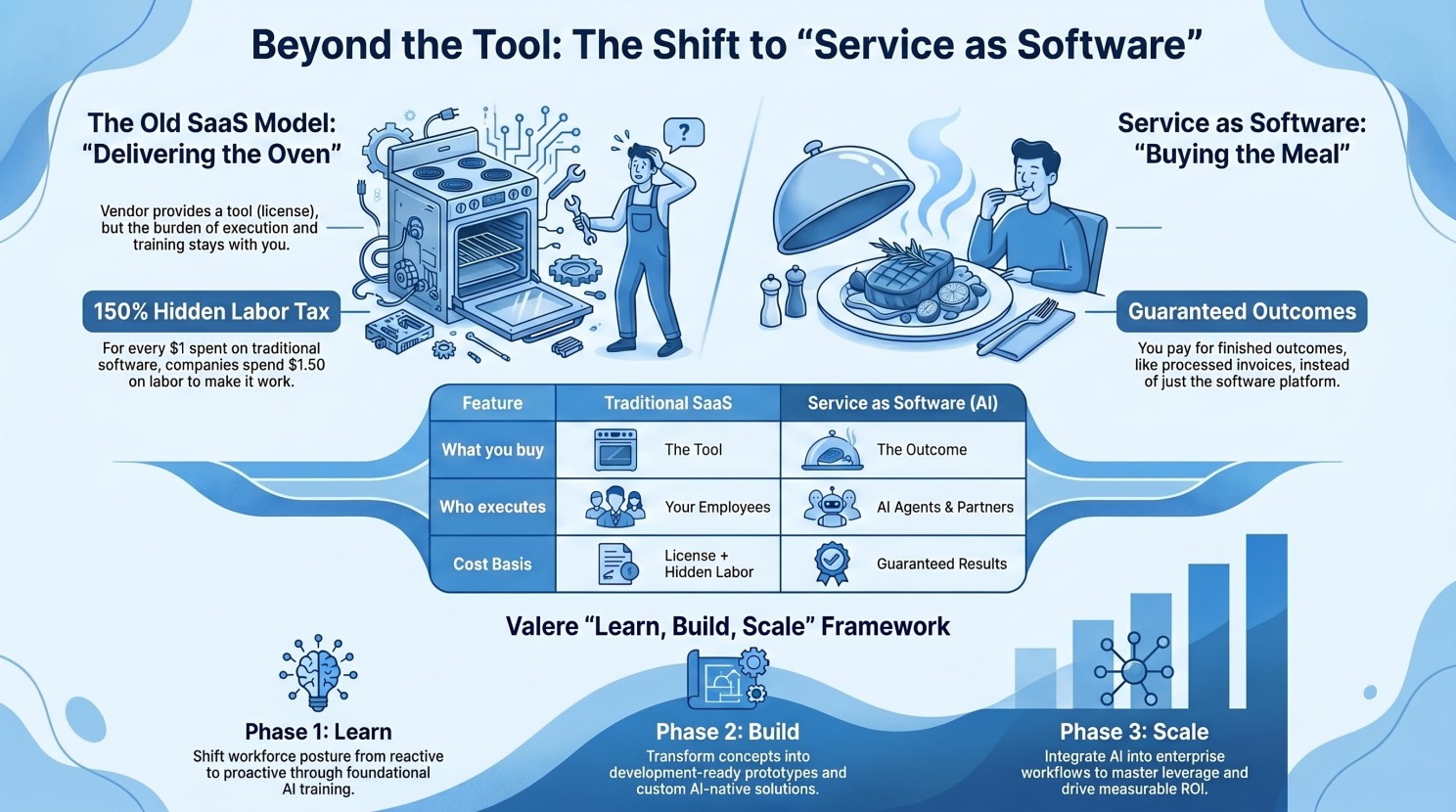
This approach goes by the name Service as Software. It removes much of the friction of implementation. It cuts the training burden. And it resets how enterprises think about cost. AI Value Creation and Delivery partners drive the change. They combine cloud infrastructure, agent orchestration, and systems integration. That lets them move past traditional software and reach the much larger professional services market. This report looks at the economics, architecture, and operations behind the change. It uses Valere as a reference point, an AWS Advanced Tier Partner and active member of the monday.com ecosystem.

Part One: The Economic Case
The macroeconomic reckoning of traditional SaaS
Start with the financial pressure on the software industry. Public software valuation multiples have fallen sharply. They dropped from a high of 18.6x to around 6.1x. The middle of the market has thinned out. Companies trying to balance moderate growth with moderate margins are stalling. They have no clear way back.
The choice has narrowed to two paths. A company can build an aggressive AI native growth engine. Or it can build a defensive margin fortress. Either way, AI has become the main route to financial targets. It lifts output per employee. It also supports outcome based pricing that can reshape valuation.
The advantage of going AI native shows up in the numbers. AI native startups reach $1 million in ARR about 30% faster than top quartile SaaS benchmarks. They reach $30 million in ARR about five times faster. That means near 20 months against the traditional 100. These gains come from data flywheels, organizational agility, and architectures built for the agentic era from the start.
From buying the oven to buying the finished meal
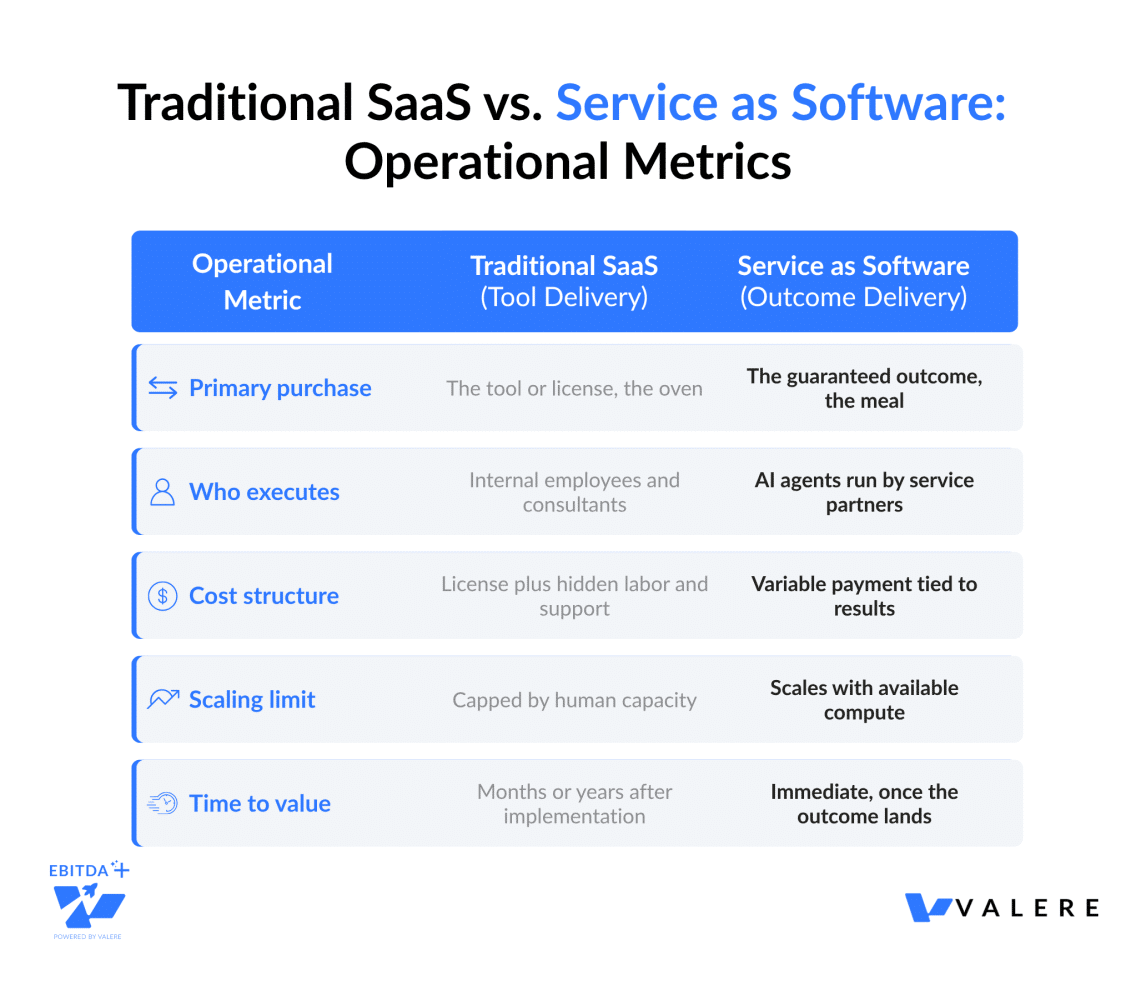
A simple analogy captures the inefficiency of traditional SaaS. Vendors sold a license, the oven. They often added an integrator for white glove delivery. The integrator would install the software, confirm it connected, and leave. The assumption was simple. The tool itself would produce transformation. But owning a high end oven does not make someone a baker.
The DIY burden carried heavy and often hidden costs. To get value, enterprises supplied the data. They paid staff to run the interfaces. They hired consultants to train those staff. And they kept IT teams on hand for maintenance. Every $1.00 of license fee came with about $1.50 of supporting labor and overhead. Capital went toward potential capability, and tool fatigue set in.
Service as Software works differently, and agent based architectures power it. Enterprises buy the finished meal. AI agents handle the analysis and operations behind the scenes. They keep the complexity away from the user. The purchasing trigger changes too. Buyers pay for finished output, such as processed invoices or delivered campaigns. Spending maps to outcomes, and the overhead of implementation, onboarding, and training falls away.
Copilots versus autopilots
The pivot makes more sense once you look at where corporate money sits. Professional services spend runs about six times larger than the software budget. By delivering outcomes directly, AI native partners move past software licensing. They aim at that larger services and outsourcing pool.
This splits the market into two models. A Copilot supports a human inside an existing workflow. The person stays responsible for the outcome. Copilots compete for the smaller software budget, so they face steep commoditization risk. A single upgrade to the underlying models can erase their edge. The usage data they create stays with the customer, which blocks any lasting advantage.
An Autopilot delivers the outcome straight to the buyer with no human in the middle. It reaches the larger services budget. It turns a fixed staffing cost into variable, outcome priced spend. That spend grows without new headcount. Autopilots also keep the outcome data. This data shows what good execution looks like across thousands of engagements. It feeds continuous model training and compounds into a durable advantage.
Part Two: The Architecture of Outcome Delivery
The boundary between intelligence and judgment
To sequence the move toward Autopilot models, separate intelligence work from judgment work. Intelligence work follows rules, however complex they get. Think contract drafting, compliance reviews, financial modeling, and accounts payable. The knowledge is dense but learnable and well structured. That makes it a good fit for AI. Judgment work leans on pattern recognition, instinct, and unwritten rules under genuine uncertainty. Current systems still struggle to run it alone.
That boundary keeps moving. Systems gather outcome data from intelligence work over time. Tasks that once needed human judgment slowly turn into learnable patterns. Software can then handle them. The smoothest place to start is intelligence work that someone already outsources. Swapping a BPO contract for an AI native Autopilot is a simple vendor change. It avoids any restructuring of internal teams.
Enterprise as Code
Almost every business uses AI in some basic form, so the differentiator is structural. Many companies run on scattered spreadsheets, undocumented know how, and manual communication. These stay opaque to machine intelligence. Bolting AI onto them just speeds up manual work.
Enterprise as Code takes a different route. It defines internal operations with the precision of a software application. Formalizing operating logic turns informal know how into machine readable structure. That makes AI a foundational layer. It lets agents interpret, run, and improve workflows without constant oversight.
One project shows the effect. A web of departmental spreadsheets hid a mid market architecture firm’s budgeting process. Valere connected a custom AI platform to its ERP. The team trained models on historical financials. Budget cycles dropped by more than 60%. Manual entry errors largely disappeared. The win came from turning informal logic into a structure a machine could refine.
Orchestration versus standalone agents
Outcome delivery depends on orchestration. The market keeps chasing perfect autonomous agents. Meanwhile it overlooks the gains from simpler, well integrated ones. People call this pattern agent washing. Frameworks like CrewAI, LangChain, AutoGen, LangGraph, and Semantic Kernel have produced huge numbers of experimental agents. The gap to reliable production is still wide.
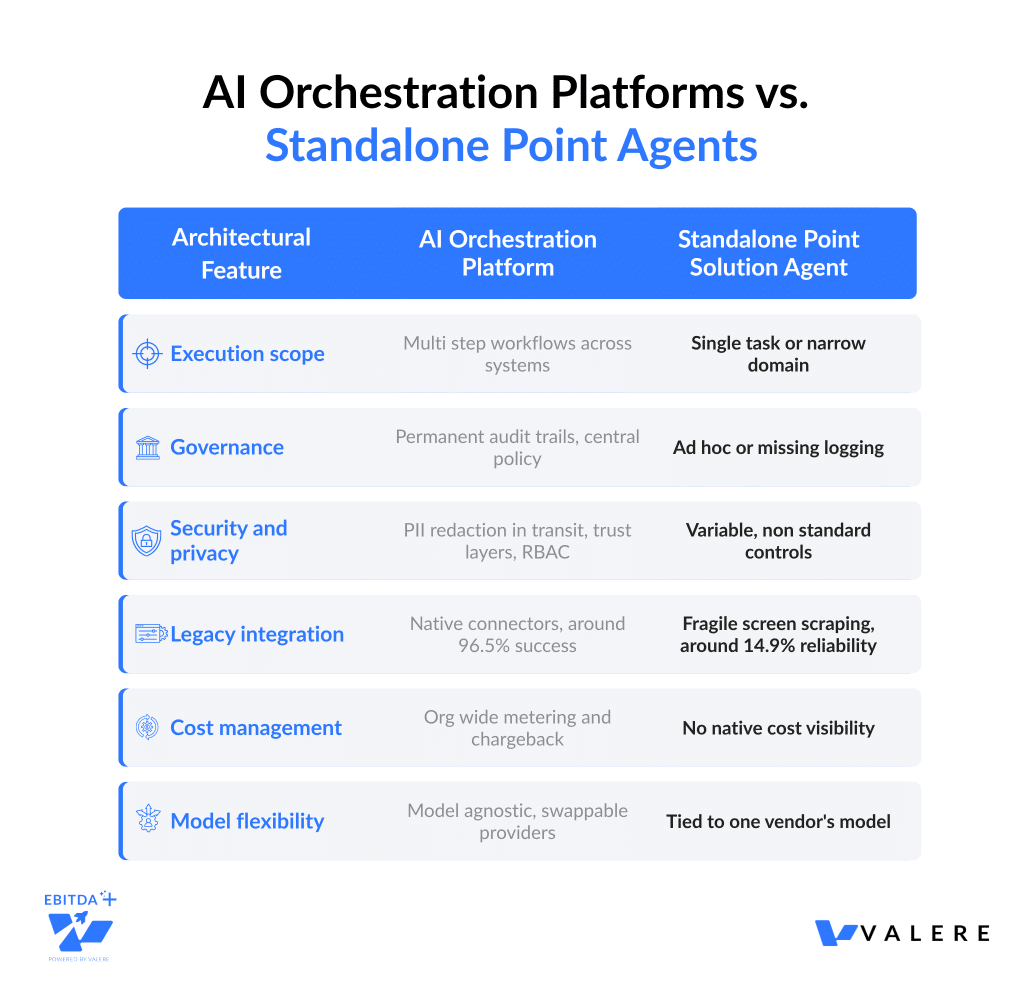
On their own, standalone agents become a liability. They lack integrated logging, they cannot trace multi step interactions. They offer no cost tracking by department. And they cannot enforce central security policy. This creates the GenAI paradox. A generative tool can produce a sharp go to market strategy in seconds. Then it has no way to build the matching campaigns in a CRM or update a project system. Insight that cannot execute itself loses momentum.
Orchestration platforms solve this. They coordinate models, agents, and human oversight across distributed processes. They act as the connective tissue between LLMs, legacy systems, and approval steps. In that setup, the model becomes one swappable part of a governed, secure, and economical system.
Prompt based development and co intelligence
Teams are also changing how they build. They are moving from heavy, scratch built model training toward precise prompt based development. Engineering the inputs to advanced LLMs lowers deployment cost. It opens the work to non technical experts. And it speeds up innovation. This works best with a co intelligence mindset. AI acts as a collaborative partner. The organization uses its speed, and people keep responsibility for strategic outcomes.
Part Three: The AI Value Creation Partner Model
Accountability for the whole outcome
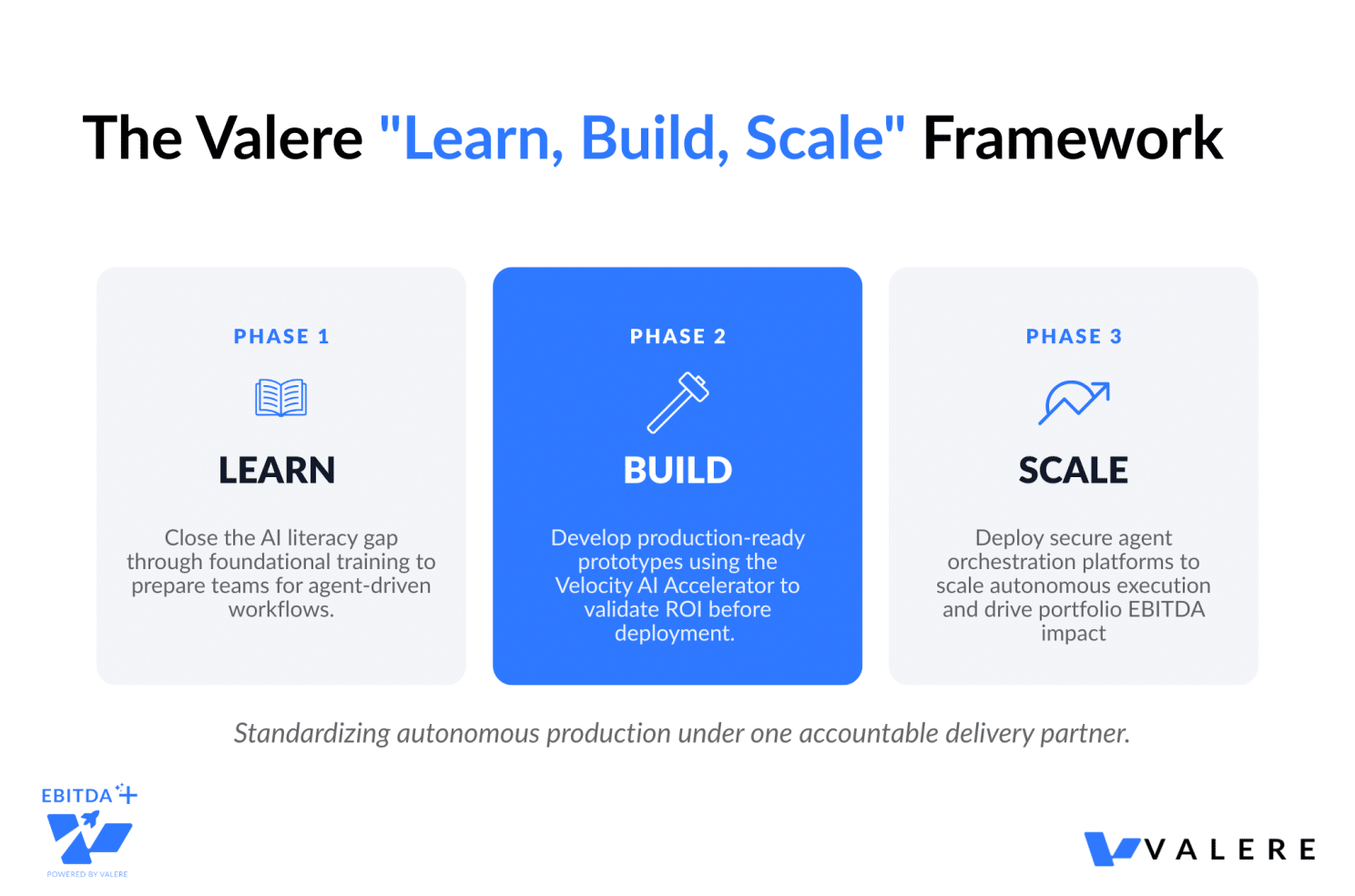
Putting these ideas into practice takes a specific kind of partner. AI Value Creation and Delivery partners own business results across the entire engagement. They build custom technology from strategy through autonomous production.
Valere is a good example. The company started in 2019 across Boston and Indore. Its founders wanted to challenge the stigma around offshore development through quality first partnerships. Valere now runs more than 225 professionals across six global hubs. These include Boston, Zagreb, Montevideo, Lima, and Indore. The spread supports around the clock development and regional focus. Uruguay handles Healthcare and EdTech, while Croatia covers FinTech and Web 3.0. G2, Upwork, and Clutch rank Valere as a top 1% agency. The firm has also won awards for its machine learning and AI work. It moved fully from SaaS to Service as Software. Today it operates as a single partner accountable for verifiable outcomes.
Keep Reading. Join Valere Evolve.
You have seen why the shift is happening. The rest of this report shows you how to act on it, and it is reserved for Valere Evolve members.
Create a free Valere Evolve account to unlock the full playbook:
- The sequencing framework. How to separate intelligence work from judgment work, and where to deploy AI first for the fastest, lowest friction win.
- The Enterprise as Code method. The structural approach that took one firm’s budget cycles down by more than 60% and cleared out manual entry errors.
- The orchestration scorecard. A side by side of governed platforms against standalone agents, including the integration reliability gap of 96.5% against 14.9%.
- The full proof file. Caylent, Onyx AI, Omnia Health, and more, with the exact accuracy, cost, and time to market numbers behind each result.
- The Work OS shift. How autonomous agents turn a monday.com board into an execution engine.
- The complete FAQ and the Service as Software Readiness Assessment, so you can benchmark your own operations.
[Join Valere Evolve to unlock the full report ]
Already a member? Sign in to continue reading.
About Valere
Valere is an award-winning AI value creation & delivery partner, providing end-to-end AI transformation & custom software solutions that transform companies into AI-first organizations through building, learning, and scaling. As an expert-vetted, top 1% agency on Upwork, Clutch, G2, and AWS, Valere serves as the trusted AI value creation partner for PE firms, mid-market companies, and Fortune 500 enterprises alike seeking comprehensive AI transformation that drives measurable ROI. With over 220 dedicated professionals and domain experts, we specialize in end-to-end AI-native solutions using our proven crawl-walk-run methodology, guiding organizations through every stage of their AI journey—from initial assessment and strategy to full-scale implementation and optimization.
About Alex
Alex Turgeon is President of Valere, serving as an embedded AI/ML strategic partner for private equity firms and their portfolio companies. He and his team operate as a vertically integrated AI solution provider throughout the PE value chain, delivering enterprise-grade solutions that enable greater operational control, cost reduction, and efficiency gains across the investment lifecycle. Connect with Alex to discuss how your organization can begin its transformation to the agent era.
Build Something Meaningful with Valere.
Frequently Asked Questions
What is Service as Software? Service as Software is a model with one core idea. Enterprises pay for a guaranteed business outcome. That might be a set number of processed invoices or delivered campaigns. Autonomous AI agents handle the underlying work. Spending maps to measurable results. This removes most of the implementation and training overhead that traditional software carries.
How is Service as Software different from traditional SaaS? Traditional SaaS sells the tool. The customer’s staff and consultants then do the work. Historically that added about $1.50 in hidden labor and support for every $1.00 of license fee. Service as Software sells the finished outcome. The provider’s AI agents and orchestration run execution. So cost becomes variable and ties to results.
What is the difference between an AI Copilot and an AI Autopilot? A Copilot supports a human worker. That person stays in the loop and owns the final outcome. So a Copilot competes for the smaller software budget. It also stays exposed when foundational models improve. An Autopilot delivers the outcome straight to the buyer with no human in the middle. It reaches the larger professional services budget. It also keeps proprietary outcome data that builds a lasting advantage.
What does Enterprise as Code mean? Enterprise as Code defines a company’s operations with the precision of a software application. It turns informal institutional knowledge into machine readable logic. Autonomous agents can then interpret, run, and improve workflows without constant human oversight. That is what enables genuine transformation.
Why are standalone AI agents risky for enterprises? Standalone agents lack key controls. They have no integrated logging, multi step traceability, departmental cost tracking, or central security enforcement. On their own, that makes them a governance and security risk. Orchestration platforms address this. They coordinate models, agents, and human oversight into one governed system. There the AI model stays a swappable, fully auditable component.
What is an AI Value Creation and Delivery partner? An AI Value Creation and Delivery partner owns business results across the full engagement. It builds custom AI systems from strategy through autonomous production. Partners like Valere combine four things: cloud infrastructure, agent orchestration, workforce upskilling, and systems integration. Together these deliver guaranteed, scalable outcomes under one accountable relationship.