From the desk of Guy Pistone, Founder of Valere
TL;DR
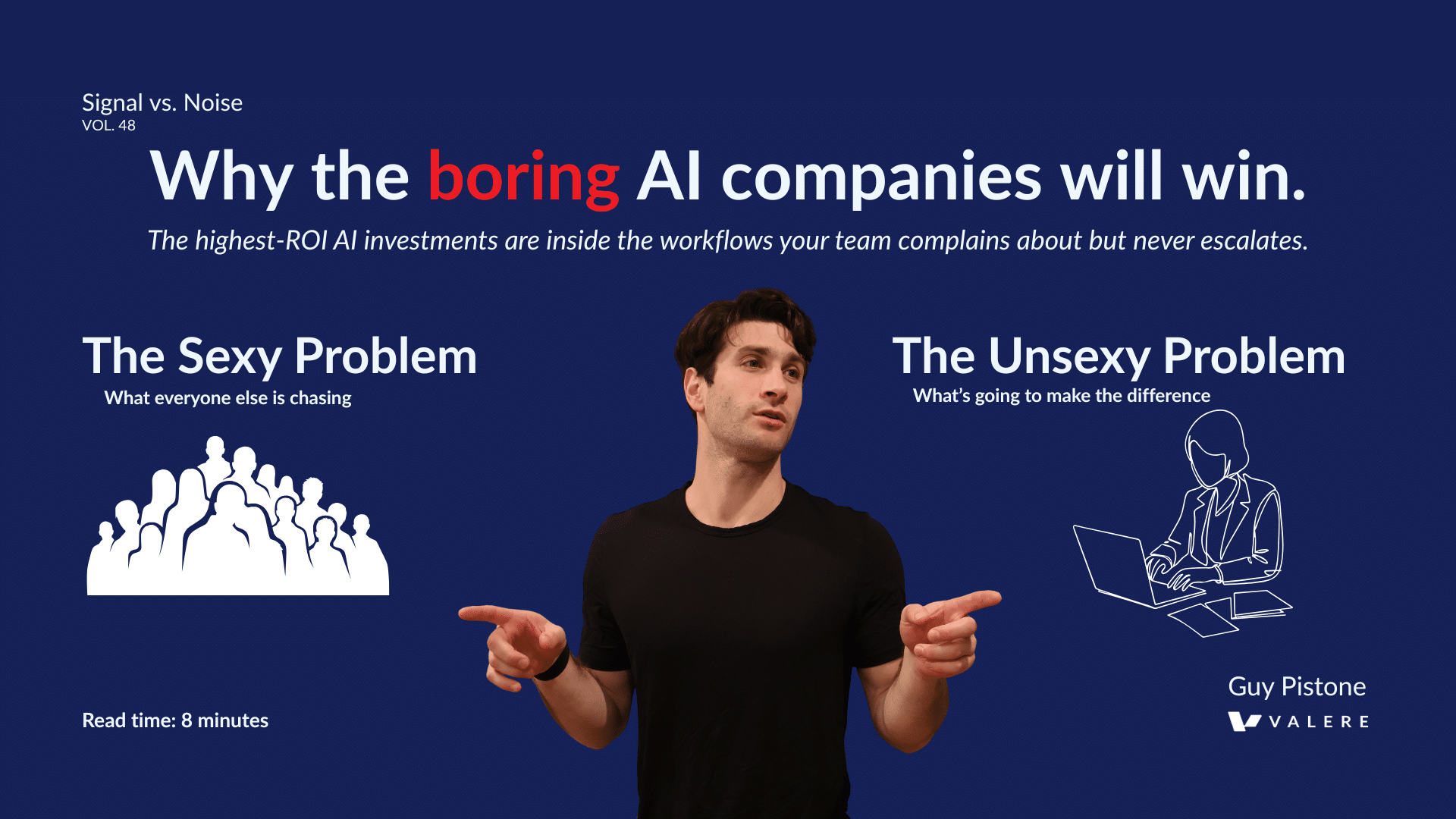
The biggest AI winners are going to be the companies solving boring workflow problems nobody wants to think about. Two things changed at once. Building got cheap, so problem selection is the alpha. Funding got patient with narrow vertical plays, so smaller bets are getting capitalized at lower traction than they used to be. For operators, the same logic flips inward. The highest-ROI AI investments are inside the workflows your team complains about and never escalates. Below is the test for finding them.
What changed
For most of the last decade, building software was the constraint. You needed engineers, time, and capital to ship something that worked. Founders chased the sexy, broad problems because building anything took years, and the upside needed to be commensurate with the effort.
AI changed both ends of that equation at once. Underneath those changes is a deeper pattern. AI is unbundling entire professional services industries into the atomic workflows they are made of. Legal, healthcare, accounting, insurance, claims, compliance. All of these are bundles of workflows held together by labor cost. AI breaks the bundle. Each unbundled workflow becomes a market that did not exist a year ago.
Two changes made the unbundling possible.
Building got cheap. A founding team can now produce something that works in a vertical workflow in weeks instead of years. The technical execution that used to cost $2M and 18 months can cost $50K and a quarter. The economics moved by an order of magnitude, which changes what you can afford to bet on.
Funding got patient with narrow plays. The bar for a seed round used to be 200K to 500K of monthly recurring revenue. The number was high because investors had to underwrite execution risk. Now, with that risk lower, founders can raise on proof of concept and early traction in a niche. Smaller markets became fundable because the cost of staking a claim dropped.
These two changes compound. If building is cheap and capital is available, the binding constraint moves to problem selection. Picking the right unbundling to attack is the new alpha.
The boring premium
Once problem selection is the constraint, the math on boring problems changes.
A boring problem has three properties that compound. It is narrow, so the addressable market looks small to a generalist investor and an ambitious founder. It is annoying enough that a specific team feels the pain every week. And it is beneath the attention of the broader market, because nobody at a dinner party wants to hear about the receivables reconciliation workflow at a regional healthcare network.
Those three properties are what make boring problems uncontested.
Peter Thiel’s framing of monopoly applies. Competition is for losers. The way to build a durable business is to find something nobody else is doing, because doing what everyone else is doing means margins compete down to zero. The boring problems are uncontested precisely because they are boring. The talent and the capital flow to the sexy ones. Whoever stakes a claim on a boring narrow workflow has the moat by default, and the toehold that becomes a market.
Boring problems also have the advantage of measurable ROI. If the workflow takes four hours per execution, costs the company a senior employee’s time, and runs 50 times a week, the math on saving even half of that is concrete. The company writes the check because the savings can be counted. Sexy problems come with hand-wavy ROI tied to positioning or future optionality. Boring problems pay for themselves in line items.
Sticky customers, too. Once you have solved the receivables reconciliation problem for a regional healthcare network, you are inside their operations. You know their data, their edge cases, their reporting needs. Ripping you out and replacing you costs more than keeping you. The boring problem creates a relationship that compounds every quarter.
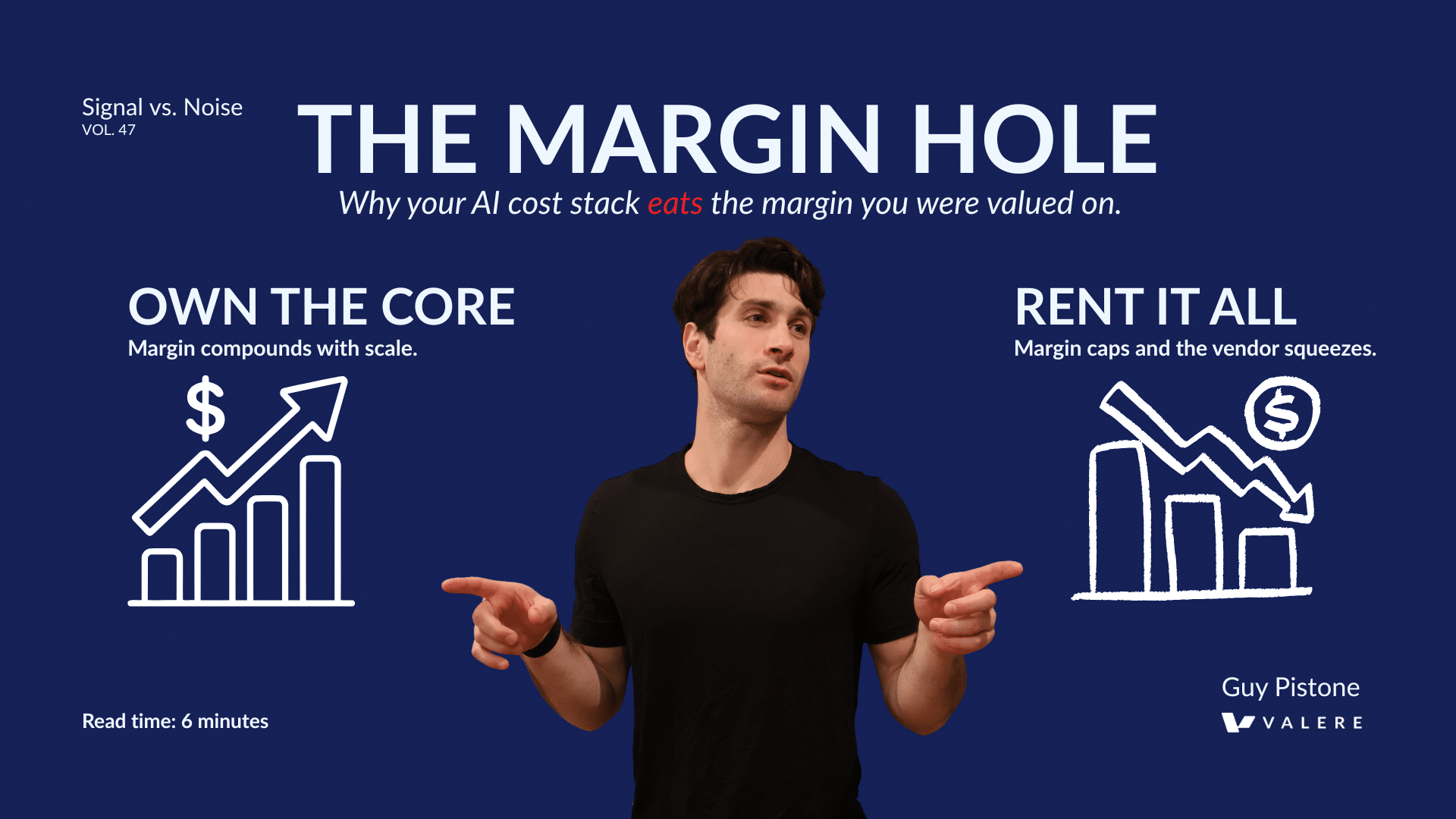
This is the inverse of last week’s service-as-software hole. Those companies look like software and run on a services cost structure that caps margins. Boring AI companies look like services in their first few years and migrate to software economics as data and integrations compound across customers. Same business shape on the surface, opposite trajectories underneath. Boring AI is the legitimate version of the migration that service-as-software founders pretend is happening.
The translation for operators
That argument is aimed at founders deciding what to build. The same logic applies inside your own organization, and the operator version is more actionable. Founders have to find a market. You already have one.
Your company has dozens of boring workflows that everyone hates and nobody owns. The receivables reconciliation. The contract red-lining. The invoice classification. The expense audit. The compliance attestation. The clinical note structuring. The ticket routing. Each one is a specific friction your team has learned to live with because the cost of fixing it always seemed higher than the cost of tolerating it.
AI changed that math. The friction is the same as it was 18 months ago. The cost of resolving it dropped by an order of magnitude. The workflows your team has been quietly absorbing for years are now economic to fix, and the first ones to fix them inside your industry pull ahead fast.
The right question is which boring workflow inside your operation has been costing you the most while you were not looking.
The follow-up question is harder. The vertical AI companies are running the same audit on your industry right now. The moment one of them productizes a boring workflow for a competitor of yours, your option to build it internally degrades. They have the data, the integrations, and the playbook. You are now buying from them at their price. The make-or-buy window on these workflows is open today. The window closes in 18 months.
The boring AI gold test
Take a candidate workflow in your organization and run it through five questions. The yeses tell you whether this is an opportunity or a distraction.
1 – Is the workflow already someone’s clear responsibility?
- If yes, it has been optimized as far as the political ownership allows, and adding AI on top is mostly going to disrupt the owner before it helps the company. If no, the workflow is orphaned and ripe to claim. The orphan workflows are where the biggest wins hide. Find the work that everyone does and nobody owns.
2 – Does it run in spreadsheets or email?
- If yes, the data is already structured enough to feed an AI system, and there is no proprietary infrastructure standing in the way. If it lives in a closed system with no API and no export, the integration cost will eat the savings, and you should look elsewhere first.
3 – What is the annual cost of the current process?
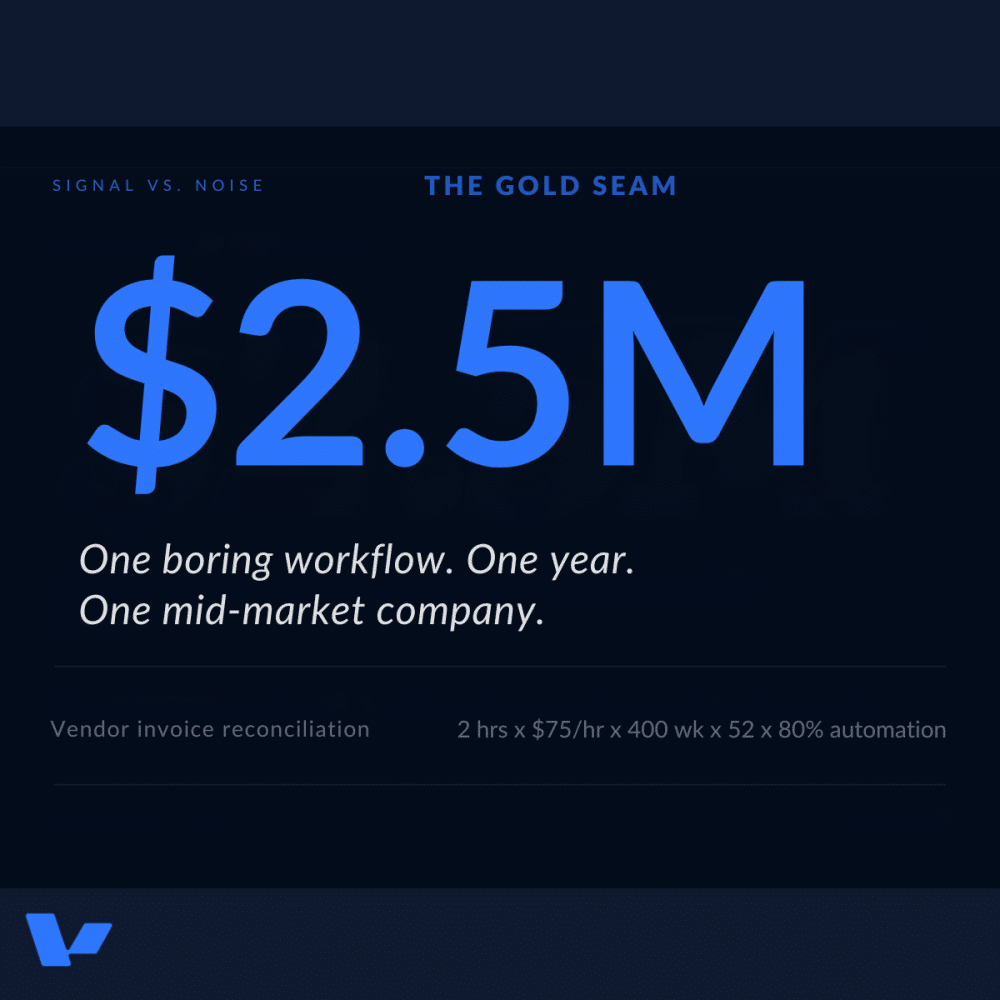
- Multiply executions per week by hours per execution by burdened cost per hour by 52. If the result is under $50K, the math will not work after implementation overhead. If it is over $250K, you are looking at a gold seam. The boring workflows worth fixing in a mid-sized company tend to sit in the $100K to $500K range, which is exactly where AI has the best return profile.
4 – Can you describe a correct output in a sentence?
- If yes, AI can probably learn it. The classifications, extractions, summarizations, and routings that humans do with their pattern-matching brain are the same operations a model handles well. If “good” requires judgment, relationships, or contextual reasoning that nobody on your team can articulate, AI will produce confident garbage that looks right at first glance and falls apart in the audit.
5 – What happens when the output is wrong?
- If the error gets caught downstream by a human or a system check, you can deploy AI aggressively and let it work imperfectly while you tune it. If a wrong answer creates silent harm (legal exposure, customer churn, an irreversible decision), you need a different posture, with human review on every output, which compresses the savings substantially. Pick the workflows where errors fail loudly.
A workflow that earns a yes on all five is the boring AI gold I’m trying to bring front stage. The majority of companies have at least one and probably three. The reason they have not been fixed is that they were uneconomic to fix until last year. They are economic now.
A warning for the boring middle
There is a category of reader for whom this article is more warning than opportunity. The losers in this transition are the mid-market services firms whose value proposition is “we have humans who do this annoying work for you.” Legal process outsourcers, claims processors, mid-tier accounting firms, ticket triage operations, contract review shops, compliance attestation desks. Vertical AI is creating winners and hollowing out the firms whose business was selling the boring middle of professional services at a markup.
If your business looks like that, the five-question test still applies. The stakes are different. The question becomes whether you productize the workflow for your industry before a venture-funded vertical AI company productizes it for your customer, and whether you end this decade as the disruptor or the disrupted.
The Stripe template
This pattern is not theoretical. The cleanest recent example is Stripe. In 2010, Patrick and John Collison started building a payment processor for online businesses. At the time, accepting payments on a website required a seven-step integration involving merchant accounts, payment gateways, and processors who treated developers as an afterthought. The work was unglamorous, the market looked small to most observers, and the Collisons’ YC batch assumed they were going to fail.
The boring workflow they picked was the smallest possible unit of online commerce. Stripe captured it, then expanded to adjacent workflows in billing, fraud, and lending, and then to adjacent industries. The grip became a market, and the market became a category. Stripe is now valued in the high tens of billions, and every fintech founder studies the way they unbundled payments from the bundled mess that came before.
The deeper pattern predates Stripe. Warren Buffett built Berkshire Hathaway on insurance, candy, bricks, paint, mobile homes, and a railroad. None of those businesses get covered at TechCrunch. All of them throw off cash because they solve specific, persistent, boring needs, and they face limited competition because they are not glamorous enough to attract it.
Bringing it all together
AI is doing to the services and operations economy what Stripe did to payments and what Buffett’s portfolio did to manufacturing. The plumbing of how white-collar work happens is becoming addressable workflow by workflow. The companies that build that plumbing for the work nobody covers will look like Stripe in ten years, even if none of them get the magazine cover.
The unsexy AI companies are going to crush in this era. The same instinct is the right one for the operators picking which AI bets to make inside their own organization. The workflows nobody is talking about are the ones generating the most pain and the most opportunity. Run the test, find the seam, and fund the unsexy thing first.
The harder problem comes after the test. Building the team that can ship the fix is where most mid-market companies get stuck, and traditional employee training does not close that gap. Valere Evolve is the platform we built to close it. It teaches the people you already have how to find these workflows, run the test on them, and put AI to work on the ones that earn five yeses.
Guy Pistone is the founder and CEO of Valere, where he has spent six years building digital products for mid-market companies and the last four years putting AI into every workflow he can find. Signal vs. Noise is his field log from inside that work, covering what AI compresses, what it stalls, and where the bottlenecks have moved.
Valere is a product and engineering firm that builds software and AI applications for mid-market companies. Six years in and an AWS Advanced Tier Partner, Valere works inside the digital transformation projects it writes about, with engineers and designers embedded in client teams from initial strategy through production deployment. Learn more at valere.io