TL;DR
The higher you climb up the business ladder, the less honest feedback reaches you. The new, coveted skill is demanding pushback and asking again when the first answer comes back polite. Prompt to get you there is included below.
The most useful feedback I got this month came from something engineered to agree with me, and that should bother you a little. It sure bothered me.
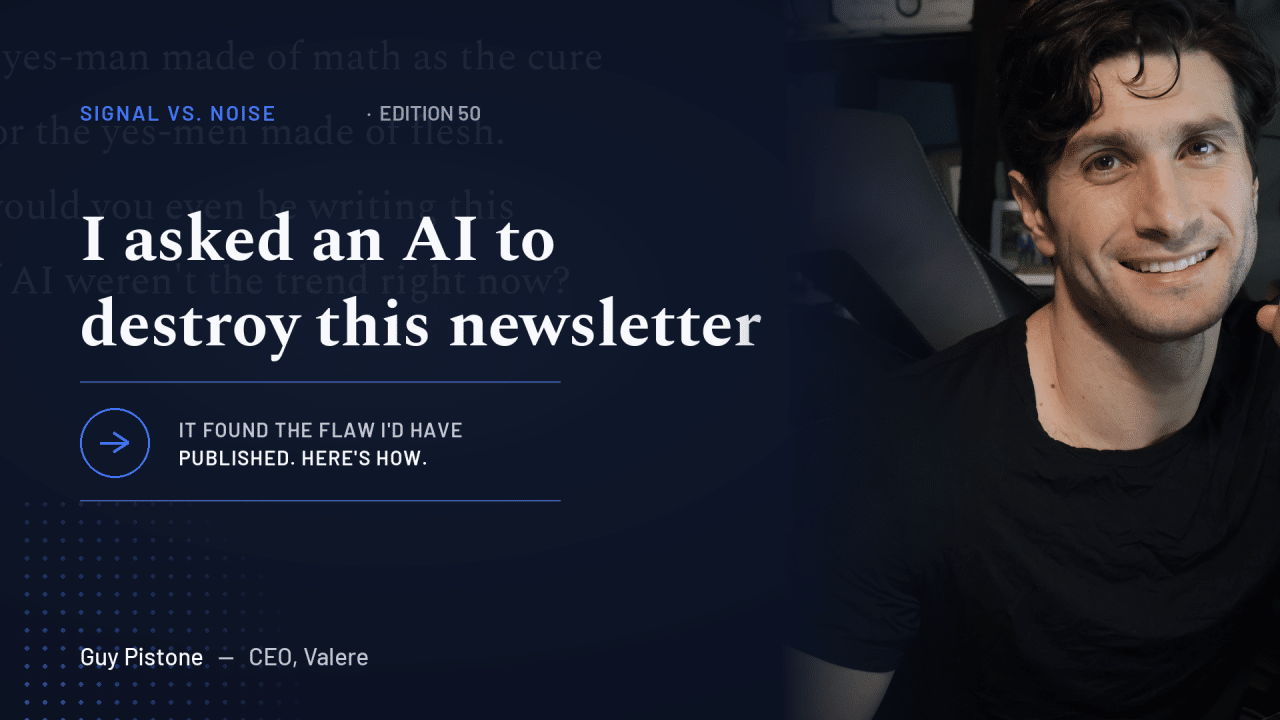
Before I wrote a word of this, I handed the idea to an AI and asked it to tear the article apart. It did. Here’s what I started with.
“The higher you climb, the less honest feedback reaches you. People respond to your title instead of your thinking. The disagreement that used to improve an idea in a meeting starts to thin out because you pay the bills. You notice months later, when a decision you were sure about turns out to have a hole someone in the room could have flagged, if they’d felt safe enough to say it in the moment, not after damage was done.”
I’ve lived that a few times. And I can admit that the strange part is how good it feels. Meetings get smoother. Your ideas seem to land better. You mistake the absence of friction for the quality of your thinking, right up until something breaks.
So I built a habit. Before an idea reaches my team, C-Suite or not, I run it past an AI to find the weak spots first. I expected this one to help me sharpen the argument. It went after the foundation instead. And I loved it.
It pointed out that my fix was the same problem wearing a different face. I was about to tell a room full of leaders that AI is the honest voice they’ve been missing. But an AI is trained, mechanically, to keep the person using it satisfied. I was going to propose a yes-man made of math as the cure for the yes-men made of flesh. Whoops.
Then it asked the question I’d been walking around. Would I be writing any of this if AI weren’t the thing everyone wants to talk about right now?
I didn’t have a straight answer, well, I did, but I just didn’t want to go that way. So the “correct” version of this piece, the one where I find the fix and hand it to you, wrapped up with a pretty bow, fell apart. Good though, because that version wasn’t useful. It was hype.
Here’s the version that survived…
The feedback you lose as you scale the ladder doesn’t come back because you found a better tool. It comes back when you decide to go get it and keep going after it. No one is going to volunteer it for free. Neither the people who work for you nor the software on your screen.
The AI didn’t gut my idea because it’s wise. It gutted it because I told it to, plainly, and twice. The first time I asked what it thought, it was generous and encouraging (as it’s built to be). I had to go back and say: You’re going easy on me, what are you softening? Only then did it tell me the thing I didn’t want to hear.
That’s the skill, and it has almost nothing to do with AI. It’s the same move you’d make with a board member or a customer who just walked. Agreement is the cheapest thing a person can hand you, and the higher you sit, the more of it you get. The only feedback worth much is the kind you asked for directly, then asked for again when the first reply came back polite.
Here’s the prompt I use to do this. A blunter early version is what produced the response that nearly killed this piece, and I’ve improved it since. Copy it, drop your own half-formed idea where it tells you to, and point it at something you care about this week.
Prompt
I'm considering the idea below, and I want a rigorous, honest assessment. Not encouragement, and not a balanced list of pros and cons. Don't soften anything to spare my feelings, but don't manufacture flaws to perform toughness either. Tell me what's genuinely weak, and briefly what actually holds, so I know what the idea is resting on.

Work through these, in order:

1. The strongest case against it that a sharp skeptic would make.

2. The single assumption the whole thing depends on, and what happens if that assumption is wrong.

3. Hidden liabilities I'm likely ignoring: legal, financial, reputational.

4. Competitor response. If a well-resourced rival saw this, how would they copy it or kill it?

5. Where it breaks going from 1 to 100.

6. The human factor: where apathy, friction, or my own team's misalignment derails it.

7. A pre-mortem. It's twelve months out, and this failed. The likeliest cause.

8. The question I'm avoiding because I don't want the answer.

Be specific. If part of it is genuinely sound, say so plainly rather than inventing a problem.

Here's the idea: [describe yours in two or three sentences]
One thing I learned the hard way is that the first answer will probably still be too kind. Lucky I make these mistakes and share them with you so you can skip them. So, when it is, reply with one line: “You’re going easy on me; what are you softening?” Then read what comes back. That second conversation is the one worth having.
It works the same way with people, minus the copy/paste. The question becomes “make the strongest case that I’m wrong.” The part that makes it work is the sentence after it: “I won’t hold it against you,” said by someone who means it. Your honesty is just as important as theirs, and that includes accepting their feedback. Don’t do this with your colleagues if you’re not ready to accept constructive criticism.
And I want to be honest about the limit of all this, because a clean ending would repeat the mistake I started with. FYI, I still don’t fully trust the answers because AI is wired to please me. Period. When it comes to the people who know my title, the pushback is probably not fully honest, and some of it may be sugar-coated. But asking for it, clumsily and more than once, beats the alternative. An office where everyone nods, and you slowly lose the ability to identify a strong idea from one that simply hasn’t been challenged yet.
That’s the idea that survived its own execution. It’s smaller and less flattering than the one I set out to write. I’m fairly sure it’s the good one.
So here’s the only homework I’ll give you.
Take one idea you’re a little too attached to, run it through that prompt this week, and tell me what it said.
I read every reply. And remember, the answers that sting most are the ones we often end up most grateful for.
Guy
P.S. I send one of these every week. Ideas I’ve put through the wringer before they reach you, including the ones that don’t make it out alive. If that’s what you want in your inbox, subscribe, and I’ll keep them coming.
Guy Pistone is the founder and CEO of Valere, where he has spent six years building digital products for mid-market companies and the last four years putting AI into every workflow he can find. Signal vs. Noise is his field log from inside that work, covering what AI compresses, what it stalls, and where the bottlenecks have moved.
Valere is a product and engineering firm that builds software and AI applications for mid-market companies. Six years in and an AWS Advanced Tier Partner, Valere works inside the digital transformation projects it writes about, with engineers and designers embedded in client teams from initial strategy through production deployment. Learn more at valere.io