TL;DR
History repeatedly shows that success doesn’t stop at rewarding leaders. It recruits them into ethical shortcuts. As stakes rise, polished offers to cut corners emerge, leading executives to talk themselves into dishonesty one “reasonable” step at a time. This edition provides tools to identify the rationalizations used before crossing a line and a method to define your boundaries before pressure strikes. As Mark Twain noted, integrity remains scarce enough to be surprising.
Here’s what no one will tell you about success
I have spent about fifteen years building companies, and there is one lesson nobody hands you on the way up. The more successful you get, the more often a chance appears to add to that success in a way that is not clean. Early on, those chances are small and easy to wave off. Later, they arrive dressed as ordinary business decisions, backed by a spreadsheet, recommended by someone you respect, and timed for a quarter when you could use the help. Are you sweating yet?
This trap deserves to be called out. As your success increases, so does the scale of the temptation. Okay, a small-scale deal probably doesn’t involve unethical shortcuts. But running a large organization brings constant, increasingly sophisticated opportunities to profit at someone else’s expense.
I keep one simple rule for myself. Whenever one of these chances shows up, I turn it down and stay clear on where I stand. Owning a business comes with an invisible duty of creating value without hurting people, in a way that still serves the company and that the wider community can live alongside. If a gain for the business comes at a hidden cost to other people, it breaks the company I set out to build and the person I want to be.
How you talk yourself across the line
People who do bad things don’t think of themselves as unethical, or bad even. They keep a clean self-image, probably through self-convincing comments like “if I don’t do it, someone else will.” Psychologist Albert Bandura identified “moral disengagement” as the mechanism that lets people make questionable choices feel justified. It echoes Upton Sinclair’s line from 1935. “It is difficult to get a man to understand something when his salary depends upon his not understanding it,” I told you this was a historic lesson we keep trying to learn. In modern terms, a steady salary does the disengaging for you.
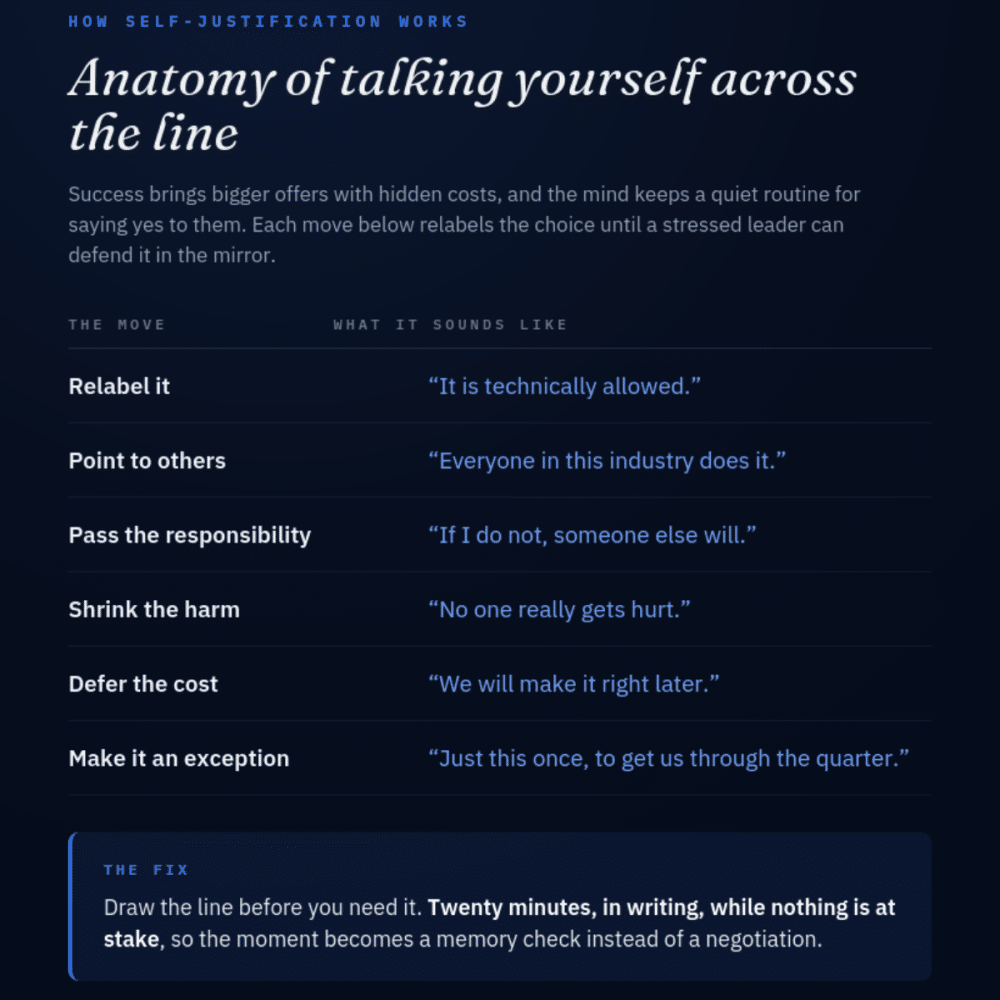
This is why character cannot be summoned in the moment. By the time the offer is in front of you, the narration has already started, and you are no longer a neutral judge of your own case. The defense has to be built earlier, and it comes in two parts. Learn the sound of your own rationalizing, the everyday sentences that signal the slide has begun, and draw your line while nothing is at stake, so a cornered version of you nine months from now is running a memory check rather than a fresh negotiation.
The map below lays out how the slide works, what each move sounds like out loud, and where to stand against it.
The version sitting on your desk this year
Look at what AI is putting in front of operators right now. These are just new shortcuts wearing technical clothes. You can use customer data in a model in a way the customer would never knowingly agree to. You can ship a system that pushes a cost or a risk onto the people it touches, because the savings land on your side of the ledger and the harm lands on theirs. Each of those will arrive with a clean business case and one of the tells attached.
- “Everyone is building this way.”
- “It is technically compliant.”
- “We could beat the rest to the punch.”
The framework does not change because the tool is new. The line you drew still applies, and the sentence in your head is still an alarm.
Trust is the thing they cannot copy
Mark Twain said it in a note to a Brooklyn youth society in 1901. “Always do right. This will gratify some people and astonish the rest.” The joke has teeth for some of us. Doing the right thing out loud, when it costs you something, has gotten scarce enough that it surprises people. That’s uncomfortable.
That trust is worth more than the corner you were tempted to cut. Customers, employees, and partners are all running checks on whether you will hurt them when it pays to. I’d say it’s a part of survival. Every time you visibly decline the easy, ugly option, you bank trust that no marketing budget can buy and no competitor can copy on demand. The clean version of value, the kind that serves the business without billing society for the difference, compounds. The other kind borrows against a reputation you will eventually have to repay or answer for, depending on how far you take it.
The question to take into your next meeting
Here is the one to carry in.
What is the line we have already decided we will not cross, before a hard quarter makes us want to?
If your leadership team cannot answer it quickly and in the same words, you have not drawn the line yet. You have only hoped you would find it in the dark, on the night you need it most.
FAQ
- Is this about ethics or about business? Both, and they are the same account. The behaviors that hurt other people also drain the trust your business runs on. Treating integrity as separate from strategy is how the spending stays invisible until the bill arrives.
- How is a written line different from a code of conduct? A code of conduct is written for everyone and read by literally no one. The line here is written by you, for you and your leadership team, short enough to remember and specific enough to use under pressure. It names the few temptations you can picture facing.
- What if a competitor takes the shortcut and wins? Some will, but those are pseudo-wins for people in the short run. The framework does not promise you will never lose a deal. It protects the thing that outlasts any single deal, which is whether the people around you can trust your word when trusting it is inconvenient for you.
- Where does AI change the calculation? It does not change the calculation. It raises the volume and the speed of the offers, and it dresses them in language that makes the tells harder to hear. The defense is the same, drawn earlier and held more deliberately.
Key takeaways
- The temptation to act unethically grows alongside success, so winning is the condition that tests you most, not the reward that exempts you.
- People don’t normally choose to harm. They disengage from it in small narrated steps, and the paycheck helps the narration along.
- Learn the tells. The sentences you say to yourself right before crossing a line are alarms, and saying them back in plain words usually answers the question.
- Draw the line in writing while nothing is at stake, so a future cornered version of you is doing a memory check rather than a fresh negotiation.
- AI multiplies and disguises these offers without changing the underlying choice.
- Visibly declining the easy, harmful option banks trust that compounds and that no competitor can copy on command.
Sources
- Albert Bandura, Moral Disengagement: How People Do Harm and Live with Themselves (2016), and “Moral Disengagement in the Perpetration of Inhumanities,” Personality and Social Psychology Review (1999).
- Upton Sinclair, I, Candidate for Governor: And How I Got Licked (1935).
- Mark Twain, note to the Young People’s Society, Greenpoint Presbyterian Church, Brooklyn (1901).
Guy Pistone is the founder and CEO of Valere, where he has spent six years building digital products for mid-market companies and the last four years putting AI into every workflow he can find. Signal vs. Noise is his field log from inside that work, covering what AI compresses, what it stalls, and where the bottlenecks have moved.
Valere is a product and engineering firm that builds software and AI applications for mid-market companies. Six years in and an AWS Advanced Tier Partner, Valere works inside the digital transformation projects it writes about, with engineers and designers embedded in client teams from initial strategy through production deployment. Learn more at valere.io