TL;DR:
SaaS products fail because people are market guessing instead of validating what’s already under their noses. Start with an internal workflow problem, refine it, build the feedback loop, prove the ROI, then turn it into a SaaS product for a specific niche. Stupidly simple, but few people are using this methodology. And that’s where the good stuff is hiding.
I finally understood why 9 out of 10 SaaS Products fail, and I think I’m about to coin a new term with my hypothesis. Stick with me, because we’re about to dive into the weeds.
All this SaaS failure happens because of (and here comes my new term) “Market Guessing.” I’ve come to this realization reflecting on some recent clients who came to Valere with internal workflow problems. I’m also sure I’m not the only one noticing this; if you’ve seen it too, let me know so we can validate this theory together. Before I get too far, let me sum up how I got here.
Client comes in, usually a business owner, with a workflow in mind that they want to improve. Maybe it’s adding automation. Some want to strengthen their human-in-the-loop process, but for now, let’s label it an improvement for simplification.
Once we get them there and they see how impactful this new workflow is, they want to make it accessible to as many people as possible. So, we turn it into a full-on product. That concept may be difficult if you’ve never been through the process, so I drummed up this graphic to bring it full circle.
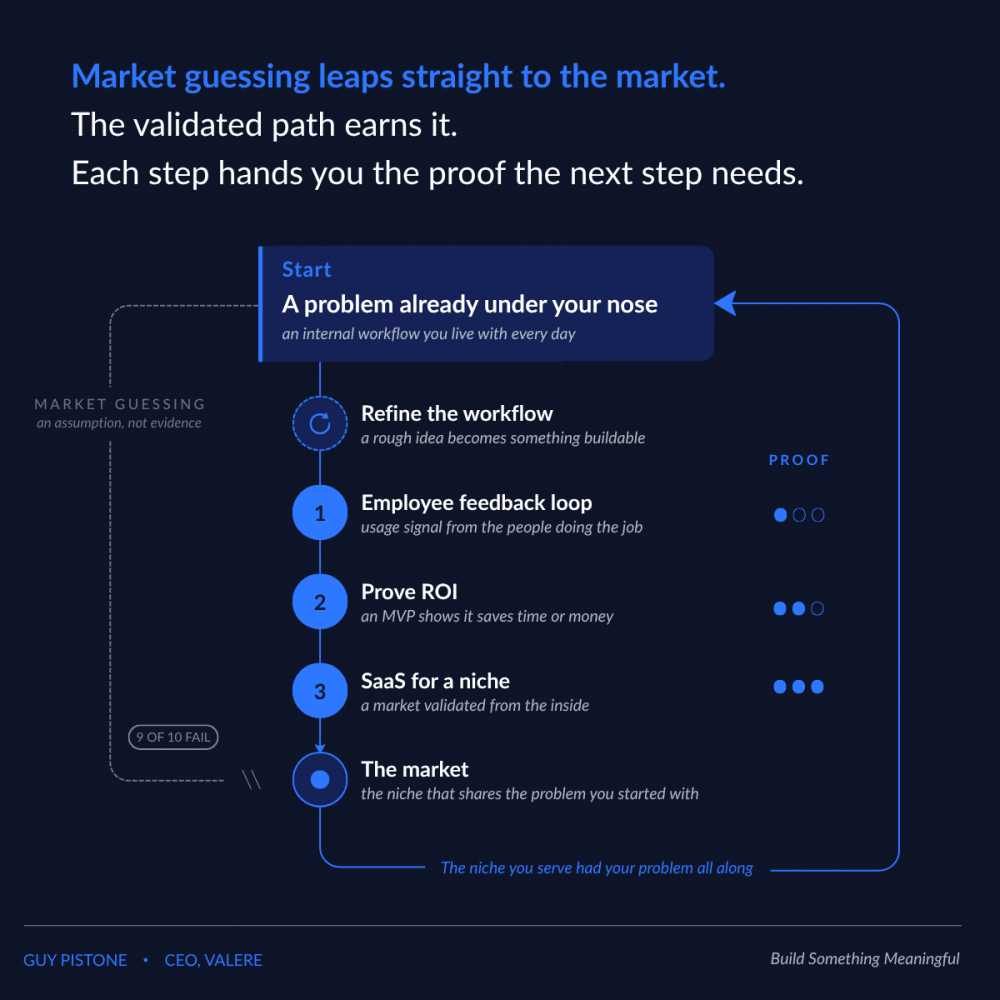
Doesn’t that just make sense? The optimal way a product should be defined and developed before you take it to the market. You may disagree, and that is a-okay, but I’ve overseen this process over and over. That’s why I’m convinced that it’s the most effective route to take, and $900M in measured client impact over +300 deployments, with a large majority of them following this process, back me up here. And I’ll welcome a debate over the topic if this just doesn’t click, just as long as you read the full article.
Okay, that should set the stage, and I think it’s time to get into this market guessing topic and the three stupidly simple steps you can take to stop assuming and start validating ideas before you go to market. We all know where assuming ends up, right? Oh, and one more thing, my team leading Valere Evolve is using this method to hyper-define the product-market fit to blow you all away. I approve all plans and changes, so I’m getting to watch them do this live, and it’s been very interesting. I’ll leave it at that, so they get to surprise you with our newest product and to streamline this lesson as much as possible. But their hard work deserved a little shoutout.
I’d compare market guessing to just making an educated guess about how to go about building a product, SaaS tool, or anything, really. I bet that this method produces less friction, fewer iterations, which is great resource-wise, and I’d challenge anyone, SaaS Founder or business owner, to give this a shot on your next idea. So, here are your three steps to take once you have the flow you want to commit to.
- Build an Employee Feedback Loop
- Prove ROI to confirm your signal
- Transition that into a SaaS Product for a Niche.
I hate to sound repetitive, but I told you this was simple. The graphic above gets into the nitty-gritty because nothing is ever as basic as it sounds. But if you take your workflow, those three steps, and a strong partner, you’ve put yourself on the fast track to a successful launch.
Quick example of how this worked for a previous client, but just over the process because I take proprietary information very seriously. And you never know who is out there conducting espionage. Not to drift off topic, but make a mental note of that to be VERY careful about what you share and who you share it with. NDAs were created for a reason. Back to my point, I met someone from the professional services industry, and he had this workflow with one goal. Make his and his colleagues’ lives easier and save them all some money along the way.
He had never built software before, but he knew he’d discovered a problem and ideated a workaround. Now he just needed to bring it all together. Jumping ahead a bit, this is where a strong partner comes into play. His AI-generated workflow wouldn’t have made it very far, but it did give us a great route into the build. Now that just made me realize I could add a pre-step you might want to consider. We refined his workflow (pre-step), then got to work on the employee feedback loop (step one). Next came the MVP, nothing fancy, just enough to prove this was going to solve his problem while achieving his goals (step 2). Now we’re on the final piece, so people like him and his industry, which has over one million certified professionals, can benefit from his solution (step 3).
I’ll give him a shoutout once we’ve wrapped things up and put a bow on it, after getting his consent, of course. And I’ll casually drop that we LOVE these projects, whether you have a fully defined workflow or not.
If this lit a fire under you, my virtual door is always open.
I’d also love to hear what you thought about this piece. And I read every comment.
Guy
P.S. One of these goes out every week. Ideas I’ve run through the wringer before they reach you, including the ones that don’t survive. Subscribe, and I’ll keep them coming.