This Month in Tech:
Valere’s CEO, Guy Pistone, Recognized as one of the Top 25 Tech CEOs of Boston in 2024
Guy Pistone , the CEO of Valere, a global tech and AI agency, has been named a Top Executive of Greater Boston for 2024. With fifteen years of experience in the tech industry, Pistone has a proven track record of building successful applications and leading innovative teams. Prior to joining Valere, he held leadership roles at Fitivity Inc. and Elete. Pistone’s recognition is a reflection of his exceptional leadership and Valere’s commitment to technological advancement that are impactful and meaningful.
Under Pistone’s leadership, Valere has achieved significant success. The company has been recognized for its innovative work in AI and machine learning, and has attracted top talent from around the world. One such talent is Logan Reilly, who has been recognized as a 25 Under 25 by BostInno for 2024.
Reilly is responsible for overseeing multimillion-dollar budgets at Valere and has worked as a lead project manager for a client, generating over $500,000 in total revenue. A graduate of Emerson College with a 3.98 GPA, Reilly was also a baseball player and the chief experience officer at EmComm, the Emerson marketing agency where he increased engagement by over 60%.
Google Search Gets a Major AI Upgrade
A New Era of AI-Powered Search
Google Search is undergoing a significant transformation, powered by advanced AI technology. To experience these exciting new features, simply download the Google app on your Android or iOS device.
Key New Features:
- Enhanced Lens: Ask questions about objects in videos and photos.
- Voice-Enabled Lens: Use your voice to inquire about objects in images.
- Smarter Shopping: Get detailed product information with Lens.
- Circle to Search: Easily identify songs playing on your phone or in movies.
- AI-Organized Results: Find more relevant answers to open-ended queries.
- AI Overviews with Links: Access supporting websites directly from AI summaries.
These updates are designed to make Google Search more informative and helpful, providing you with a richer and more efficient search experience.
Boston Generative AI Meetup: An Evening of Insights and Networking
Boston, MA – The Boston Generative AI Meetup is returning on Thursday, October 24, 2024, with a lineup of experts and an interactive panel discussion. This event offers attendees the opportunity to learn about the latest advancements in generative AI and network with industry leaders.
The event will take place at the Microsoft New England Research and Development Center in Cambridge, MA. Tickets are $20 and include catered food, beverages, and admission to the event.
Graph of the Month
Maximizing Generative AI Impact: Focusing on Key Function
While generative AI has captured significant attention, traditional AI applications still dominate the market. A recent report by McKiney & Company found that advanced analytics and machine learning algorithms continue to offer the most substantial value in various industries.
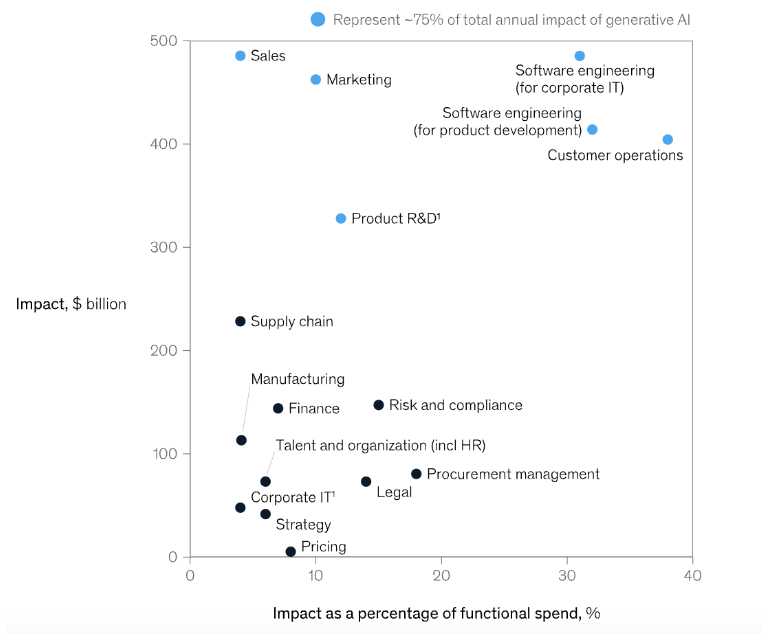
However, generative AI’s potential is undeniable. As the technology evolves, it could revolutionize creativity and innovation. The report highlighted four business functions—customer operations, marketing and sales, software engineering, and research and development—as areas where generative AI could have the most significant impact, accounting for approximately 75% of its total annual value.
Tool of the Month
Runway ML is a revolutionary AI-powered video editing platform that’s quickly becoming a favorite among content creators and filmmakers. With its innovative tools, Runway ML makes video editing easier, faster, and more creative than ever before.
Runway ML is more than just a video editing tool; it’s a platform that empowers creators to bring their visions to life. Its AI-powered tools significantly speed up the editing process, allowing you to focus on the creative aspects of your work. With its generative AI features, you can explore new possibilities and create unique visuals that will captivate your audience. Whether you’re a veteran or rookie who is just starting out, Runway ML’s intuitive interface and comprehensive tutorials make it easy to use. And by joining the vibrant community of creators who are using Runway ML, you can share your work, get feedback, and learn from others.
Building Intelligent Chatbots: The Future of User Interaction
By Bruno Cornelio
Chatbots are transforming the way we interact with technology, revolutionizing industries from customer service to healthcare. By 2025, chatbots are expected to handle 90% of customer inquiries, reshaping user interaction as we know it.Businesses that adopt these intelligent agents today are spearheading a rapidly evolving future.
The Evolution of Chatbots
The journey of conversational AI began in 1966 with ELIZA, a rule-based chatbot that simulated human conversation. Since then, technology has made incredible leaps. By the early 2000s, Natural Language Processing (also known as NLPs) ushered in a new era of chatbots capable of more complex conversations. Fast forward to today, and we have advanced models like GPT-4 and Gemini, which leverage vast amounts of data to mimic human-like interactions.
These chatbots are now essential in industries such as finance, e-commerce, and healthcare, providing services that range from handling simple customer inquiries to offering mental health support. However, the potential of intelligent agents goes far beyond these current applications.
The Promise and Challenges of Intelligent Chatbots
Despite these advancements, challenges remain. A Forrester study revealed that only 16% of U.S. consumers interacting with a chatbot found a solution to their problem. Complex issues often require human intervention, and demographic factors play a role in user satisfaction. For example, Baby Boomers tend to prefer human interaction, while Generation Z is more open to AI solutions, with 20% expressing a preference for starting interactions with chatbots.
This gap in chatbot performance highlights the need for further AI advancements. As OpenAI outlined in its five-stage AI vision—spanning from basic chatbots to fully autonomous organizations—current technology is at stage two: reasoners. Models like GPT-4 exhibit advanced reasoning, but the leap to stage three, which involves self-directed agents, is imminent and will occur more rapidly than previous advancements.
As AI progresses, intelligent chatbots will become more adept at handling complex customer inquiries, selecting appropriate tools and solutions, and seamlessly integrating into business processes. The question is, how can businesses capitalize on this potential?
5 Best Practices for Implementing AI Chatbots
To effectively deploy intelligent chatbots, companies should follow a strategic approach. Here are some best practices to guide implementation:
- Start with MVPs (Minimum Viable Products) Begin by addressing critical pain points with a scalable MVP. This allows for testing and refinement before larger rollouts, ensuring high ROI while minimizing risks. If you’re interested in a probono consultation, feel free to reach out to us at https://valere.io/contact
- Leverage Domain-Specific Data For chatbots to excel, they must be trained on data specific to your industry. This ensures that they understand not just general inquiries, but complex, niche queries.
- Focus on User-Centered Design Incorporate feedback loops and interaction data into your chatbot design. Continually refining the system based on user feedback ensures that it meets customer expectations.
- Integrate Advanced Models and Tools With AI technologies evolving, companies should integrate most recent models, like GPT-4 and the upcoming GPT-o1 preview, to keep their systems current and capable of handling increasingly complex tasks.
- Prepare for Future Scaling Once your chatbot proves effective in one area, scale it to other parts of your business, such as sales, HR, or technical support, where repetitive tasks can be automated efficiently.
These practices ensure that businesses not only deploy intelligent chatbots but do so in a way that maximizes their potential and addresses both customer and operational needs.
Real-World Success Stories
Intelligent chatbots have already made significant strides in various industries. Retail giants like H&M use chatbots to streamline customer service inquiries, while Bank of America’s Erica helps users manage their finances more efficiently. In healthcare, chatbots like Woebot offer mental health support, demonstrating that AI can handle sensitive, personal conversations effectively.
These success stories provide a blueprint for how companies in any sector can adopt and tailor chatbot solutions to meet specific business objectives.
The Future of AI-Driven User Interaction
As AI continues to evolve, we are on the verge of unlocking a new wave of capabilities. OpenAI’s third stage of development—agents—will enable AI systems to act autonomously, selecting the best methodologies and tools for solving customer problems without human input. This shift could revolutionize industries, with chatbots performing tasks that were once exclusive to human employees.
The potential impact of these advancements is vast. For example, the integration of AI with emerging hardware, such as Meta’s Orion AR glasses, could enable virtual assistants to provide real-time support in augmented reality environments. Imagine a chatbot not only answering your questions but visually guiding you through complex procedures in real-time.
Why Businesses Must Act Now
The window for early adoption is closing quickly. Companies that integrate intelligent chatbots today are not just improving customer satisfaction; they’re laying the groundwork for the next generation of AI-driven solutions. Chatbots can reduce operational costs, enhance productivity, and improve customer retention by offering instant, personalized support.
By following best practices, starting with MVPs, leveraging domain-specific data, and staying current with AI advancements, organizations can ensure they stay ahead in this rapidly advancing field.
The rapid advancement of generative AI has brought us to the cusp of a new era in user interaction. Chatbots, now more intelligent than ever, offer businesses an unparalleled opportunity to enhance customer engagement and streamline operations. As we move closer to fully autonomous AI systems, early adoption will be key to staying competitive in the marketplace.
For businesses that act now, the benefits are clear: reduced costs, improved customer experiences, and a strategic advantage in a future dominated by AI-driven interactions. The time to pioneer the adoption of intelligent chatbots is now, before the next leap in AI arrives and reshapes the landscape for good.