TL;DR
AI’s in a bubble moment. But that shouldn’t scare you; it should focus you. Bubbles burst.
But the operational advantages you build with AI now stay on your balance sheet.
The opportunity isn’t the hype. It’s the execution. When implemented correctly, AI unlocks:
- Operational efficiency
- Productivity increases
- Data-driven decision-making
- Real cost savings
But there’s a catch…
None of this is possible without a meaningful culture of AI learning and a strong internal execution model.
Data Determines Whether Your AI Survives (The Reality)
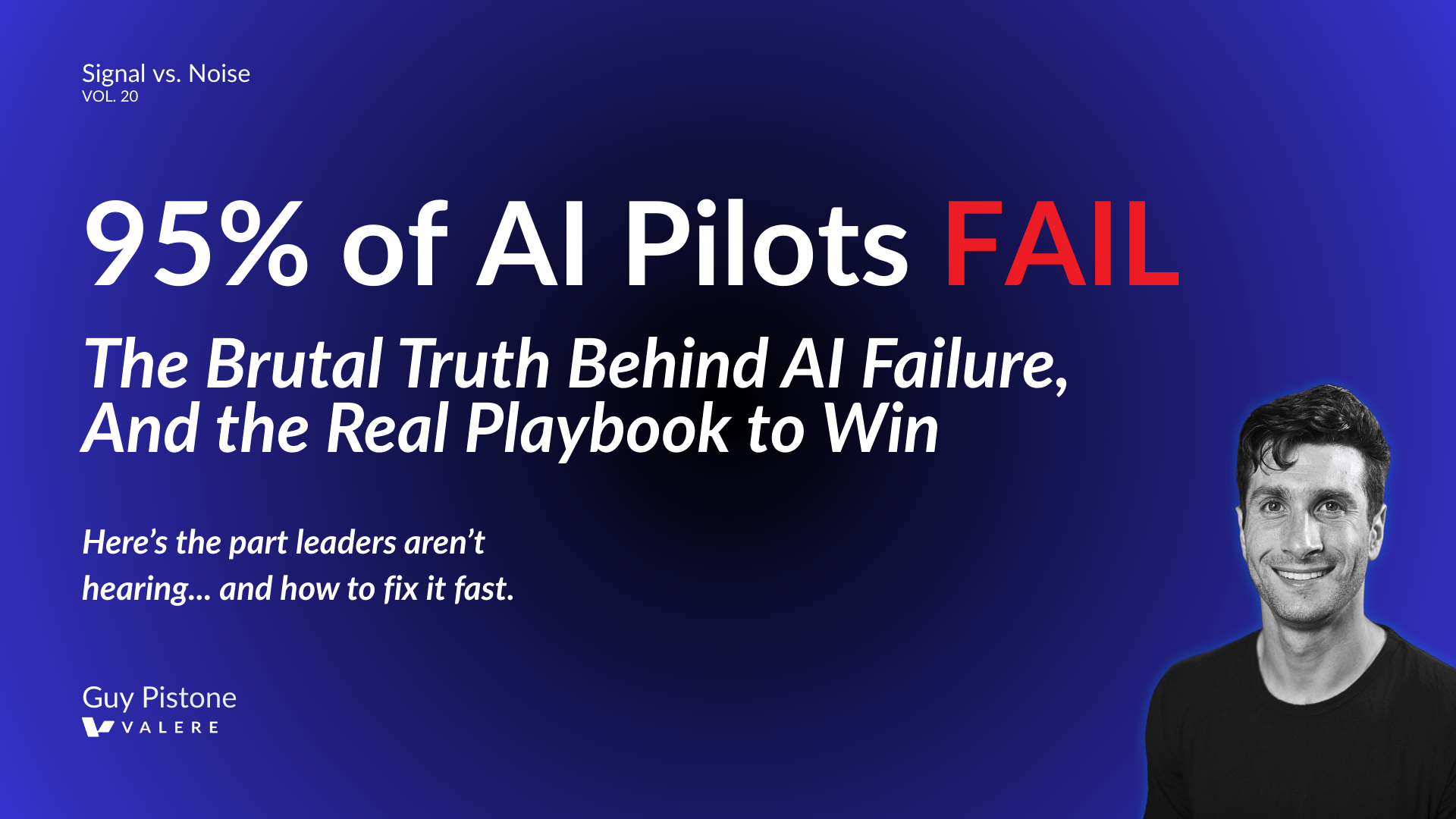
In 2025, 42% of companies abandoned their AI initiatives, up from 17% the year before. And 46% of proof-of-concept projects never make it to production. (S&P Global).
The culprit? Execution failures, not the technology itself.
Avoiding this is simple, but not easy… You have to build internal AI capability, invest in data foundations, and implement with intention.
AI Adoption and Implementation (A.K.A. The Silent Killer)
Forget panic over AI valuations. The real crisis is the number of failed implementations.
ChatGPT adoption is universal. Yet custom, high-impact AI struggles due to integration complexity and poor fit with existing workflows.
And according to MIT’s State of AI in Business 2025, 7 of 9 sectors show little structural change despite increased AI adoption. (MIT CISR)
You’re chasing trends when you should be worried about delivering measurable outcomes through disciplined execution…
Why AI Pilots Fail (and How to Avoid It)
The technology isn’t the problem. But your process is.
Integrate AI correctly, and you can see a 270% improvement in key processes, as I spoke to last week. When AI is integrated with the right data and workflows, everything falls in place.
Here’s where organizations typically go wrong:
1. Data quality issues. AI can’t perform without consistent, clean, high-quality data. Most pilot failures start here.
2. Skills shortages. Organizations lack internal expertise to integrate AI into existing systems. Role-based AI education is now non-negotiable.
3. Employee resistance. Without buy-in, even the strongest projects stall. Implementation must include stakeholders from Day 1.
4. Resource constraints. AI is not a one-off project. It’s ongoing capability-building. Teams need time, investment, and a clear plan to succeed.
Build Internally With Four Critical Foundations
Buying off-the-shelf AI tools is tempting. But long-term success comes from building tailored, internal solutions aligned with your organization.
Here’s how to get it right:
- Invest in your team’s AI education: From executives to new hires, AI training tailored for each role is crucial for success.
- Focus on data: Your AI’s success depends on high-quality data. Build the right data foundations to power meaningful insights.
- Ensure buy-in across your organization: AI needs support at all levels. Ensure alignment across IT, operations, and leadership to drive adoption.
- Measure outcomes: Define clear KPIs and success metrics for each AI initiative. This way, you’ll track progress and ensure your AI delivers ROI
Where AI Delivers Real ROI
The productivity gains are real when execution is done right. GitHub’s Copilot, for example, helps developers code 51% faster with 84% more successful builds.
Enterprises achieving measurable results are doing one thing differently: They’re tailoring AI to their own workflows, systems, and processes, not relying solely on generic products.
Be in the small minority of companies seeing real, repeatable ROI.
A 30-Day Execution Plan (Your Next Steps)
If you want AI to drive results (not gather dust) focus on disciplined, internal execution:
1. Identify 3–4 high-impact use cases. Choose areas where AI can make immediate, measurable improvements. Examples:
- Customer support deflection
- Invoice reconciliation
- Claims triage
- Sales email drafting
- Process exception handling
2. Build your internal team. Use external partners for training and support, but own the expertise. Create champions inside your org.
3. Strengthen data governance. Establish data standards, cleaning processes, and role-based access. Quality data is non-negotiable.
4. Define clear success metrics. Adopt measurable KPIs aligned with business outcomes (cycle time, cost reduction, accuracy, throughput, etc.).
You can’t control the AI bubble. But you can control your execution. What you build now is what lasts.
Organizations that focus on building and scaling custom AI solutions, supported by strong teams, clean data, and a clear roadmap, will lead the next decade of operational transformation.
Guy Pistone, CEO, Valere | Building meaningful things
Resources & Research:
- S&P Global: Generative AI Shows Rapid Growth but Yields Mixed Results (October 2025). Read the full report here
- MIT CISR: GenAI Divide: State of AI in Business 2025. Download the full report
- MIT Report: 95% of Generative AI Pilots at Companies Failing. Full article coverage on Fortune
- GitHub Copilot Research: Quantifying GitHub Copilot’s Impact on Developer Productivity. Explore GitHub’s findings