Key Takeaways
- The gap between companies deploying autonomous AI in production and those stuck in pilot is widening fast, and the architecture decisions being made right now determine which side an organization lands on.
- Most AI pilots fail not because the technology is wrong, but because no single party owns the outcome across strategy, orchestration, security, and adoption.
- Organizations that encode proprietary institutional knowledge into production AI systems build compounding advantages that generic platform deployments cannot replicate.
The Execution Gap Is Where the AI Era Gets Won or Lost
Enterprise AI has moved past the question of whether the technology works. The question now is whether organizations can get it into production and keep it there. The companies pulling ahead are not doing so because they found a better model or a smarter platform. They changed what they expected from an AI initiative entirely. They stopped measuring success by deployment and started measuring it by outcomes. This article covers what that shift looks like in practice, where most initiatives break down, and what organizations building durable AI advantage are doing differently.
A meaningful divide is forming inside the global economy, and most organizations are underestimating how quickly it is moving.
On one side are companies that have moved past AI experimentation. They have deployed autonomous systems that execute business processes end-to-end, at scale, without human intervention at every step. On the other are companies still cycling through pilots, accumulating proofs-of-concept that never reach production, and watching the gap between what AI can deliver and what their deployments actually deliver grow wider each quarter.
This is an execution gap, and it is where most of the equity value in the AI era will be won or lost.
Working inside the environments where that gap is most expensive, including healthcare systems, enterprise SaaS platforms, regulated financial infrastructure, and mission-critical cloud architecture, a consistent pattern emerges. The organizations that successfully move from pilot to production are not doing so because they found a better tool. They changed how they think about what AI is supposed to deliver. They stopped buying software and started buying outcomes.
From Chatbots to Autonomous Agents: The Architecture of Execution
It is worth being precise about what autonomous AI agents actually are. The term has been stretched to cover everything from a basic FAQ bot to a fully orchestrated multi-agent workflow.
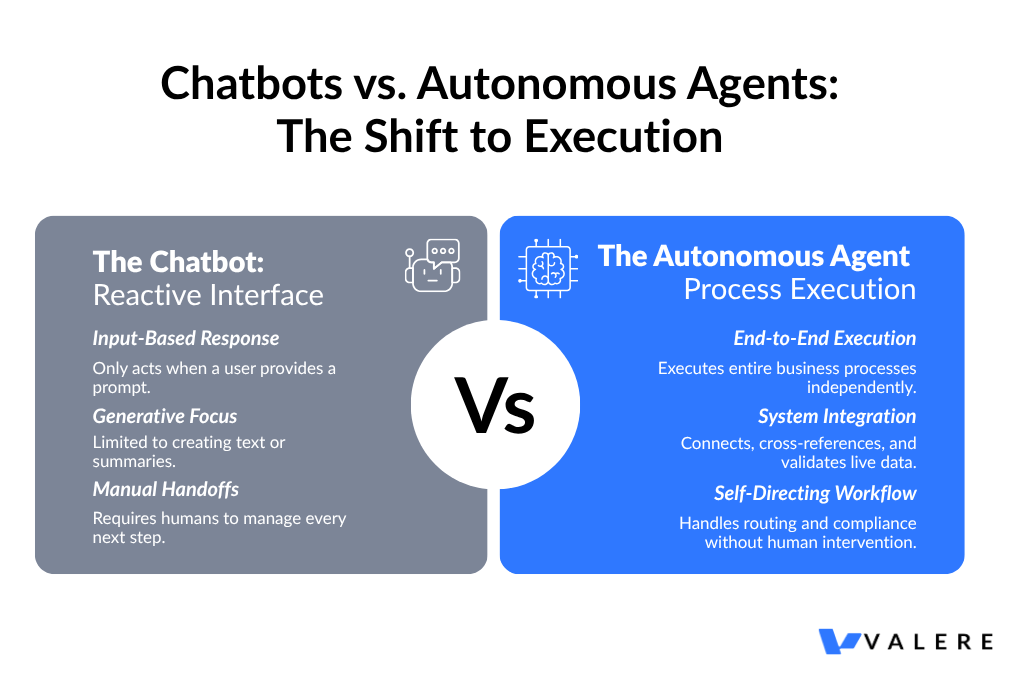
A chatbot responds. An autonomous agent executes.
What Execution Actually Looks Like
When a user asks a chatbot to summarize a document, it generates text. When an autonomous agent handles the same task, it retrieves the document from a connected system, cross-references it against a live database, and flags anomalies against historical thresholds. It then routes the output to the appropriate stakeholder and logs every action for compliance purposes, all without a human initiating each step. That chain of connected execution across real business systems is what autonomous means in a production context. It replaces a series of human hand-offs with a continuous, self-directing workflow.
A chatbot is a reactive tool built on scripted logic. An autonomous agent is a goal-oriented system built on large language models capable of contextual reasoning, multi-step planning, and direct action across an enterprise stack. This includes ERP, CRM, HRIS, document repositories, and communication systems. The agent does not just answer a question about your invoice process. It runs the invoice process.
Why the Distinction Matters
This distinction matters enormously when evaluating an AI initiative. Building a chatbot and labeling it an agent is not the same as building a system that executes business workflows. The consequences of that confusion show up in production.
What Agents Actually Deliver
The real proof of agentic AI is not in architecture diagrams. It is in the specific workflow transformations that change the economics of core business functions.
Finance and Accounting
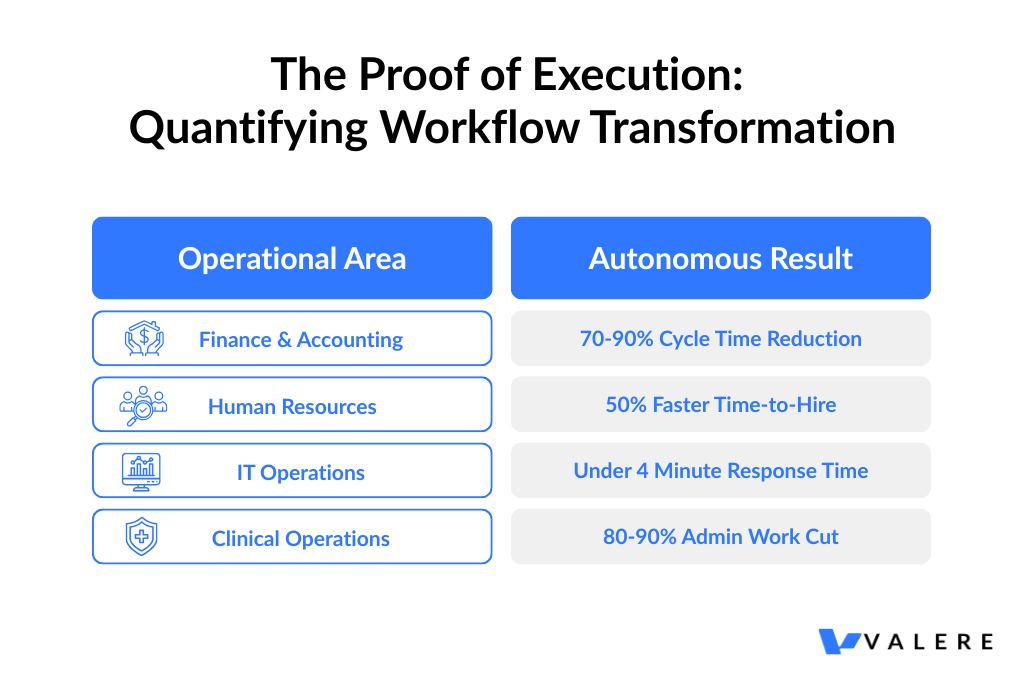
Autonomous agents function as always-on, audit-ready process executors. A mid-market financial operations platform built to handle the full invoice management lifecycle autonomously illustrates what this looks like in practice. The platform reads, validates, and processes payments without a human in the chain. Businesses in this space routinely face costly bottlenecks from manual invoice processing. Invoices arrive through multiple channels, validation involves multiple people, and payment runs require sign-off at every stage. Replacing that with an end-to-end automated workflow means human involvement becomes the exception, applied only where genuine judgment is required. Across invoice processing deployments, these systems consistently deliver 70 to 90 percent reductions in cycle time.
Operations and Field Services
The execution gap here tends to be the most visible and the most expensive. One national construction services firm managed over 3,000 active projects through spreadsheets, email threads, and text messages. That coordination model generated more than $200,000 in annual losses from scheduling failures and dispatch bottlenecks. An AI-powered operations platform unified scheduling, dispatch, and field communications into a single orchestrated system. Agents now handle crew assignments autonomously and interface directly with more than 70 field installers via GPS tracking and voice-to-text. The manual dispatch layer that had been limiting growth no longer exists.
Human Resources
Agents are changing both recruitment logistics and employee self-service. On the talent side, agents screen thousands of applications against evolving skill criteria and manage interview scheduling across global time zones. They maintain candidate communication at a pace human recruiters cannot sustain at volume. Organizations deploying these systems consistently report 50 percent faster time-to-hire. On the self-service side, agents reason over internal policy documents to answer employee questions about benefits, leave policies, and compensation, delivering accuracy comparable to an HR specialist around the clock.
IT Operations
The shift has moved from reactive alert triage to autonomous incident response. In cloud environments generating thousands of daily alerts, an autonomous DevOps agent can detect a production incident and test root cause hypotheses across container logs, pod telemetry, and network topology. It initiates containment actions in under four minutes. The same cycle requires thirty minutes or more with a human SRE, assuming the alert gets seen promptly.
Healthcare
The focus is on reducing the administrative burden that pulls clinical resources away from patient care. Work with a Fortune 100 veterinary diagnostic provider addressed a scheduling and logistics coordination problem for lab tests and surgical procedures. The routing challenge touched dozens of variables per booking. Automating that coordination end-to-end removed the human touchpoints from complex logistics routing and drove measurable efficiency across their laboratory network. A separate clinical operations engagement delivered a HIPAA-compliant AI system in five months, against an industry standard of twelve to eighteen. That deployment achieved 90 percent clinical data extraction accuracy and an 80 to 90 percent reduction in manual administrative work.
The Common Thread
None of these outcomes can be delivered by a chatbot, a standalone AI tool, or a fragmented vendor stack. They require an end-to-end architecture that connects strategy to execution, built on knowledge specific to how that business actually operates.
Why Most AI Initiatives Stall Between Pilot and Production
Between 80 and 95 percent of AI pilots never reach production, depending on the source. The pilots work. The demos impress. Then the initiative quietly dies somewhere between proof-of-concept and operational reality. Understanding where that happens is the only way to avoid it.
The Data Readiness Gap
Pilots run on clean, curated, manually prepared data. Production runs on whatever your enterprise systems actually contain. This means inconsistent formats, legacy structures, missing fields, and naming conventions untouched for a decade. Organizations that move agents to production without addressing this find that a system achieving 94 percent accuracy in a demo degrades to 52 percent in the first week of live operation. The model did not get worse. The environment got real.
The Knowledge Gap
Competitors have access to the same foundational models. If your agent reasons from the same publicly available data every other company’s agent uses, the outputs are commoditized. Competitive advantage comes from agents that know what only your organization knows. This includes the institutional wisdom senior employees carry, the undocumented workflows teams have refined over years, and the exception-handling patterns that exist nowhere in writing but drive how decisions actually get made. You must deliberately capture that intelligence and feed it into the system, or it simply is not there.

The Orchestration Gap
This is where most initiatives die, and it is the least visible failure at the pilot stage. A strategy consultant tells you what to do. A platform vendor sells you a tool. A training provider runs a workshop. Your team is then left to figure out how these pieces connect to your actual business processes. One example: a B2B marketing automation firm needed to orchestrate email operations across more than 250,000 contacts. A basic generative AI tool could not manage the operational complexity of rotating sending infrastructure, dynamic personalization at scale, and compliance management across hundreds of active inboxes. A custom orchestration layer engineered to match the actual operational requirements enabled a revenue-generating process that runs without additional headcount.
The Security Gap
The default configurations that make AI tools fast to prototype are built for speed, not production. API credentials leak through URL history and server logs. Shared conversation contexts expose user data across sessions. Unvetted inputs create prompt injection vectors that can redirect agent behavior in ways nobody anticipated in the demo. These are predictable failure modes of systems deployed without production hardening, and they are behind breach incidents that have already made headlines.
The Fragile Pilot Trap
Perhaps the most costly version of the divide is the AI system that appears to be working until the moment it cannot. An enterprise AI firm brought in for architectural rescue had built their core platform on an automation framework that handled simple queries adequately but collapsed under complex enterprise interactions. It passed every internal review and performed well in every sales demonstration. It was systematically failing the enterprise clients the firm was trying to win, clients representing more than $100 million in potential annual revenue. Full migration to AWS, custom API development, and iterative prompt optimization grounded in production data delivered a 50 percent improvement in response accuracy. The team was not incompetent. They had deployed a pilot-grade architecture into a production-grade business environment, and the cost of that mismatch carried a nine-figure number.
Rebuilding from a broken foundation consistently runs three to five times the cost of building correctly from the start. Roughly a quarter of engagements begin with exactly that situation, and the pattern is always the same.
Owning the Outcome, Not Just the Delivery
The conventional enterprise software model is a licensing transaction. You pay for access to a platform and take responsibility for making it work inside your organization. The vendor’s job ends when you sign the contract.
The Problem With That Model
In the context of autonomous AI, that structure puts execution risk entirely on the buyer, who is often the least equipped party to manage it. Most buyers do not know how to architect multi-tenant session isolation or build retrieval-augmented generation pipelines that scale beyond demo data. They do not know what production hardening looks like for an AI system processing sensitive business data. They bought a platform and discovered, usually after something breaks, that the platform was a starting point.
A more defensible model shifts that accountability. The partner takes responsibility for the outcome, not just the delivery of a tool. Success means the workflow was transformed and the business objective was achieved, not simply that the software was deployed.
What Outcome Ownership Looks Like in Practice
One practical illustration: a quality assurance platform processing large volumes of annotation data against a complex 50-page rulebook relied entirely on human reviewers to apply guidelines consistently. The variability and cost of that human review layer was becoming a ceiling on the business. Building an automated logic bridge using AWS Bedrock mapped the complex guidelines into precise JSON logic. The result is a deterministic quality score and full audit trail delivered in a single API call. The human review bottleneck is gone. The outcome does not vary by reviewer, time of day, or volume.
The Production Hardening Question
This is where production hardening becomes the partner’s problem rather than the client’s. One question is worth asking any AI implementation partner before signing: what does your production hardening process look like? The answer tells you immediately whether the partner has built something for production or built demos.
A rigorous framework addresses four layers. Hardened Access establishes the credential and authentication foundation. This includes API key lockdown, strong authentication protocols, and unique credential management per team and per session. It eliminates the most common failure mode of credentials leaking through URL history and public logs. Privacy Shield implements session isolation to prevent user data from surfacing across interactions. It also enforces filesystem lockdown and log redaction to keep sensitive information out of audit trails. Safety Guardrails enforces mandatory sandboxing, input filtering, and hostile content handling. This addresses prompt injection attacks before they reach the reasoning layer. Enhancement and Security runs deep adversarial scanning, vets third-party integrations before they touch production systems, and establishes proactive monitoring for unauthorized access patterns.

Regulated Environments
This matters most where security requirements are non-negotiable. A government contracting technology firm needed to deploy an AI platform to manage the full capture lifecycle inside AWS GovCloud. The platform handled document intelligence, compliance verification, and workflow coordination. Building it natively on GovCloud infrastructure and integrating compliance architecture from the ground up produced a system that cut capture timelines in half, operating inside an environment most development teams would not have been permitted to enter.
How AI Creates Durable Competitive Advantage
The financial case for autonomous AI agents is not primarily a cost reduction story, though the cost numbers are real. The deeper mechanism is competitive moat construction, and it compounds over time.
Operational Leverage
This is the most immediate layer. Cycle time reductions of 70 to 90 percent in finance workflows, 50 percent faster time-to-hire in HR, and sub-five-minute incident resolution in IT operations create cost structures that competitors running manual processes cannot match. That gap translates directly to margin and to the capacity to reinvest in further advantage.
Proprietary Knowledge Compounding
This is the more durable layer, and where the gap between organizations genuinely widens over time. A government contracting firm whose revenue growth depended on identifying the right opportunities early faced a specific problem. The intelligence required to make accurate calls lived entirely in the heads of their senior sales executives, undocumented and unavailable to any AI system. Structured knowledge extraction with those executives captured the scoring logic, competitive pattern recognition, and bid qualification heuristics developed over years. That institutional knowledge trained agents that now scan federal procurement portals around the clock. The agents predict and score the win probability of new contract opportunities 30 to 90 days earlier than the manual team could. A competitor starting fresh from a generic model is not competing against that firm’s day-one deployment. They are competing against years of proprietary operational learning encoded into a production system.
Workforce Adoption
This is the layer most organizations underinvest in. AI literacy built around your actual workflows, your specific systems, and your team’s real operational context produces durable behavior change. Generic AI training does not. The gap between organizations whose AI investments generate lasting adoption and those whose deployments collect dust is almost entirely attributable to whether workforce education was a first-class requirement from the start.
Architecture as a Multiplier
Organizations that build modular AI foundations find that each subsequent initiative builds on the last. The cost of capability expansion falls and deployment speed increases. A well-architected foundation creates a widening gap between organizations that built with the future in mind and those that built for the immediate demo.
From Pilot Thinking to Production Reality
Enterprise AI is no longer a strategic experiment. It is an operational decision with compounding consequences, and the window for getting the foundational choices right is narrower than most organizations appreciate. The companies building durable advantages right now are not necessarily the ones with the largest AI budgets or the most sophisticated technical teams. They are the ones that treated AI as infrastructure from the start, chose partners who owned outcomes rather than delivered tools, and invested in the layers that determine whether a deployment actually holds: knowledge capture, orchestration, security, and adoption.
The execution gap is real and it is widening. But it is entirely bridgeable for organizations willing to make the transition from pilot thinking to production thinking.
Ready to Stop Piloting and Start Compounding?
The organizations pulling ahead are not running more experiments. They are building production-grade AI systems that encode institutional knowledge, execute at scale, and compound in value over time. Valere works with mid-market companies and their investors to design, build, and deploy AI that delivers measurable outcomes across the full stack.
Whether you are trying to understand where your current AI deployments are breaking down, moving an initiative from proof-of-concept to production, or building the foundation for autonomous operations across your business, Valere brings the platform, expertise, and outcome accountability to make it real.
- An AI Readiness Assessment that identifies exactly where your current deployments lack the data quality, knowledge capture, and orchestration architecture needed to move from demo performance to production reliability
- A clear path from disconnected pilots to a governed, end-to-end execution layer that integrates with your existing operations, encodes your institutional knowledge, and improves with every cycle it runs
- A personalized value creation roadmap from isolated AI experiments to production-grade autonomous infrastructure, with the security hardening, human oversight, and proprietary intelligence that no competitor can replicate by licensing the same tools
Start building AI that compounds: valere.io
Frequently Asked Questions
How do mid-market companies typically get started with AI implementation?
Most mid-market organizations start with an AI readiness assessment. It maps existing data infrastructure, workflow complexity, and organizational capacity against realistic implementation timelines. The assessment typically surfaces two or three high-value use cases where data is already clean enough to support a production deployment. Companies with 50 to 200 employees generally see the strongest early returns from automating one repeatable, high-volume operational process before expanding scope. Rushing past this stage is the most common reason pilots fail to reach production.
What is the difference between AI strategy and AI execution?
AI strategy defines what to automate, in which order, and how to measure success. AI execution is the technical and organizational work of building and deploying those systems in a production environment. These require different expertise, and the gap between them is where most enterprise AI initiatives stall. A useful way to evaluate any AI engagement is to ask which party is accountable for production outcomes, not just delivery milestones.
How do you evaluate an AI consulting partner?
The most useful evaluation criteria center on production track record rather than demo performance. Ask how many of their deployments are currently running in production versus still in pilot, also what their process looks like for production hardening and security, and finally; ask whether they can provide specific outcome data from comparable engagements, and what happens when something breaks after launch. Partners who are vague about any of these are likely selling deliverables rather than outcomes.
What does an AI readiness assessment include?
A useful AI readiness assessment covers data quality and accessibility across your core systems, workflow complexity and integration requirements, organizational capacity for change management, and realistic timeline and cost benchmarks based on comparable deployments. It should surface not just opportunities but blockers, including data issues, legacy system constraints, and skill gaps that will determine whether a deployment reaches production.
Why do most AI pilots fail to reach production?
The primary causes are data readiness gaps that only surface under production conditions, orchestration failures when multiple AI components need to work together inside real business systems, security configurations built for speed rather than production requirements, and workforce adoption failures when teams deploy AI tools without role-specific training. The highest-cost failure mode is the fragile pilot: a system that passes every internal review and performs well in demos but systematically fails under the complexity of real enterprise use.