TL;DR
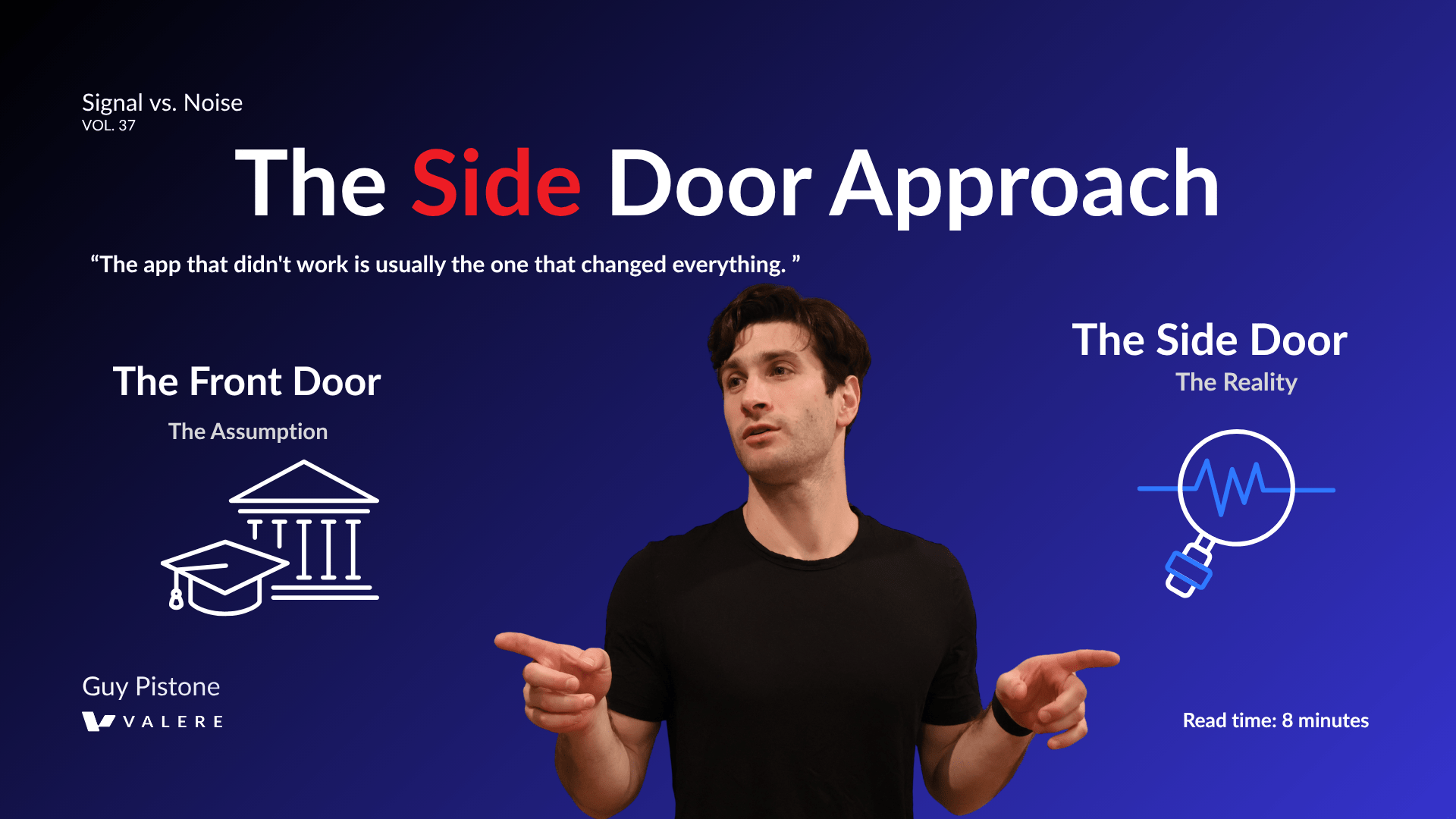
The app that didn’t work is usually the one that changed everything. Not because of what ended up getting built, but because of who was in the room while you were building it. There are multiple paths to success, and many start with a side door.
Key Concepts: Front Door vs. Side Door
These two terms describe fundamentally different approaches to entering a new field or industry. Understanding the difference matters because most people default to one without realizing the other exists.
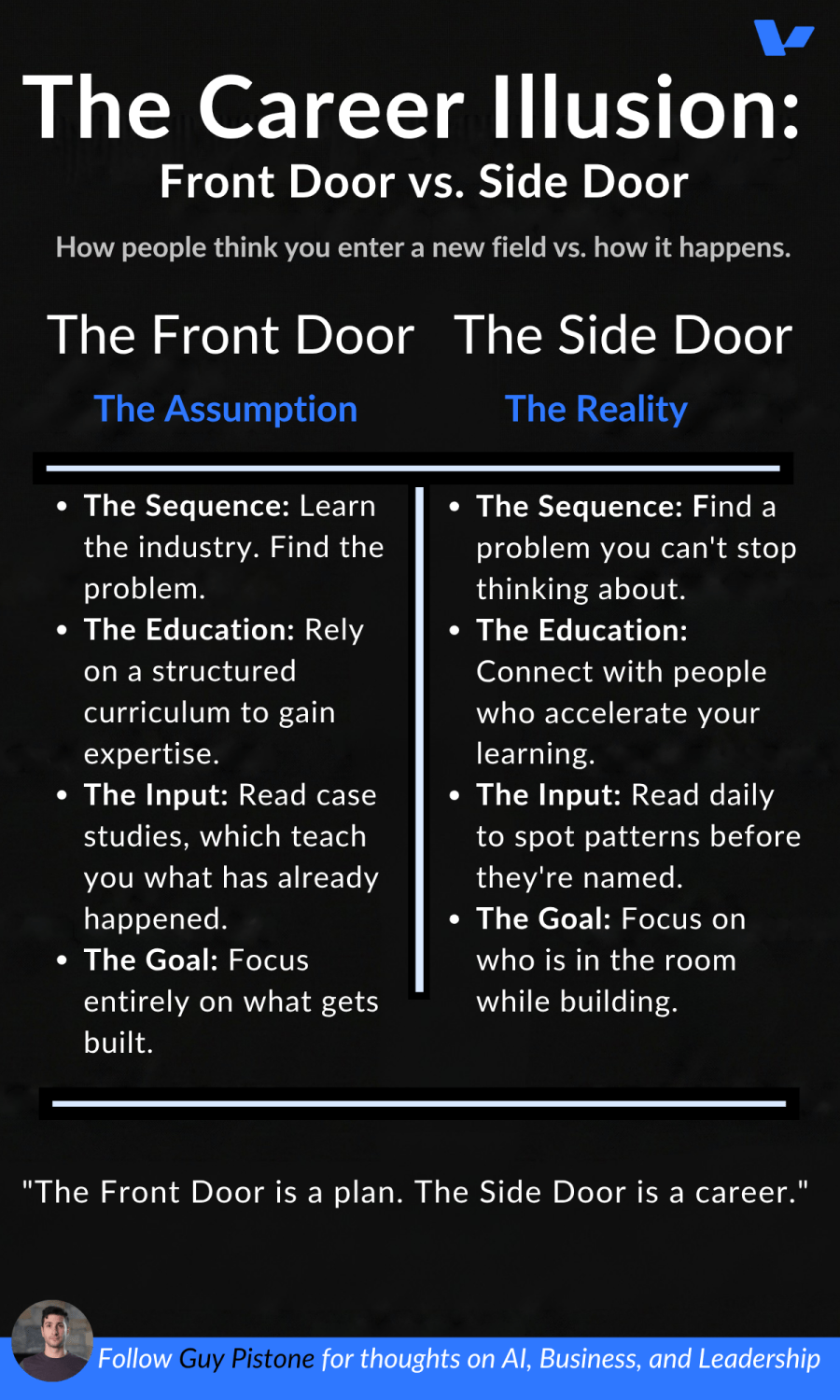
The Front Door refers to credential-first, sequence-driven career entry. Learn the industry. Get the degree. Follow the established curriculum. Wait for the job offer. It feels structured because it is. The assumption is that expertise comes before opportunity.
The Side Door refers to problem-first entry, where the obsession precedes the expertise. You find a problem you can’t stop thinking about, that problem pulls you into contact with people who know things you don’t, and those people, almost accidentally, accelerate your education in ways no formal program would. Opportunity comes before expertise, and expertise is built through proximity.
The App Nobody Remembers
Foursquare launched in 2009 with a mechanic so simple it’s easy to underestimate in retrospect. Your phone knew where you were. It could tell other people. That was mostly used for checking into restaurants and competing for digital mayorships of your local coffee shop. But the underlying technology wasn’t really about restaurants. It was about location data at scale: where people go, how often, and what they do when they get there. A small number of people looked at that same layer and saw something completely different.
One of them saw basketball courts.
The logic was straightforward. If a phone can surface the nearest coffee shop and tell you how many people are inside, it can tell you which outdoor court has a pickup game running. That’s a real problem. Anyone who played pickup basketball growing up knows that half the effort is just finding a game. The tech existed. The use case was sitting there.
So there was a team, a product, and a few years of real work. 2012, 2013, 2014. The app never became what it was supposed to become. What happened instead was more interesting.
What the Developers Were Reading
The people on that project were passing around articles. Not as homework, not as a structured curriculum. Just the way people who are deep in a field do: they share what they’re reading because it’s relevant to what they’re thinking about. The publication was TechCrunch, which in that era covered new companies and emerging technology in a way that was accessible without being watered down.
The effect was cumulative and mostly invisible while it was happening. New terms, new companies, new mental models for thinking about what technology could and couldn’t do. Not absorbed all at once, but built up daily, the way any kind of pattern recognition actually develops.
The basketball app was the reason for being in the room. The developers were the actual educators. And the developers weren’t trying to teach anyone anything.
Why Reading Every Day Is a Strategy
Something specific happens when you read about an industry consistently over a long period of time. The goal shifts from absorbing information to developing pattern recognition. Problems that keep coming back become visible. So do the solutions that keep failing, the companies approaching the same challenge from different angles, and the terms being used to describe things that didn’t even have names two years ago.
That kind of recognition is hard to get any other way. Case studies teach you what happened. Daily reading teaches you what’s happening and trains you to notice what hasn’t been named yet.
The healthcare ambient scribing category (Ambient AI mentioned last week) is a useful example here. The pain it solved had existed for decades. The technology to address it had been theoretically available for years. What changed was that enough people had been paying close enough attention to recognize that the conditions had finally aligned. That recognition doesn’t come from a single article. It compounds.
The developers who passed around TechCrunch links in 2013 understood this, maybe not explicitly, but in practice. They were maintaining their pattern recognition in real time. Bringing someone else into that habit, even unintentionally, was probably the most valuable thing that happened in that whole project.
The Pattern Holds Across Industries
This isn’t a startup anomaly. The same sequence, problem first, then room, then education, shows up across fields and generations.
Stewart Butterfield didn’t set out to build a workplace communication platform. He was building a game called Glitch. When the game failed, the internal communication tool the team had built to coordinate their work became Slack. The failed project was the Side Door into a category that, in 2013, barely existed. Slack reached a $7 billion valuation within four years of launch.
YouTube started as a video dating site. The founders, three former PayPal employees, pivoted when they noticed users uploading all kinds of video, not just dating profiles. The original obsession got them in the room. The pattern they spotted while building it became the actual business.
Instagram launched as a location-based check-in app called Burbn. Kevin Systrom noticed users were primarily using one feature: photo sharing. Everything else got cut. The side observation became the product.
In each case, the original project wasn’t the point. It was the excuse to start. The real value came from the room it put the founders in and the patterns they were positioned to notice because they were already building.
My Final Thoughts
The basketball app never became the point. It was the excuse to start, which turned out to be enough. The actual trajectory came from the room the app put you in, the people in that room, and the discipline to keep reading after the original obsession had run its course.
Most paths into a field that matter look more like this than they look like a plan. The Side Door is usually how it actually happens. What separates the people who build something from it is whether they stay curious long enough for the compounding to kick in.
What’s the side project that got you into the room you’re in now?
Frequently Asked Questions
- How do most successful founders actually break into a new field? Research from First Round Capital’s State of Startups surveys consistently shows that founders who successfully break into new fields typically start with a specific problem rather than a deliberate career plan. The most common pattern is accidental proximity: working on one project puts them in contact with people and information that redirect their focus. Formal credentials or prior industry experience are less common entry points than most people assume.
- What is the Side Door career strategy? The Side Door is a problem-first approach to entering a field or building a career. Rather than acquiring credentials and then looking for opportunities, it starts with an obsession over a specific problem. That obsession leads to building something, which puts you in proximity to people who accelerate your learning. Expertise is developed through practice and exposure, not prerequisites. The term contrasts with the Front Door, which describes the more traditional credential-first, sequence-driven path.
- Why does daily reading matter more than structured learning for pattern recognition? Structured curricula teach what has already been documented and categorized. Daily reading, particularly across a range of sources covering an active industry, builds the ability to spot patterns before they’re named. According to a 2021 McKinsey analysis of early-stage technology adoption, the companies that moved earliest on AI and cloud infrastructure were disproportionately led by people who had been reading trade coverage of those categories for years before acting. The compounding effect of regular reading is pattern fluency, not just information accumulation.
- When does a failed project become valuable? Failed projects tend to generate value through two mechanisms: the people they put you in contact with, and the patterns they force you to observe. A project that fails after two years in a specific domain typically leaves its founders with a network, a set of unresolved questions, and a refined sense of what doesn’t work. That combination often turns out to be more useful than the outcome the project was originally targeting. Stewart Butterfield’s Glitch, which failed as a game, produced Slack. The timeline from failed game to $7 billion communication platform was roughly four years.
- How do you find the right room to be in while building? The room tends to follow the problem, not the other way around. People who are working on the same problem, or adjacent problems, cluster around the same tools, forums, communities, and publications. Being genuinely engaged with a problem, even at an early or unpolished stage, is usually sufficient to get access. The barrier to most valuable rooms is demonstrated interest, not credentials.
Key Takeaways
For quick reference, here is what the evidence and experience across multiple cases consistently point to:
- The Side Door starts with a problem, not a plan. Most significant career pivots and company pivots trace back to an obsession that preceded any formal strategy.
- The failed project is often the real education. Its value is in the network it builds and the patterns it forces you to observe, not the outcome it was targeting.
- Daily reading compounds into pattern recognition. Knowing what’s happening in real time gives you the ability to spot conditions before they’re documented in a case study.
- Proximity is the accelerant. The room you’re in while building matters more than the curriculum you follow. People who know things you don’t are the fastest path to knowing them yourself.
- Expertise follows interest. In most fields, consistent demonstrated interest is sufficient entry. Credentials are the Front Door. Genuine engagement opens the Side Door.
The Side Door is always open. Most people just keep looking for the handle on the wrong one.
Guy Pistone | CEO, Valere | AWS Premier Tier Partner
Building meaningful things.