Here’s the data nobody wants you to hear, but I’m pointing out anyway…
- 68% of employees report feeling overwhelmed by the pace of AI tool rollouts (Gartner, 2025).
- 41% of workers say AI has increased their workload, not decreased it (MIT Sloan, Q4 2024).
- 53% of AI initiatives stall due to employee pushback, not technical failure (McKinsey, 2025).
Want me to sum that up for you?
Your team isn’t resisting AI. They’re resisting you.
AI fatigue is the #1 adoption killer in 2025. Leadership thinks this is a “change management problem.” It’s not. It’s a trust problem. And you created it. Find out how to fix it before you fall further behind. 👇👇👇
The Myth vs. The Move
Roll it out. Train people. Watch productivity soar. That’s a common misconception about AI. If you think:
- “If we mandate AI usage, adoption will follow.”
- “Employees just need training.”
- “Resistance is fear of being replaced.”
I have a hard truth for you.
“AI without proof of value = more work, not less.”
Adoption doesn’t come from mandates. It comes from relief. Resistance isn’t fear of replacement. It’s exhaustion from empty promises. Your dashboard says: “AI adoption is up 40%,” and your team is silently screaming: “I have 40% more tools, 40% more logins, and 0% less work.” If your AI strategy creates more work before it removes any, you’ve already lost.
It’s Leadership’s Fault (Not the Team’s)
If I told you: “Your AI project is failing, and it’s 100% on you.” How would you respond? I’ll read your replies in the comments. AI is landing in the same psychological bucket. And here are three things on everyone’s mind you should have been solving before any kind of AI adoption.
1. Just another thing leadership is excited about that will make my job harder.
- Only 23% of employees say their company clearly communicated the benefits of AI before rollout (Slack’s State of Work 2025)
- 34% of workers report being told to “just start using it” without understanding why (BCG, 2025)
Does this remind you of that CRM nobody ever used, or the PM tool that created more meetings, or maybe your last “digital transformation” that added 6 spreadsheets and 0 real automations? Don’t roll out AI company-wide. Prove it works in one workflow first.
- Pilot with volunteers, not mandates
- Measure time saved, not adoption rates
- Show results before you scale
2. You’re layering AI on top of broken processes.
- 72% of AI implementations fail because the underlying workflow was never optimized (Forrester, 2025)
- Teams using AI report an average of 3.7 additional tools in their stack vs. one year ago (Asana Work Innovation Lab, 2024)
Audit the workflow before you automate it.
- Map the actual process (not the “official” one)
- Kill unnecessary steps first
- Then (and only then) apply AI to what’s left
3. You’re measuring activity, but not relief.
- 58% of executives track “AI tool usage” as their primary success metric (PwC, 2025)
- Only 19% of employees feel that AI has meaningfully reduced their workload (Stanford HAI, 2024)
Usage ≠ Impact. Logins ≠ Relief. Training completion ≠ Time saved. Ask:
- “How many hours did this AI buy back per person, per week?”
- “What work are people not doing anymore because of this?”
- “Do employees feel less busy or more busy since we rolled this out?”
If you can’t answer those questions, you’re not measuring AI. You’re measuring vanity KPIs.
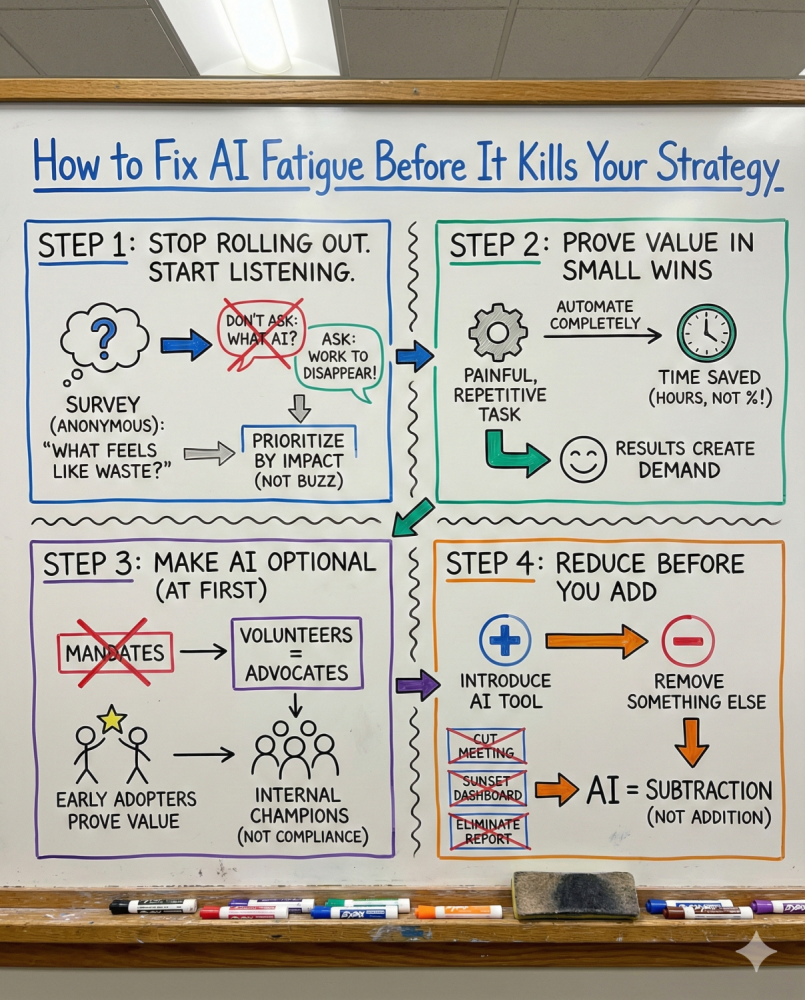
How to Fix AI Fatigue Before It Kills Your Strategy
The Bottom Line
AI fatigue isn’t a people problem. It’s a leadership execution problem.
Your team wants relief. You’re giving them another initiative. Your team wants proof. You’re giving them another login. Your team wants less work. You’re giving them more tools.
See where this is going?
The companies that win in 2026 won’t be the ones with the most AI. They’ll be the ones whose teams actually feel the difference.
If your AI strategy doesn’t start with: “What will this remove from my team’s plate?” Then you’re not building leverage. You’re building fatigue.
Guy Pistone, CEO @ Valere