TL;DR
- The expensive pattern: $150K pilots become $840K failures because companies measure adoption instead of impact. 30% of GenAI projects get abandoned after POC (Gartner).
- The three failures everyone’s STILL buying: AI chatbots (bad data kills them), generative AI for “everything” (noise without use cases), predictive dashboards (can’t fix broken infrastructure).
- What actually works: Problem-first, not tech-first. AI-augmented teams (not replacement), 2-3 specific workflows (not broad access), clean data foundations (not fancy predictions).
- The 6-month test: If you can’t show measurable ROI in 6 months with specific KPIs, you’re building theater, not tools.
Most AI spending in mid-market companies is just “expensive theater.” I’m basing this on three sources:
- Direct consulting work with PE portfolio companies over 18 months.
- Conversations with over two dozen operational leaders navigating AI implementations.
- Publicly available research from companies willing to share their data.
The pattern I see is expensive, and nobody’s talking about it openly, even though almost all follow suit.
Vendors pitch $150K pilots with promises of transformation. CTOs get excited about the possibilities. Boards approve the spend. Everyone moves forward with optimism. Eighteen months later, and they’re significantly over budget.
Nothing makes it to production. Everyone quietly moves on to the next initiative…
Keep reading if you’re DONE wasting AI funds. 👇
Research Says…
Gartner predicts that at least 30% of generative AI projects will be abandoned after PoC (proof of concept) by the end of 2025, due to poor data quality, inadequate risk controls, escalating costs, or unclear business value.
The failure rate for mid-market companies, those without dedicated AI teams and mature data infrastructure, is even higher…
I’m not claiming statistical significance across the entire market. But I am noticing a pattern that I’m seeing repeatedly in mid-market environments.
What do you think? I’ll be on the lookout for your opinion in the comments.
The Three AI “Solutions” That Keep Failing
1. Are they AI Chatbots for Customer Service or just an Automation Mirage?
- The pitch: Replace your support team completely with a 24/7 automated service. Cut headcount. Improve response times.
- What actually happens: Most implementations fail due to poor training data and user frustration.
53% of customers have said they were frustrated when interacting with a chatbot, and the problem gets worse when bots can’t handle anything beyond scripted scenarios. The user frustration problem compounds. When the bot fails to solve problems (which happens often in the first 6-12 months), customers get angrier than if they’d just reached a human immediately.
What works: AI-augmented team support.
Examples: Smart routing analyzes incoming tickets and sends them to the right specialist. Sentiment analysis flags frustrated customers for priority handling. AI suggests responses to agents, who can edit and personalize them.
Measurable ROI will reduce handle time and improve customer satisfaction. Not headcount reduction.
2. Generative AI for “Everything” is NOT A Strategy.
- The pitch: ChatGPT will revolutionize all your operations overnight. Give every employee access and watch productivity soar.
- What actually happens: Without clear use cases, organizational impact is minimal.
Employees log in, experiment for a week, then return to old workflows. Some create inconsistent content requiring heavy editing. Others feed sensitive data into external models, creating security risks.
What works: Identify 2-3 specific, high-friction workflows first.
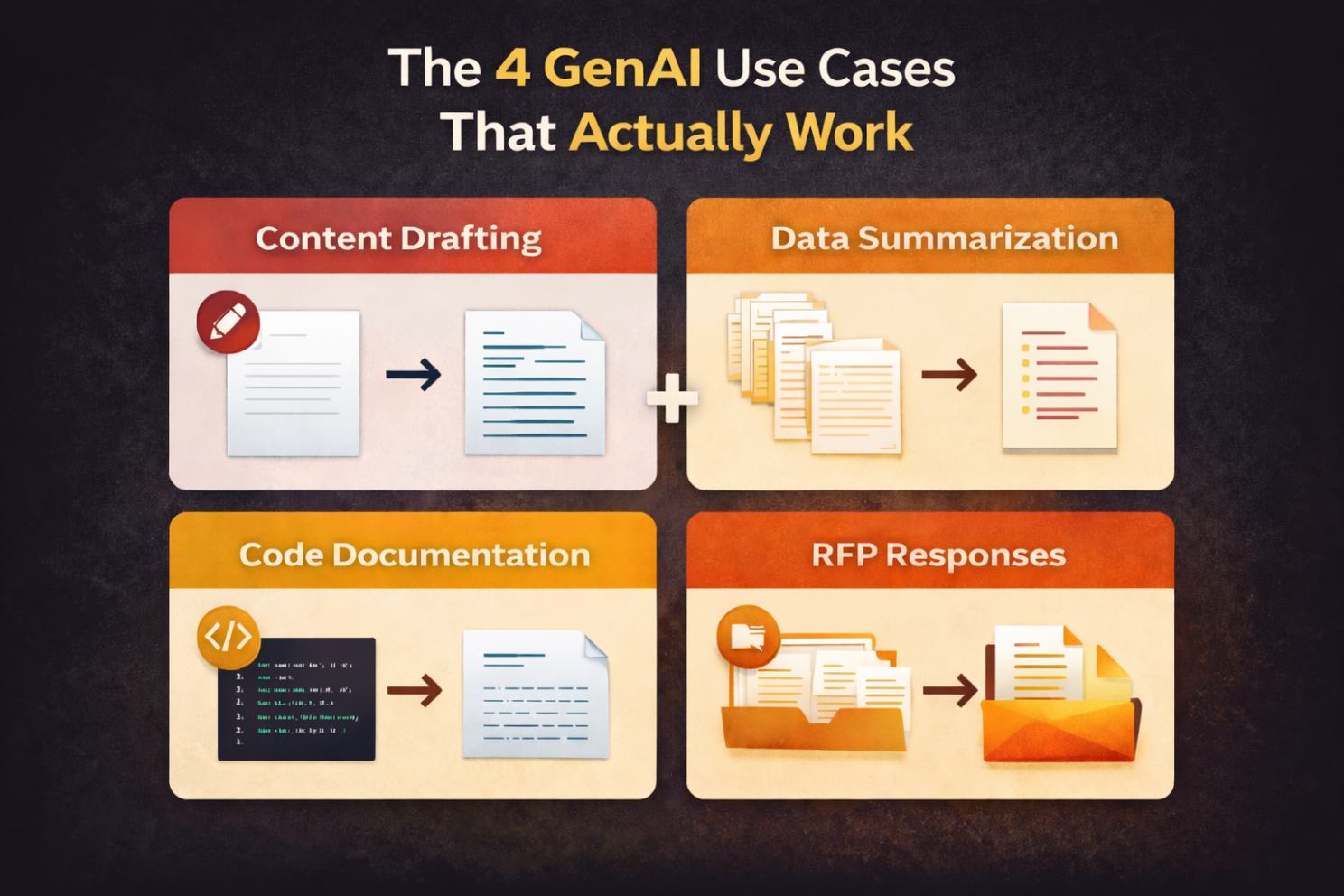
Focus on reducing the time spent on tasks people already perform, rather than inventing new use cases that sound impressive but don’t exist in current workflows.
3. Predictive Analytics Dashboards Are A Data Infrastructure Problem
- The pitch: See the future of your business. Accurate forecasts instantly. Better decisions with AI-powered insights.
- What actually happens: Garbage in, garbage out.
Your data lives in six different systems. Customer records are duplicated. Sales data is manually entered with inconsistent conventions. Financial data doesn’t reconcile properly across departments.
70% of AI project time is spent preparing data (Scalefocus). Summarizing, no amount of AI can fix a broken data infrastructure.
What works: Build clean data foundations first. Before you buy any predictive analytics tool, invest in:
- Data governance: Clear ownership and standards
- Data quality: Cleaning, deduplicating, and standardizing
- Data integration: Making systems actually communicate properly
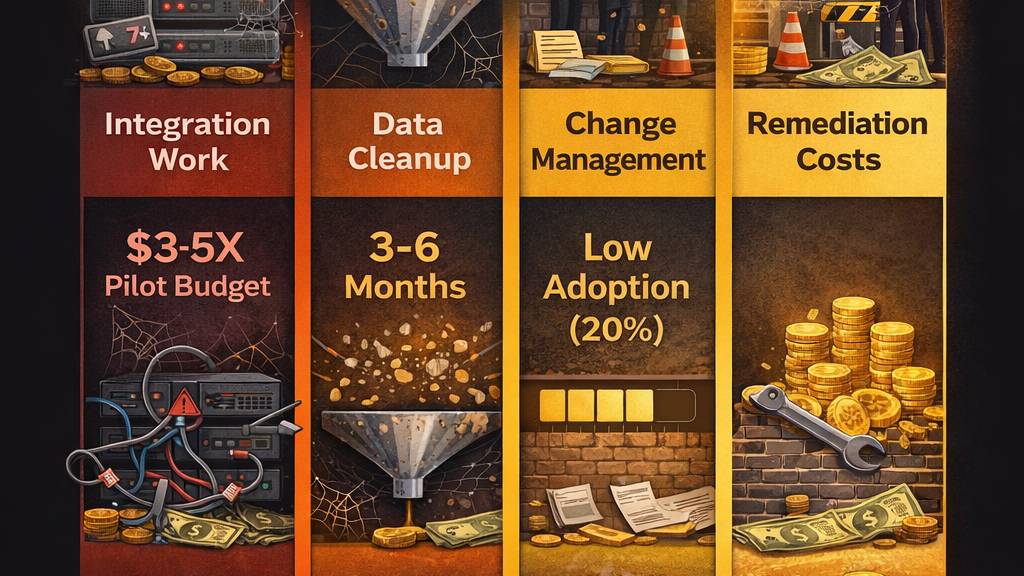
Costs Nobody Talks About
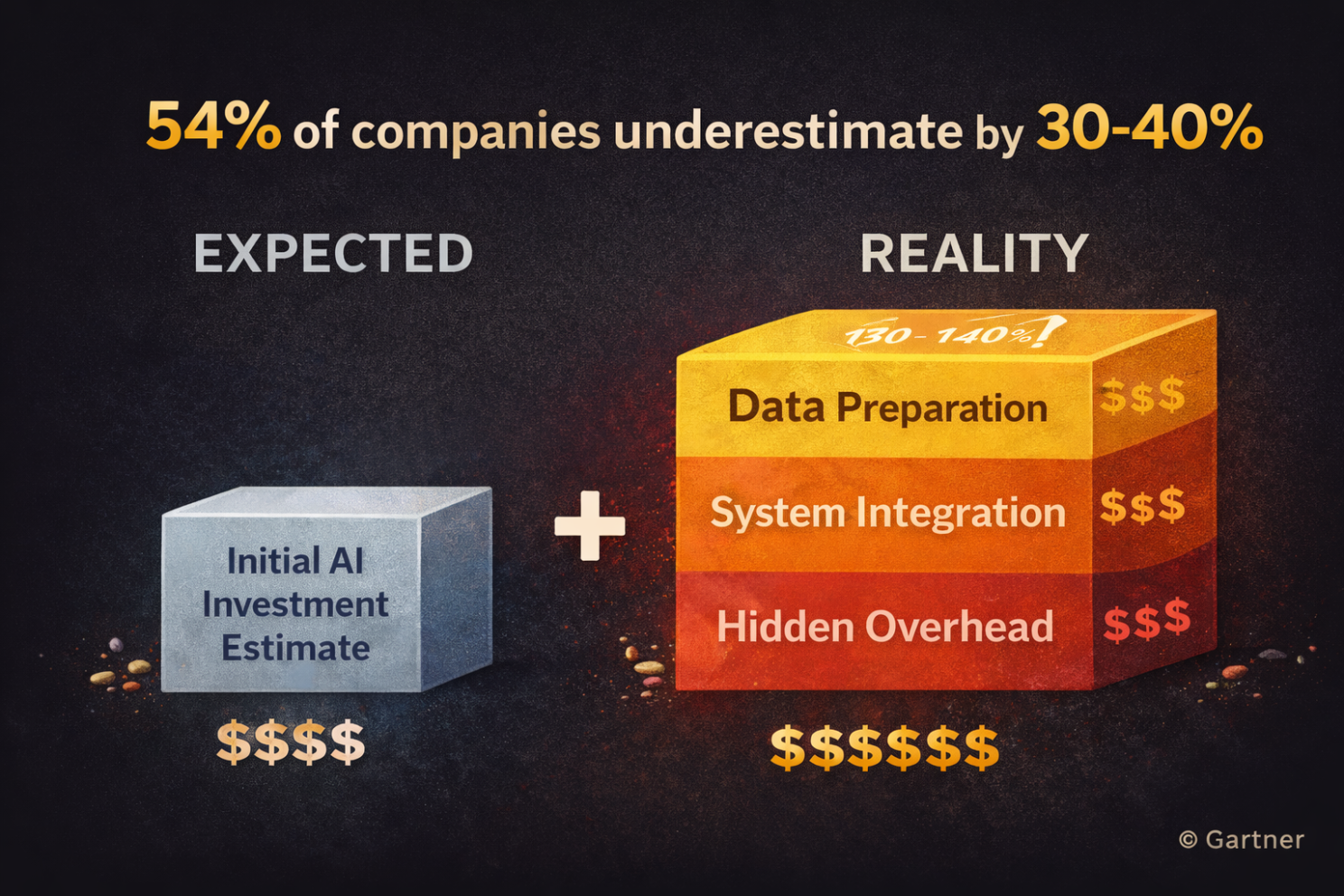
Deloitte‘s research provides realistic expectations for AI ROI timelines, indicating that most organizations need at least a year to overcome adoption challenges, including governance, training, talent development, and data preparation. The software license is usually the smallest expense. What actually adds up:
Here’s What Winning Operators Do
1. They skip the hype and focus on specific, measurable outcomes.
Not “improve productivity.” Instead: “Reduce average ticket resolution time from 4.2 hours to under 2 hours.” Not “enhance decision-making.” Instead: “Cut forecasting error rate from 18% to under 8%.“
2. They think in 6-month timelines, not 18-month science projects.
If you can’t show measurable value within six months, you’re building something too complex or too disconnected from real operational needs.
3. They treat AI as a tool to solve existing problems, not as the problem to solve.
Start with the problem: “Our customer support team is overwhelmed and response times are suffering.” Then ask: “Could AI help solve this specific problem?” Not: “We need an AI strategy. What should we do with it?”
Your Final 2025 Question
“What specific operational problem are we trying to solve, and is AI the right tool for it?”
If you can’t answer that question clearly (clear enough that you could measure success or failure in six months), you’re not ready to buy AI solutions.
Stop buying AI to check a box.
Start buying it to solve specific problems with measurable ROI.
Guy Pistone, CEO, Valere | Building AI measurement that PE owners actually trust
P.S. If you’re a VP of Ops or CAIO at a PE-backed PortCo and your PE owners are asking “where’s the AI ROI?” but you don’t have a framework to answer, let’s talk. I’m offering operators at PE-backed companies a quick diagnostic on whether your AI initiatives can be measured credibly for PE exit value. https://bit.ly/AIStrategy2026
Sources:
- Gartner. “Gartner Predicts 30% of Generative AI Projects Will Be Abandoned After Proof of Concept By End of 2025.” July 29, 2024. https://www.gartner.com/en/newsroom/press-releases/2024-07-29-gartner-predicts-30-percent-of-generative-ai-projects-will-be-abandoned-after-proof-of-concept-by-end-of-2025
- Callin. “Cost of Implementing AI in 2025.” March 14, 2025. https://callin.io/cost-of-implementing-ai
- Vladimir Siedykh. “AI Business Implementation Guide: McKinsey Research & Success Patterns 2025.” August 20, 2025. https://vladimirsiedykh.com/blog/ai-business-implementation-guide-mckinsey-research-success-patterns-2025
- DemandSage. “Latest Chatbot Statistics 2025 (Market Share & Trends).” December 2024. https://www.demandsage.com/chatbot-statistics
- Missive. “66 Most Significant Customer Service Statistics in 2024.” 2024. https://missiveapp.com/blog/customer-service-statistics
- AgentiveAIQ. “AI Implementation Cost Breakdown: Hidden Expenses Revealed.” August 28, 2025. https://agentiveaiq.com/blog/how-much-does-ai-implementation-really-cost