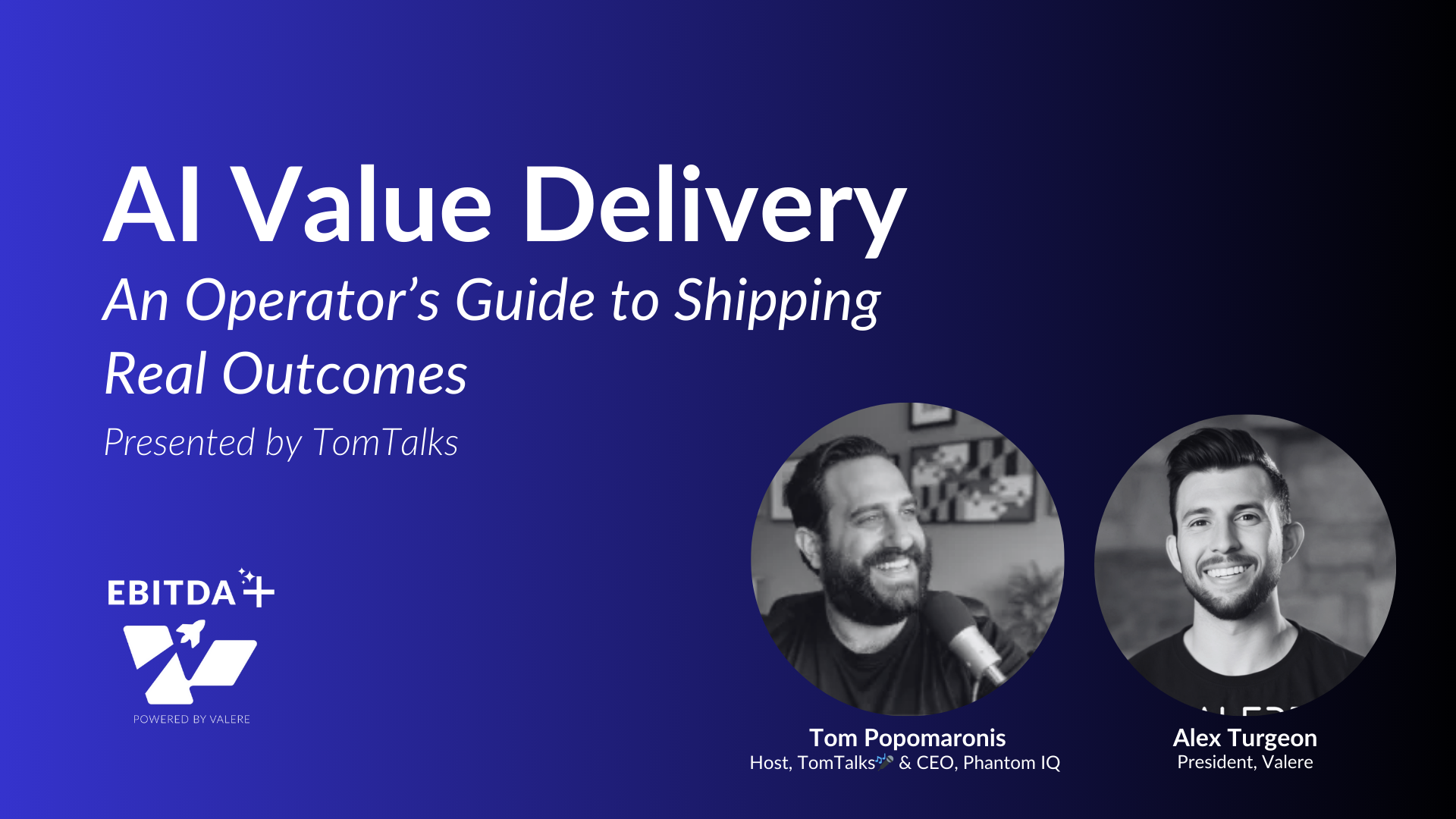
The following is an Executive Q&A that originally aired on Tom Popomaronis’ excellent newsletter TomTalks 🎤. You can check it out on LinkedIn, and view Tom Popomaronis’ Trusted AI Agencies exclusively on Clutch.
Tom Popomaronis: Executives shouldn’t have to spend weeks vetting AI agencies. Thanks to my partnership with Clutch, I can now spotlight agencies that deliver tangible results — providers I personally trust.
Most AI conversations still revolve around models, tooling, and what’s “coming next.” Alexander Turgeon has a different lens — and it’s the lens of someone who has to make AI work inside real organizations with real constraints.
Alex is President of Valere, an award-winning AI-native and custom software development company that transforms mid-market and enterprise companies into AI-first organizations through building, learning, and scaling. As an expert-vetted, top 1% agency on Upwork, Clutch, G2, and Amazon Web Services (AWS), Valere serves as an embedded AI/ML strategic partner for PE firms and their portfolio companies, delivering vertically integrated solutions throughout the investment lifecycle—from AI assessments and strategic planning to employee upskilling and technical execution. Unlike strategy consultants who won’t execute or implementation partners without strategic perspective, Alex and Valere owns the complete journey from assessment through deployment, driving measurable operational control, cost reduction, and efficiency gains. Before Valere, Alex led work at Booz Allen Hamilton, including UX and product leadership for large-scale digital systems like USPS.com. That combination—consulting rigor, product leadership, and delivery execution—is what helps Valere’s partners join the successful 5% that get AI right the first time, and shapes his point of view today.
In this TomTalks🎤 Q&A, Alex breaks down why AI projects rarely fail because the technology isn’t good enough. They fail because incentives are misaligned, business processes are broken, teams aren’t enabled, and the last mile of UX and adoption gets ignored. We also dive into what changes when you’re no longer designing software just for humans — but for agents and humans together — and why tribal knowledge capture is becoming the foundation for AI that delivers measurable ROI.
Hybrid delivery is notorious for quality issues — not because teams aren’t smart, but because coordination breaks down across time zones, languages, and expectations. What does Valere do differently to make hybrid delivery feel “tight” and high-trust?
Here’s the truth: most firms use “hybrid” as a euphemism for cheap, disconnected labor. And honestly, we get why so many companies steer away from it entirely; hybrid delivery is genuinely hard.
The breakdown typically happens in one of two places. You either get a great strategy with no code, or you get code with no strategic context. There’s this persistent gap between consulting rigor and delivery execution that kills most hybrid engagements. The strategists live in one world, the builders live in another, and the client gets caught in the middle trying to translate between them.
Before Valere, we lived this problem firsthand. We spent years building and scaling digital solutions and our own consumer app startups with nearshore and offshore teams, and we experienced what many others do when you don’t have a truly unified team—gaps in communication, misalignment on priorities, and execution that feels perpetually one step behind. When we built Valere Global’s workforce (including investing in physical offices) across six countries (USA, India, Croatia, Peru, Uruguay, and Argentina), those painful lessons became our playbook for what not to do.
What we’ve learned is that treating distributed teams as a globally integrated unit changes everything. We don’t just “hand off” tickets at 5 PM and hope for the best. The key is shortening feedback loops and building accountability into the sprint itself, not after the fact. That means continuous process optimization, a unified culture that transcends geography, and rigorous hiring standards that prioritize alignment over time zone arbitrage.
From our partners’ perspective, Valere acts as a vertically integrated AI solution provider. We don’t operate as separate “strategy” and “delivery” teams. We’re partners’ AI SWAT team that owns the outcome end-to-end. We close what we call the “Implementation Gap” by having a unified leadership layer that understands both the business objectives and the architecture diagram. When you’re the partner that both strategizes and ships, you eliminate the friction that usually exists between “the thinkers” and “the builders.”
Hybrid is hard, no question. But when it’s done right, it gives you global delivery zones, the ability to punch above your weight class, and enterprise quality at mid-market economics. That’s the distinct value we bring, and it’s why we don’t run from the complexity; we run toward it.
Most companies feel stuck between two extremes: large consultancies that are expensive and slow, and low-code tools that aren’t flexible enough for real transformation. Where does Valere fit in that middle zone — and what’s the moment a company realizes it needs that kind of partner?
The moment usually comes after they’ve already tried one of the extremes and gotten burned. Maybe they brought in a Big 5 firm that spent six months on discovery and handed them a beautiful deck with no actual implementation. Or they bought an off-the-shelf AI tool that promised to revolutionize their operations but couldn’t handle the messy reality of how their business actually works.
What we’ve seen is that AI transformation fails for two core reasons, and neither has much to do with the technology itself.
First is incentive misalignment. If a manager is incentivized to “use AI” without a clear purpose or alignment with business objectives, nothing is actually accomplished. Vice versa, if a manager is incentivized to maintain headcount, they will quietly sabotage an AI tool that increases efficiency. It’s not malicious, it’s just rational behavior when the incentive structure is broken. Leadership assumes everyone wants to work smarter, but the org chart tells a different story.
Second is lack of enablement. Leadership buys the tool but doesn’t actually enable the team to use it. The pilot gets treated as an experiment instead of a fundamental shift in how the business generates ROI. So it sits there, underutilized, and six months later someone says AI doesn’t work for them.
The market options reinforce this stuck feeling. Companies are understandably hesitant to pay large consulting fees, but they’re also finding limited impact from generic SaaS and off-the-shelf educational courses. Custom development is too expensive for most mid-market organizations. Off-the-shelf AI lacks the flexibility and customization needed for real transformation. And employee training courses don’t fit the specific workflows, data sources, or business rules that make each company unique. Meanwhile, most mid-market companies don’t have AI implementation teams sitting around ready to execute. So they fail to see meaningful ROI, and the cycle continues.
This is where Valere fits. We’ve built a hybrid AI consultancy focused specifically on mid-market organizations, and we’ve found our market fit by delivering faster, more cost-effective, and frankly more pragmatic results than Big 5 consulting while providing significantly greater value than off-the-shelf SaaS.
Our approach is built on customized services on top of AI platforms. We solve for the unique characteristics of each business: their tooling, their data sources, their workflows, their budgets, their rules, their AI employee readiness. This isn’t about forcing a square peg into a round hole. It’s about understanding what you’re actually trying to accomplish and building the solution that gets you there.
Two things differentiate our model. First, our education-first approach through Valere Learning closes the AI readiness gap in a way that most consulting groups don’t even attempt. We’re not just handing you a tool and walking away. Second, Conducto, our AI orchestration platform, is designed for long user tenures because we’re deeply integrated into client systems. We build on top of a product framework with custom services to get clients the last mile, enabling real scale from pilot to production.
The hybrid products and services model wins because it provides the same custom engineering value to the end client with the benefit of cost reduction. We use a blend of products and custom services to help mid-market companies develop AI solutions and upskill their employees’ AI abilities. That’s the middle zone. That’s where the real work happens, and it’s where companies finally find a partner who can bridge the gap between what AI can do and what their business actually needs it to do.
You believe AI transformation is rarely a pure technology problem. It’s usually a business process problem. What’s the most common process failure you see that quietly kills AI initiatives before they scale?
The biggest killer is trying to automate a broken process. If your manual process is a mess, AI will just make it a faster, more expensive mess. We see this constantly: organizations try to layer a chatbot on top of fragmented data and misaligned incentives, then wonder why adoption tanks and ROI never materializes.
There’s a Jurassic Park problem at play here. Companies get so excited about what they could do with AI that they don’t stop to think if they should. They’re asking what technology to use instead of asking why they’re using it in the first place.
The companies building meaningful agentic systems understand a critical distinction: they’re redesigning from scratch, not retrofitting. They’re rethinking what the process should be when AI agents are the primary actors. This requires moving from human-centric interfaces to machine-legible software. If you remove the human from the loop, you don’t need a review step or a dashboard—you need a governance layer and an API. Most companies haven’t made that mental shift yet.
Successful implementations also invest in capturing proprietary knowledge. Shallow implementations rely on public LLMs that give everyone the same generic capabilities. Meaningful systems capture and scale the institutional knowledge locked in their people’s heads and turn it into reusable intelligence that creates actual competitive advantage.
There’s also a leadership component. The traditional generalist operating partner model is breaking because you cannot govern what you do not understand. Companies building real agentic systems have AI Operating Partners: hybrid executives who can read both a P&L and an architecture diagram, bridging the gap between data scientists and business teams.
This is why 95% of our engagements start with an assessment. We identify high-ROI opportunities before any implementation commitment, often telling clients that the highest-leverage move isn’t a custom AI tool at all—it’s redesigning the workflow entirely to take advantage of what technology can now do autonomously.
The mindset shift is this: we’re solving business problems, not technology problems. You have to fix the foundation before you put the AI roof on. Until organizations internalize that distinction, their AI initiatives will keep stalling out before they ever reach scale.
A strong product leader doesn’t default to building. Sometimes the highest-leverage move is buying, deferring, or redesigning the process entirely. What’s a real example where the best outcome came from not building a custom solution?
I’ve learned that each challenge requires its own optimal solution, whether that’s fully custom development, off-the-shelf tools, or a hybrid of both. Most people see this as binary, but reality is far more nuanced.
A good software team operates like a good manager: do, delete, and delegate for managers; build, buy or integrate, or defer for developers. The most optimal route is usually a blend.
Here’s a concrete example: we recently worked with a client who came to us wanting a custom contract review platform. They assumed they needed something built from scratch because their contracts were complex and industry-specific. During assessment, we discovered the real problem wasn’t contract review itself but the handoff between legal review and deal execution.
The best outcome came from integrating existing contract intelligence APIs with their CRM and building a lightweight custom layer just for the handoff orchestration. They got 70% of the functionality from off-the-shelf tools at a fraction of the time and cost, then we built only the 20-30% that was unique to their business process.
They avoided six months of custom development and got to production in six weeks instead. More importantly, they could actually maintain and iterate on it without needing a dedicated engineering team.
The key is recognizing when you’re solving a business problem versus when you need proprietary intelligence. If the challenge requires capturing tribal knowledge that creates a defensible moat, build custom. If existing tools can address the business process problem, integrate them and defer custom work until the ROI clearly justifies it.
This pragmatic approach requires the ability to both assess strategically and implement tactically. You need to bridge strategy consulting that won’t execute with implementation partners who lack strategic perspective. The transparency matters: recommend custom development only when it creates a defensible advantage. Recommend existing tools when they solve most of the problem.
This isn’t about overselling development work. It’s about demonstrating sound business judgment by recognizing that sometimes the best outcome comes from not building at all.
Many AI projects look strong at 80–90%… then stall in the final stretch. What does that “last mile” actually consist of — and why is it where trust and adoption most often break?
The last mile is where projects transition from pilot to production, and it’s consistently the hardest part. The 80/20 principle applies here: you can hit 80% accuracy with 20% of the effort, but that final 20% demands the remaining 80%. Those last percentage points in accuracy, reliability, and consistency are incrementally harder to achieve.
What catches people off guard is that technical performance is only half the battle. User adoption matters just as much. A product is only valuable if people actually use it and realize that value. We’ve seen this repeatedly. You can have a technically sound solution, but if users don’t trust it or find it useful, it won’t succeed. In the last mile, you’re not just debugging code. You’re building trust.
When AI makes a mistake in a high-stakes environment without proper failsafes, users often won’t touch it again, even if they’re required to. Trust breaks quickly when a system feels opaque or unpredictable. This is where proprietary knowledge becomes critical. Public LLMs are generic. The real competitive advantage sits in the expertise locked in your team’s heads. When you capture that organizational knowledge and turn it into something reusable, AI becomes an extension of your best experts rather than just another tool someone dropped into your workflow.
Our work with Onyx showed exactly what this looks like in practice. Their initial solution functioned on Zapier, but enterprise buyers wouldn’t consider it. The issues weren’t obvious in demos but were fatal in production: inconsistent response quality, variable confidence levels, unpredictable conversational tone, and edge cases that kept surfacing. What made the difference was honest assessment of the complexity involved and willingness to iterate beyond the initial scope until we had production-quality outputs.
We’ve learned that getting through the last mile requires realistic expectations about AI development timelines paired with commitment to quality over feature count. The iterative refinement cycles, LLM fine-tuning, and response validation weren’t extras. They were the difference between a platform enterprises would trust and one they’d dismiss. Onyx needed a team that would treat their success metrics seriously, with leadership engaged throughout rather than delegating after signing.
The last mile isn’t just where projects stall. It’s where you discover whether you’re working with people committed to getting it right or just checking boxes on a deliverable list.
You have a UX/UI background, and you’ve seen the same pattern repeatedly: even a great AI product fails if users aren’t enabled to use it well. What does “enablement” actually mean in practice — and how do you diagnose readiness before the build starts?
Enablement starts way before you write any code. In my experience, most organizations jump straight to implementation without understanding what they actually need. True enablement means diagnosing readiness by identifying what I call the implementation gap: strategy consultants give you beautiful decks but won’t execute, and implementation partners can build things but lack the strategic perspective to know what to build.
Before building anything, you need to understand the business problem you’re solving. Most AI initiatives are actually addressing business process problems, not technology problems. The focus has to be on the business outcome, not the technology itself.
The biggest failure I see is companies trying to retrofit AI into processes that were designed for humans back in the 1990s. Real enablement means preparing the organization to redesign systems from first principles rather than just automating steps in a manual process. This requires a fundamental shift in thinking: moving from human-centric interfaces to machine-legible software.
Here’s a practical example of what readiness looks like: if you remove the human from the loop, you don’t need a review step or a dashboard anymore. You need a governance layer and an API. Leadership that understands this distinction is ready for agentic AI. Leadership that wants to add AI features to their existing dashboard probably isn’t.
Another critical piece is capturing tribal knowledge before you start building. Public LLMs can’t capture your institutional expertise. The readiness assessment identifies which expertise is locked in people’s heads and whether the organization is prepared to turn that into scalable, reusable intelligence.
You diagnose readiness by looking for high-ROI opportunities while simultaneously evaluating whether the organization is prepared to fundamentally redesign processes, not just add AI features to existing workflows.
AI is changing what “user experience” even means. You’re no longer designing software just for humans — you’re designing workflows where agents are acting alongside people. What changes when the “user” isn’t always a person?
We’re seeing a fundamental shift from SaaS to what’s emerging as Agents as a Service. When the user is an agent, UX isn’t about dashboards, forms, and buttons anymore. It’s about APIs, permissions, clear instructions, and oversight loops. Traditional CRUD interfaces are collapsing as AI agents absorb business logic and execute workflows across multiple systems dynamically.
The human experience shifts to a manager role. Instead of navigating through siloed applications, people interact through conversational interfaces where agents understand context and act on their own. Rather than doing the task yourself, you’re reviewing what the agent did, approving it, tweaking it, delegating the next step. This requires interfaces that surface exceptions and risks rather than standard outputs.
In our work, we’ve found this eliminates application silos entirely. Solutions need to be machine-legible so agents can operate seamlessly, while the human interface gets reserved for high-level decisions and handling exceptions. The system adapts to how people actually work rather than forcing them into predefined software workflows. Agents learn to anticipate needs, execute proactively, and orchestrate across business functions without traditional navigation.
The people who succeed in this environment are those who can effectively provide governance while agents handle execution. This is how organizations move to higher-value work and fundamentally transform how they interact with software systems.
You’re building around a core belief that tribal knowledge is the missing fuel for real AI outcomes. Where does institutional knowledge actually live inside most companies today — and why is it so hard to capture and structure?
Institutional knowledge lives in Slack messages, old emails, and most importantly, in the heads of your senior employees. It’s the unrecorded conversation where someone explains why you always handle that particular client differently. It’s the workaround that everyone knows but no one documented. It’s the context that makes the difference between a decent decision and the right decision.
The problem is that this knowledge is unstructured and often completely invisible to leadership. You can’t put it in a spreadsheet. You can’t find it in your CRM. It exists in fragments across a dozen systems and inside the institutional memory of people who have been around long enough to know how things actually work versus how the org chart says they should work.
This is why we believe tribal knowledge capture is the foundation for AI that actually delivers ROI. Public LLMs know everything about the internet, but they know nothing about your specific procurement contracts, your unique customer service philosophy, or why your finance team structured that particular workflow the way they did. Without that context, AI becomes a generic tool that gives you generic answers. It might sound impressive, but it doesn’t move the needle on what actually matters to your business.
At Valere, we recognize that AI falls short when it relies only on public data. The real opportunity is helping companies build proprietary intelligence by structuring that tribal knowledge. This is what transforms a company from being a tool adopter into an AI-First Organization that can scale its unique expertise through technology. Your competitive advantage isn’t in the AI model itself. It’s in teaching that model the things only your organization knows.
We built Dactic specifically to serve this need. Dactic delivers primary research at scale, using advanced AI and automation to capture and codify the proprietary institutional and tribal knowledge that public AI models simply cannot access. It transforms that scattered, unstructured data into a proprietary qualitative knowledge base and reusable intelligence.
This works for organizations across the spectrum, from startups trying to codify their early processes to large enterprises with decades of accumulated expertise. The result is enhanced operational efficiency and better strategic decision-making because your AI solutions are built on your unique internal reality, not generic best practices scraped from the internet.
Dactic serves as the foundation for system-level AI transformation. Without it, you’re building on sand. With it, you’re delivering tangible ROI and creating sustainable competitive advantage because your AI actually understands your business the way your best people do.
If you were giving a TED-style talk to mid-market leaders who know they need AI but don’t know where to start, what would your opening argument be?
I’d start with the harsh reality check: that more than 40% of agentic AI projects will be canceled by the end of 2027 due to escalating costs, unclear business value or inadequate risk controls (Source: Gartner). This isn’t because the technology isn’t ready, but because companies approach it backwards. They start with what to build instead of why they’re building it.
Before committing to any implementation, you need to identify high-ROI opportunities through assessment that ties business goals directly to AI solutions. The problem mid-market leaders face isn’t a lack of options. It’s that the current options are fundamentally broken.
Big consulting firms give you strategy decks but won’t execute, leaving you with an implementation gap. Off-the-shelf solutions are too generic and can’t capture your institutional knowledge. Traditional implementation partners lack the strategic perspective to solve actual business problems.
What’s needed is someone who can both assess and implement, bridging the gap between strategy and execution. But here’s the critical insight most leaders miss: you’re not solving technology problems. You’re solving business process problems, and your focus must be on business outcomes.
The biggest mistake is trying to retrofit AI into processes designed for humans in the 1990s. The companies winning in 2026 are redesigning systems from first principles rather than adding AI features to existing workflows.
You also can’t rely on public LLMs to create competitive advantage. They’re generic by nature. Your moat comes from capturing the tribal knowledge and expertise locked in your people’s heads and turning it into reusable, proprietary intelligence.
This requires a pragmatic philosophy: recognize that some challenges need fully custom development, others can leverage off-the-shelf solutions, and most benefit from a hybrid approach. Take existing tools that get you 60-70% of the way, then build the remaining 20-30% custom to address your unique business problems.
Finally, you need hybrid leadership. The AI Operating Partner who can read both a P&L and an architecture diagram. You cannot govern what you do not understand. Success requires leadership that bridges data scientists and business teams.
Start with assessment. Prioritize the why over the what. And find partners who can navigate corporate politics, redesign business processes, and build high-performing software all under one roof.