TL;DR
AI-personalized education could be one of the most meaningful applications of this technology. It could also follow the same pattern as every democratizing technology before it, benefiting the already-advantaged first, and leaving the gap wider than it found it. The difference comes down to a set of structural decisions that the market, left alone, will not make correctly.
The Promise Is Real
Every classroom has the same structural problem. One teacher, twenty kids, and a curriculum paced for the middle of the room. The kid who is two grade levels ahead spends a lot of time waiting. The kid who is two grades behind spends a lot of time lost. Both get the same lesson anyway.
That is a system design failure, and it has persisted for over a century because there was no practical alternative. You cannot run thirty simultaneous individualized lesson plans with one person in the room.
AI changes that constraint in a way nothing has before. A system that can adjust reading complexity in real time, frame a math concept around whatever a student is actually interested in, and identify where a specific child is struggling without waiting for a quarterly assessment. That is a different kind of tool. Structurally different.
The most credible independent evidence comes from a 2020 meta-analysis in the Review of Educational Research, which examined intelligent tutoring systems across a wide range of studies and found effect sizes roughly equivalent to one-on-one human tutoring in controlled settings. That is a meaningful benchmark. Controlled settings rarely survive contact with real-world deployment conditions. Vendor-funded research tends to paint a more optimistic picture. For instance, Carnegie Learning’s own 2022 efficacy study reports that students using its MATHia platform outperform control groups by roughly 30% on standardized algebra assessments, a number worth knowing and worth reading with the awareness that the research was commissioned and published by Carnegie Learning itself. Both data points belong in the conversation, but it’s not to say that they should carry equal weight.
The case for the technology is real. The evidence base just needs to be read with some care about who funded what.
The Catch Nobody Wants to Talk About
Every technology that has promised to democratize access (smartphones, broadband, edtech platforms) has followed the same adoption curve. And one-size-fits-all does not create a strong adoption strategy. The people who benefit first and most are the ones who already had the most. The gap does not close immediately. It often widens before it narrows.
AI tutoring is not exempt from this pattern. A student in a well-funded suburban district gets an AI tutor that adjusts to their pace, surfaces content aligned with their interests, and flags gaps to a teacher who has time to act on the information. A student in an underfunded rural or urban district may not have reliable broadband at home, may attend a school that cannot afford the licensing fees, or may have a teacher so stretched thin that the AI-generated insights never translate into changed instruction.
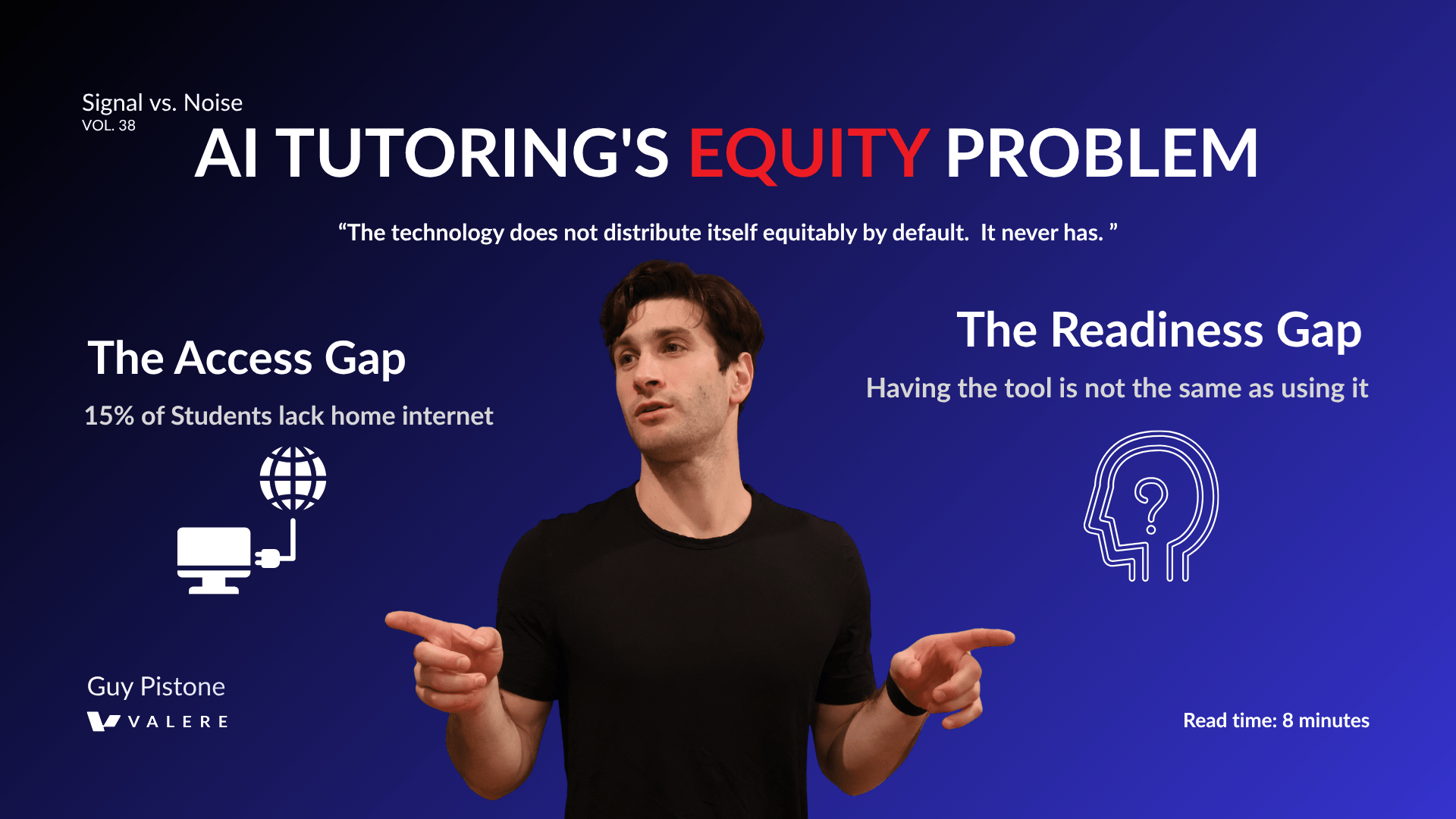
According to 2025‑era data, roughly 15% of U.S. children (tens of millions of students) still lack reliable home broadband, with the gap concentrated disproportionately in low‑income, rural, and Tribal communities. Personalized AI education delivered through a device that requires a stable connection is, for those students, not a tool at all. That’s our story: millions left in the margins, now imagine less fortunate areas around the globe.
A 2021 RAND Corporation study on edtech adoption found that schools serving low-income students were significantly less likely to have the infrastructure and professional development resources needed to implement adaptive learning tools effectively, even when the tools themselves were provided at low or no cost.
But how do we fix it?
The Readiness Gap Is the Harder Problem
Keep in mind, this is an issue close to my heart. I have two kids on their educational journey, and my dad was a History & Government teacher for +20 years. Which is why this is a problem we’re tackling head-on through Valere Learning.
There is a concept worth naming here called the readiness gap. It is the distance between having access to an AI tool and being able to use it effectively. It shows up everywhere AI is deployed, not just in education, and it is almost always the harder problem than the access problem.
An AI system can identify that a student is struggling with fractions. If that insight never reaches a teacher who has the time and training to do something different with it, the feedback loop does not close. The tool runs. The gap persists. The school reports that it deployed an AI tutoring platform, which is technically accurate and practically meaningless.
The same dynamic plays out in organizations trying to adopt AI. Working with companies on AI implementation, the failure mode is consistent: it is rarely the model. It is teams that have not been trained to interpret what the system is telling them, or workflows that have no mechanism for acting on the output. The insight gets generated and goes nowhere.
What this means for K-12 is that the schools with the most to gain from adaptive learning technology are often the least positioned to close that loop. Fewer teachers per student, less planning time built into the schedule, less administrative bandwidth to track what the system is surfacing and route it to the right person. The tool works the same in both schools. The conditions for it to matter are completely different.
What Closing the Gap Actually Requires
The optimistic version of this story is not wrong. It just requires more than deploying a good model. Connectivity has to be treated as infrastructure, not a nice-to-have. The FCC’s E-Rate program has expanded broadband access for schools and libraries significantly over the past decade, but home connectivity remains an unresolved problem for millions of students. As of early 2026, districts report 1 in 5 low-income families (20%) still lack reliable home broadband.
AI tutoring tools that work offline or are designed for low-bandwidth environments exist, but are not the default. That is a product decision the market is not currently making on its own.
Teacher training matters as much as the technology itself. The most effective deployments of adaptive learning platforms are in classrooms where teachers understand what the system is measuring, how to interpret the signals, and what to do differently based on what they see. That requires sustained, contextual professional development, not a one-day onboarding. Schools that cannot fund that investment will capture a fraction of the tool’s potential value.
Procurement decisions need to account for equity explicitly. If school districts are choosing AI education tools based primarily on price and feature lists without requiring evidence of efficacy across different student populations, they are likely selecting tools optimized for the students who need them least. The Department of Education’s Office of Educational Technology published guidance in 2023 calling for equity-centered evaluation frameworks in exactly this kind of decision. Whether districts actually use it is a different question.
The Part to Think About
Being excited about what AI can do for education and being honest about the ways it could go wrong are not contradictory positions. They are both necessary ones.
The one-size-fits-all classroom is a real problem. A third grader interested in horses who gets a math lesson framed around horses is more engaged, more likely to retain the concept, and more likely to stay curious. A student at an advanced reading level who is bored and a student at a beginner level who is lost are both underserved by the same instruction. These are not small things.
But the technology does not distribute itself equitably by default. It never has, nor will. The question worth paying attention to is not just whether AI can personalize education (it clearly can) but whether the conditions exist for that personalization to reach the students who would benefit most. That answer depends on decisions happening right now in school boards, state legislatures, and product teams, most of which are not paying enough attention to the readiness layer underneath the tool.
We see this same readiness gap in organizations every day. The companies that get the most out of AI are not necessarily the ones with the most sophisticated models. They are the ones who invested in helping their people understand what the tools are doing and what to do with what they surface. That lesson applies just as much in a third-grade classroom as it does in a mid-market operations team.
The promise is real. So is the gap. And both deserve to be taken seriously.
Frequently Asked Questions
What AI tutoring tools are currently being used in K-12 schools at scale? The most widely deployed platforms as of 2024 include Carnegie Learning’s MATHia, which is used in over 3,000 schools and focuses primarily on middle and high school math. Khan Academy’s Khanmigo, built on GPT-4, is available to US teachers and students at no cost through a partnership with OpenAI. DreamBox Learning, now part of Discovery Education, covers K-8 math and claims over 5 million active students. Synthesis, originally built for SpaceX employees’ children, has expanded broadly and focuses on problem-solving and reasoning rather than direct curriculum alignment. Most of these tools are strongest in math, where adaptive assessment is more tractable than in reading or writing.
How much does AI tutoring software typically cost per student? Pricing varies significantly by platform and procurement model. District-level licensing for platforms like MATHia and DreamBox typically runs between $15 and $30 per student per year at scale, though negotiated rates for large districts can be lower. Khan Academy’s Khanmigo is currently free for US educators and students, subsidized through philanthropy and its OpenAI partnership. Consumer-facing AI tutoring tools like Synthesis run closer to $20 to $35 per month per student when purchased by families directly. For context, the national average per-pupil expenditure in K-12 public schools was approximately $14,800 in 2022, according to the National Center for Education Statistics, meaning even the pricier platforms represent a small fraction of per-student spend, the barrier is rarely the license cost itself.
What states have passed legislation or policy specifically addressing AI in K-12 education? As of early 2025, state-level AI education policy is fragmented and moving quickly. California passed AB 2876 in 2024, requiring the state board of education to develop AI literacy guidelines and incorporate them into curriculum frameworks. Virginia and North Carolina have both released state-level guidance documents on responsible AI use in schools, though neither has codified them into law. Several states, including Texas and Florida, have addressed AI primarily through the lens of academic dishonesty policy rather than adoption or equity frameworks. At the federal level, the Department of Education’s 2023 report on AI remains guidance rather than regulation. The overall picture is a patchwork, with most meaningful policy happening at the district level rather than through state or federal mandates.
How are school districts actually deciding which AI tools to adopt? Most district procurement decisions for edtech tools, including AI platforms, still run through traditional RFP processes that prioritize cost, curriculum alignment, and vendor references over equity or efficacy evidence. A 2023 survey by RAND found that fewer than a third of districts reported using structured efficacy evidence as a primary factor in edtech adoption decisions. Pilot programs followed by district-wide rollout remain the most common pathway, which tends to favor tools that perform well in controlled, well-resourced pilot environments. The CoSN (Consortium for School Networking) and ISTE have both published frameworks for AI tool evaluation that incorporate equity criteria, but adoption of those frameworks by procurement offices is inconsistent.
What does the research say about teacher training requirements for adaptive learning tools to be effective? A 2022 study published in Computers and Education found that teachers who received more than 10 hours of platform-specific professional development reported significantly higher rates of acting on student data surfaced by adaptive learning systems, compared to teachers who received standard onboarding of two hours or less. The effect was most pronounced in schools where teachers had dedicated data review time built into their schedules. RAND’s longitudinal research on edtech implementation consistently identifies teacher confidence in interpreting system outputs as a stronger predictor of student outcome improvement than the platform itself. The implication is that training investment is the mechanism through which the tool’s value actually reaches students.
Key Takeaways
- The structural problem is real. AI removes a constraint that has persisted in education for over a century. That matters.
- The efficacy data is promising but need careful reading. Vendor-funded studies and independent meta-analyses tell different stories. Both are worth knowing.
- The access gap is not hypothetical. 9 million US students lack adequate home internet. A tool that requires connectivity is not universal.
- The readiness gap is the harder problem. Schools and organizations that cannot close the feedback loop between AI insight and changed behavior capture little of the tool’s value.
- The market will not solve this on its own. The business incentives point toward well-resourced early adopters. Policy and procurement standards have to compensate.
- The pattern of democratizing technologies widening gaps before narrowing them is well-documented. AI tutoring is not exempt from it unless specific interventions are made.
The tools are ready. The question is whether we build the conditions for them to work where they’re needed most.
Guy Pistone | CEO, Valere | AWS Premier Tier Partner
Building meaningful things.
Resources & Sources
- Carnegie Learning — MATHia 2022 Efficacy Study
- Khan Academy — Khanmigo AI Tutor Overview
- National Education Association — 2023 Digital Equity Report
- RAND Corporation — 2021 Edtech Adoption Study
- Review of Educational Research — 2020 Meta-Analysis on Intelligent Tutoring Systems
- U.S. Department of Education — 2023 AI Guidance for Education
- FCC E-Rate Program — School & Library Broadband Access
- Valere Learning — AI Readiness & Workforce Education
- Sustaining Progress to Close the Digital Access Divide in K–12 Education