TL;DR
- The “Tourist Phase” is over. Your board is no longer impressed by chatbot pilots; they are demanding EBITDA expansion and OpEx cuts.
- 95% of AI pilots are failing to scale. The problem isn’t the vision; it is the “Data Reality Gap” between your strategy and your messy infrastructure.
- Stop building slide decks. In the current PE climate, presenting a strategy without a forensic audit is a roadmap to failure.
- The fix is a “Forensic Data Audit.” Instead of promising transformation, you must execute a “Kill List” of zombie projects and test your systems for machine legibility.
The “EBITDA Expansion” Mandate
It starts with an email from your Operating Partner. The subject line is vague, “Thoughts on 2026?,” but the attachment is specific. It’s a manifesto titled The 2026 AI Thesis, and it demands a shift from “Chatbot Experiments” to “EBITDA Expansion.”
The subtext is clear: The “tourist phase” of AI is over. Your owners expect you to stop playing with ChatGPT and start cutting OpEx. The natural reflex for a PortCo executive is to call a strategy consultant, pay $50k for a glossy 30-page deck promising “Agentic Transformation,” and present it at the next board meeting.
Do not do this.
In the current Private Equity climate, a strategy deck without an execution audit is a death sentence. Why? Because your owners are reading the same terrifying stats you are: 95% of AI pilots fail to scale. They fail not because the vision was small, but because the implementation gap swallowed them whole.
If you send a deck promising “transformation” while your data is still locked in on-prem SQL servers and PDF scans, you are handing your board a roadmap to failure. Instead of a deck, send them a Forensic Data Audit. Keep reading to see exactly how to do it.
Why Projects Die (The “Data Reality Gap”)
The 2026 AI Thesis highlights a concept called the “Data Reality Gap.” This is the single biggest killer of AI ROI in mid-market companies.
- The Executive View: “We have terabytes of historical customer data. We are rich in intelligence!”
- The Database Reality: That “data” consists of 50,000 unorganized PDF invoices, messy text fields where salespeople typed notes like “called him back,” and three different ERP migrations that never quite synced up.
If you try to build an “Autonomous Agent” on top of that mess, you don’t get efficiency. You get “Scaled Stupidity.”
You get an AI that hallucinates discounts because it misreads a PDF, or an agent that insults a customer because it wasn’t trained on angry support logs. Before you commit to a roadmap, you must quantify this gap.
The Forensic Audit: From “Zombies” to Machine Legibility
To bridge the gap between a glossy deck and actual P&L impact, you need a forensic approach. Use this framework to gut-check your current roadmap before your next board meeting:
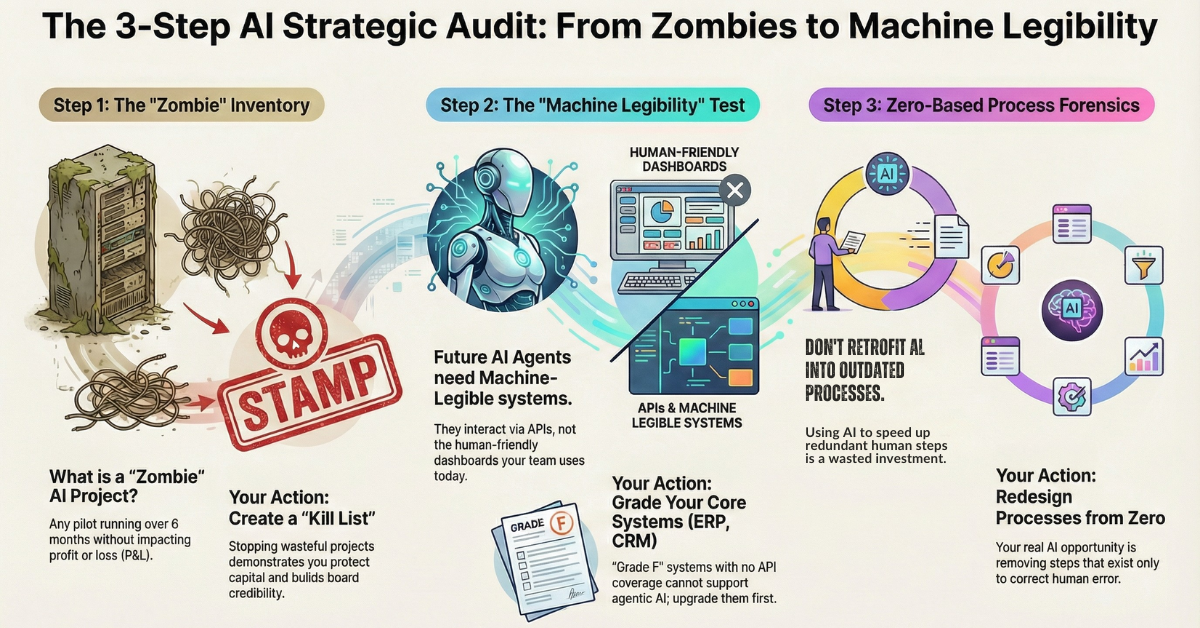
- The Kill List Mandate: Identifying what you are stopping builds more credibility with a Private Equity board than promising what you will start. It proves you are a protector of capital, not just a spender.
- API > Dashboards: If your core systems (ERP, CRM, WMS) are Grade F (Human Dependent), you cannot deploy Agentic AI. You must prioritize infrastructure upgrades to reach the EBITDA goals the board is demanding.
The “Board-Ready” Conclusion
When the deadline comes, don’t send the “Vision Deck.” Send a 2-page memo titled: “AI Readiness & Risk Assessment.”
Structure it like this:
1. The Reality Check: “We audited our data. 40% of our high-value data is currently unstructured (PDFs/Images). We cannot run Agents on this yet.”
2. The Clean-Up: “We are pausing 3 ‘Zombie’ pilots to redirect budget toward a Data Hygiene Sprint.”
3. The Ask: “We request a $X budget to build an API layer over our legacy ERP. This is the foundation required for the EBITDA impact you want in 2026.”
Your board doesn’t want another roadmap that leads to a cliff. They want a guide who knows where the potholes are. Be that guide.
Your Burning Question
If you audited your own core systems today, would they get a Grade A (API Ready) or a Grade F (Human Dependent)?
If you don’t know the answer, you aren’t ready for the board meeting.
I help Managing Directors and PortCo executives execute Forensic Data Audits to ensure their AI roadmap actually impacts EBITDA.
Ready to stop the “Zombie” projects? Book a 30-Minute Data Audit.
Resources
- Gartner Press Release: Gartner Predicts 30% of Generative AI Projects Will Be Abandoned After Proof of Concept By the End of 2025
- RAND Corporation Report Analysis: AI Apocalypse: 80% of Projects Crash and Burn (SalesforceDevops Analysis)
- MIT Sloan / CloudFactory: 6 Hard Truths Behind MIT’s Finding That 95% of AI Pilots Fail
- Bain & Company: Field Notes from the Generative AI Insurgency in Private Equity (2025 Report)
- Accenture PE Insights: Unlock AI Value in Private Equity Mid-Market
- McKinsey & Company: The State of AI in 2025: Agents, Innovation, and Transformation
- Space-O AI (Implementation Roadmap): AI Implementation Roadmap: 6-Phase Guide for 2026
- Pitcher Partners: The AI Readiness Gap: Why “Fairly Ready” Deserves a Closer Look Key Insight: Only 12% of firms are actually ready to scale; the rest are in the “Fairly Ready” trap, which leads to stalled pilots.Most AI strategies die in the Data Reality Gap. Use these 3 steps to move from Scaled Stupidity to actual EBITDA expansion.