TL;DR
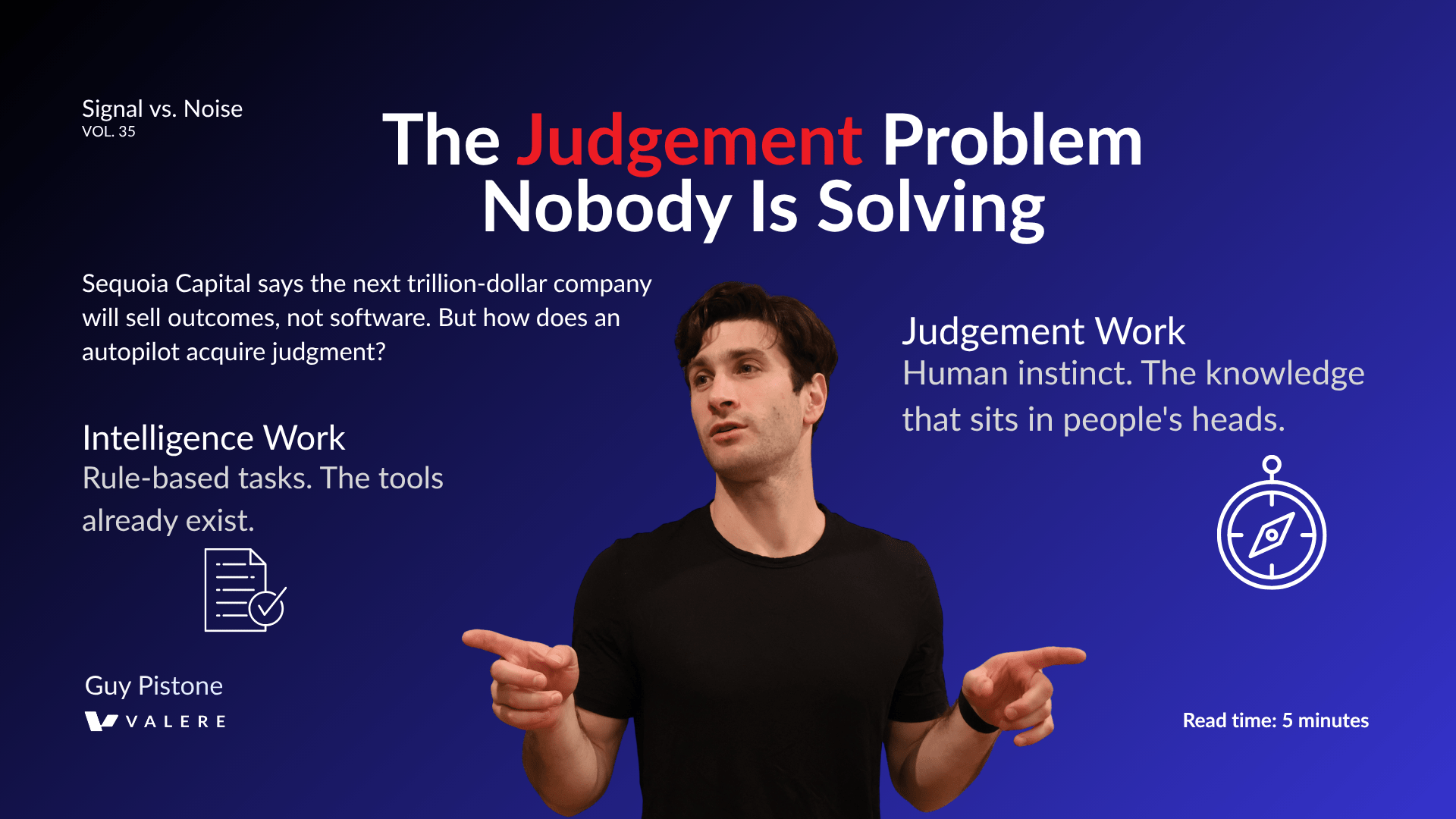
Sequoia just published a thesis about why the next trillion-dollar company will sell outcomes, not software. They’re right about the opportunity. But there’s a gap in the playbook that nobody is talking about yet, and it’s the one that actually determines whether autopilots work.
The Backstory
Julien Bek at Sequoia Capital published a piece this week worth reading in full. If you missed it, catch up here: Services: The New Software.
The core argument is that for every dollar companies spend on software, they spend six on services. The next generation of AI companies won’t sell tools that help professionals do work. They’ll just do the work.
He calls it the shift from copilots to autopilots. A copilot sells the tool. An autopilot sells the outcome. That framing is clean and largely correct. But it leaves a question sitting on the table that the piece doesn’t fully answer.
The Intelligence and Judgement Split
Bek distinguishes intelligence work and judgment work.
Intelligence work has rules. Complex ones, sometimes, but rules. Writing code, transcribing notes, filling forms, drafting contracts. Given enough data and the right model, AI can handle most of it autonomously.
Judgement work is different. It’s knowing which feature to build next, whether to take on tech debt, how to read a room in a negotiation. It’s instinct built on years of experience. The kind of thing that doesn’t live in a database.
He argues that autopilots win first in high-intelligence categories and expand into judgement over time as they accumulate proprietary data about what good decisions look like in their domain.
That’s where I’d push back slightly. Not on the conclusion, but on the assumption underneath it.
The Gap
How does an autopilot acquire judgment in the first place?
That’s the question you have to start with. And Bek’s answer is essentially “compound the data over time.” Start with an outsourced intelligence task, nail it, then let the model learn its way toward judgement. That works if you have years and enough volume to learn from.
But most of the service categories on his opportunity map (which includes: management consulting, legal, accounting, marketing) are judgement-heavy from day one. The wedge task might be intelligence, but the reason clients are paying isn’t. They’re paying for someone to know what to do with the output.
That knowledge doesn’t compound automatically. It has to be captured intentionally.
What Actually Has to Happen
Here’s how I think about the problem in practice.
Any company trying to deliver outcomes in a new vertical faces the same challenge. The intelligence tools already exist. Harvey for legal. Rillet for accounting. Dozens of others. Integrating them isn’t the hard part anymore.
The hard part is encoding the judgement layer. The senior lawyer’s instinct for which clause creates risk. The accountant’s read on which number needs a closer look. The consultant’s sense of which recommendation a client will actually implement. That knowledge sits in people’s heads. It doesn’t transfer automatically to an AI system just because the system is smart.
This is the same problem healthcare solved, by accident, with ambient scribing (more on this next week). The doctor-patient conversation was always the most valuable data in the system. It just took the right capture mechanism to make it usable.
Every services vertical has an equivalent. The question is whether you build the infrastructure to capture it.
Here’s Where Dactic and Conducto Come In
Two quick definitions of our flagship products:
- Conducto is the autonomous execution engine of the Valere Evolve platform. In other words, it is the component that translates strategy into operational output and scales AI-driven work across the organization without requiring the organization to manage the infrastructure beneath it. It is a cloud-native AI orchestration platform built for organizations that need AI agents, automated workflows, and human decision-making to function as one connected, intelligent system. Where most platforms handle either planning or execution, Conducto handles both, and connects them with the proprietary institutional intelligence that makes automation reflect how the business actually operates rather than how automation tools think it should.
- Dactic is the proprietary intelligence foundation that makes Valere’s AI systems fundamentally different from anything built on generic training data. It is a knowledge capture platform that extracts the undocumented institutional expertise, like the operational judgement, pattern recognition, and contextual know-how that only lives in the heads of your most experienced people, and structures it into proprietary training intelligence that powers every AI system deployed across the organization.
This is the pattern we’ve been building toward at Valere, and it maps directly onto what Bek is describing.
Conducto is the execution layer. It integrates existing intelligence tools, whatever the relevant stack is for a given vertical, and runs the automations. It’s the infrastructure that delivers the outcome.
Dactic is the judgement layer. It deploys an AI detective to interview the relevant experts, like employees, practitioners, and domain specialists, and turns their tacit knowledge into structured data that feeds the system. Not a survey. Not a knowledge base someone has to maintain. A systematic capture process that extracts what experienced people actually know and makes it usable by AI.
That combination is what makes an autopilot viable in a judgment-heavy vertical. In our case, Conducto handles the intelligence work. Dactic captures the judgement. Together, they let you enter a services category without spending years waiting for the model to learn it on its own.
The Bigger Signal
Sequoia’s thesis is right. The services opportunity is huge, and the shift to outcome-based delivery is real. The companies that figure out how to capture the judgement layer early will compound it into a data advantage that’s hard to replicate.
Others will build very capable intelligence tools that still need a human in the loop for every decision that actually matters. Which is still a copilot… Just an expensive one.
Referenced: “Services: The New Software” by Julien Bek, Sequoia Capital — sequoiacap.com