TL;DR: The Bottom Line Up Front
Everyone’s talking about AI integration frameworks in 2025, but success isn’t about picking the “right” framework; it’s about building the right foundation first.
The companies winning with AI integration are those that solve the data, governance, and talent problems before they choose their tools.
The magic isn’t in the framework; it’s in the infrastructure that makes any framework work.
What I’m Seeing This Week
Three posts caught my attention this week that show where AI integration is heading and where the real challenges lie.
1. The “Agent Washing” Reality Check
Tim Sanders’ LinkedIn post nailed it. “There is no such thing as Agent Washing.”
His point? Companies are paralyzed, hunting for “perfect” agents while missing real productivity gains from basic ones. Tim defines agents as existing on a gradient from weak (chatbots that give dynamic directions) to strong (fully autonomous systems).
The companies winning aren’t waiting for full autonomy; they’re building trust with simple agents first.
Key takeaway: The hunt for “perfect” agents is the biggest barrier to AI adoption.
2. The Framework Explosion
Manthan Patel’s breakdown of the 5 leading frameworks (CrewAI, LangChain, Microsoft AutoGen, LangGraph, and Semantic Kernel) shows just how rapidly the landscape is evolving.
But here’s what caught my eye: “600,000 CrewAI Agents have been created in just a week.” That’s not adoption; that’s experimentation.
The real question isn’t how many agents are being created, but how many are making it to production and delivering measurable business value.
Key takeaway: The gap between building and deploying is where most AI projects die.
3. Co-Intelligence Beats Replacement
Ethan Mollick’s “Co-Intelligence” has become the unexpected enterprise playbook. Instead of replacement fantasies, successful companies treat AI as a collaborative partner.
His four principles (always work with AI, start immediately, treat as a creative partner, maintain responsibility) are showing up in organizations with measurable gains.
Stanford recently highlighted Mollick’s research showing AI out-innovates humans in idea generation, but through partnership, not substitution.
Key takeaway: Success comes from human-AI collaboration, not AI autonomy.
What The Data Shows
Here are some statistics that cut through the integration framework hype:
- Over 80% of organizations report no tangible EBIT impact from GenAI use, despite widespread adoption (McKinsey, 2025).
- GitHub repositories using agentic AI frameworks increased 920% from early 2023 to mid-2025 (DigitalDefynd, 2025).
- Only 37% of executives report successful AI adoption at companies without a formal AI strategy, compared to the 80% with a strategy (Writer, 2025).
Let’s break that down for businesses:
- Building doesn’t equal business impact
- Strategy beats technology every time
- Pilots rarely become production systems
- Framework proliferation creates decision paralysis
- Clear plans win over cool tools
Infrastructure Before Innovation
After +100 AI projects, I’ve learned that successful AI integration follows a specific sequence, and it’s not the one most companies are following.
The 60-Second AI Integration Reality Check – Before choosing any framework, answer these 5 questions:
- Can you reliably access, clean, and govern your data?
- Do you have clear AI decision-making and risk policies?
- Can you integrate AI without breaking existing workflows?
- Do you measure business impact over technical metrics?
- Are you starting simple before going complex?
Your score: 5/5 = Framework-ready | 3-4/5 = Fix infrastructure first | 0-2/5 = Focus on fundamentals (Share your score in the comments – most companies score 2/5.)
The Wrong Sequence (What Most Companies Do):
- Choose a trendy framework
- Build a proof of concept
- Struggle with data integration
- Hit governance roadblocks
- Abandon or restart the project
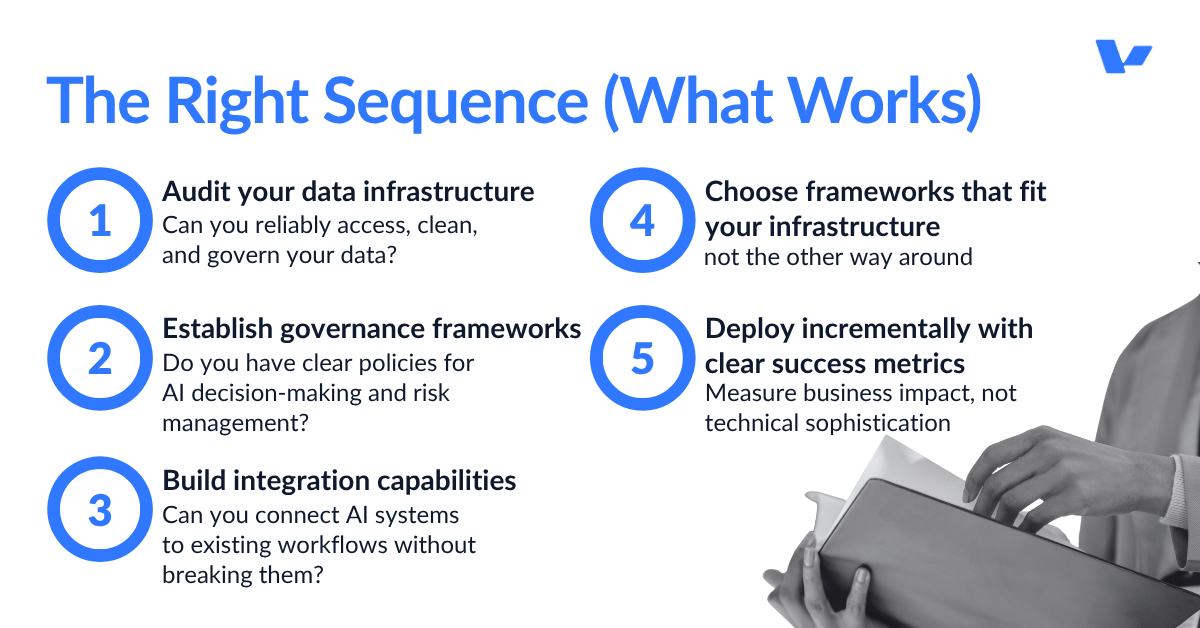
The most successful AI integrations I’ve seen share three characteristics: Data-First Architecture, Governance as a Feature, and Integration-Ready Infrastructure.
ROI measurement for Agentic AI
The companies succeeding with AI integration frameworks are measuring success differently from those that are failing.
Instead of focusing on technical metrics like model accuracy or processing speed, they’re tracking business outcomes: process efficiency, error reduction, and actual cost savings.
How Valere Measures ROI for Agentic AI
We focus on three simple metrics that matter:
- Time savings: How much manual work disappears.
- Quality gains: Fewer errors, better consistency.
- Capacity unlock: Staff freed for strategic work.
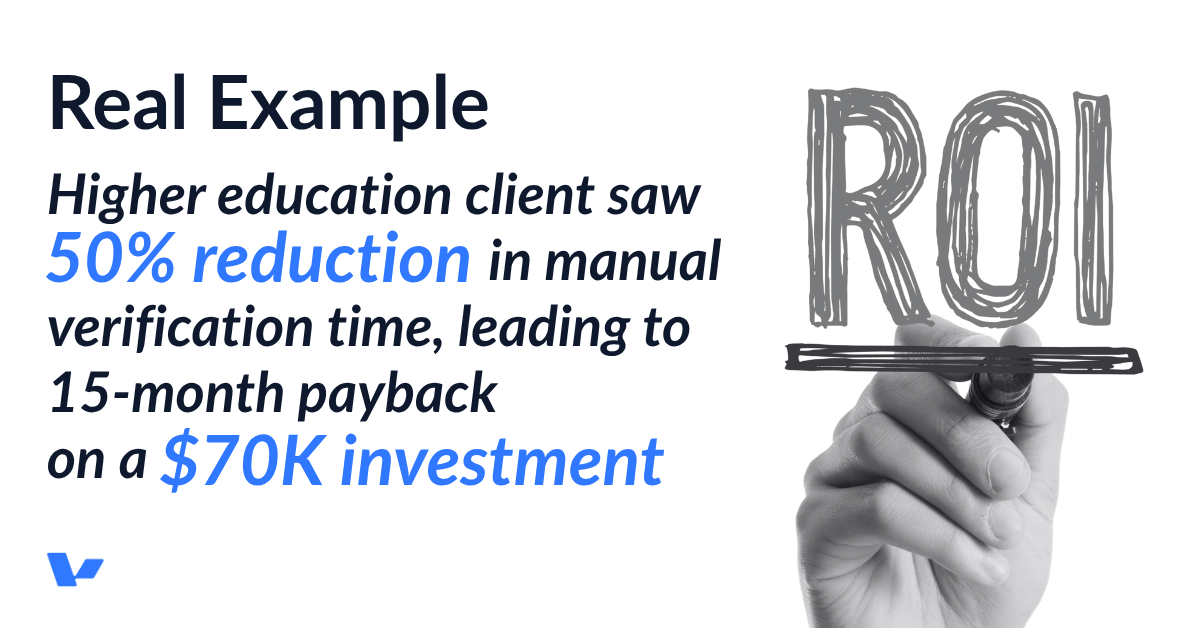
Key insight: ROI comes from solving specific business problems, not implementing impressive technology.
Three Practical Recommendations
- For CTOs: Stop framework shopping until you’ve solved your data and governance problems. The “perfect” framework won’t fix fundamental infrastructure issues.
- For AI Teams: Build integration capabilities as a core competency. The ability to reliably connect AI systems to existing workflows is more valuable than expertise in any specific framework.
- For Business Leaders: Define success metrics before choosing frameworks. If you can’t measure the business impact of your AI integration, you’re building technology, not solutions.
Worth Your Time
Books:
- “Building Intelligent Systems” by Geoff Hulten – The definitive guide to production AI systems
Articles:
- “Building A Generative AI Platform” by Chip Huyen.
- “What is Agentic Testing?” by UiPath.
- Agentic AI and Multiagentic: Are We Reinventing the Wheel?” by Vicent Botti.
- “Top 7 Free AI Agent Frameworks” by Botpress.
Frameworks to Watch:
- Microsoft AutoGen – Leading enterprise adoption for multi-agent systems
- LangChain – Most mature ecosystem for building AI applications
- CrewAI – Fastest growing framework for collaborative AI agents
The Week Ahead
I’m watching three key developments over the next week:
- Enterprise Integration Patterns – How are successful companies connecting AI frameworks to existing systems?
- Governance Frameworks – What risk management approaches are proving effective at scale?
- Cost Management – How are companies controlling the escalating costs of AI framework experimentation?
Final Thought
AI integration is about building the infrastructure that makes any framework successful.
Making the real question “Are we ready to make any framework work?”
That’s where the real opportunity lies.
What’s your take on AI integration frameworks? Are you building infrastructure or chasing the latest tools?