From the desk of Guy Pistone, Founder of Valere
TL;DR
Six years building Valere. Four years intensively using AI tools, and the bottleneck is still UX/UI. Engineering compressed, but design runs on the old clock. The reason is structural because LLMs are engineered to produce the most probable answer, and the design’s value lies in the details of the distribution. If your design org has been converging on the mean over the last 18 months, the signals are observable in your next 1:1 with your Head of Design. Below are six questions that surface those signals, organized into workflow, output, and measurement. Bring them. The pattern you find tells you whether your design org is using AI as a map of the median or surrendering to it.
The mechanism in a nutshell
LLMs run on next-token prediction. Meaning they are mathematically engineered to produce the most probable continuation of any input, which is the average one. Code tends to benefit from this because the canonical implementation of a sort algorithm, the majority of the time, is the right one.
But design works the other way around. The brand that looks like every other brand has no value. The interface that resembles every other interface gets ignored. Design’s value sits in the details. AI is engineered to find the mean.
The implication is that AI in a design workflow can do two things, depending on how it’s used. It can act as a map of the median, showing the designer what the average answer looks like, so they know which direction to push. Or it can become the design itself, in which case the work regresses toward generic on its own. The signals telling you what is happening are observable.
I am telling you right now that the problem is the architecture itself. More training won’t change it. So your design org’s convergence on the mean, if it’s happening, isn’t a temporary phase that resolves on its own.
Find it now, and you can correct course. Find it in a year, and you’ve already lost the differentiation that was holding the brand together.
The 1:1 questions
Take these into your next regular meeting with your Head of Design. The strong answers tell you your design org is intact. The weak answers tell you it’s already drifting, and you have somewhere between one and four quarters before the work starts being indistinguishable from your competitors’. Clocks ticking.
Workflow signals
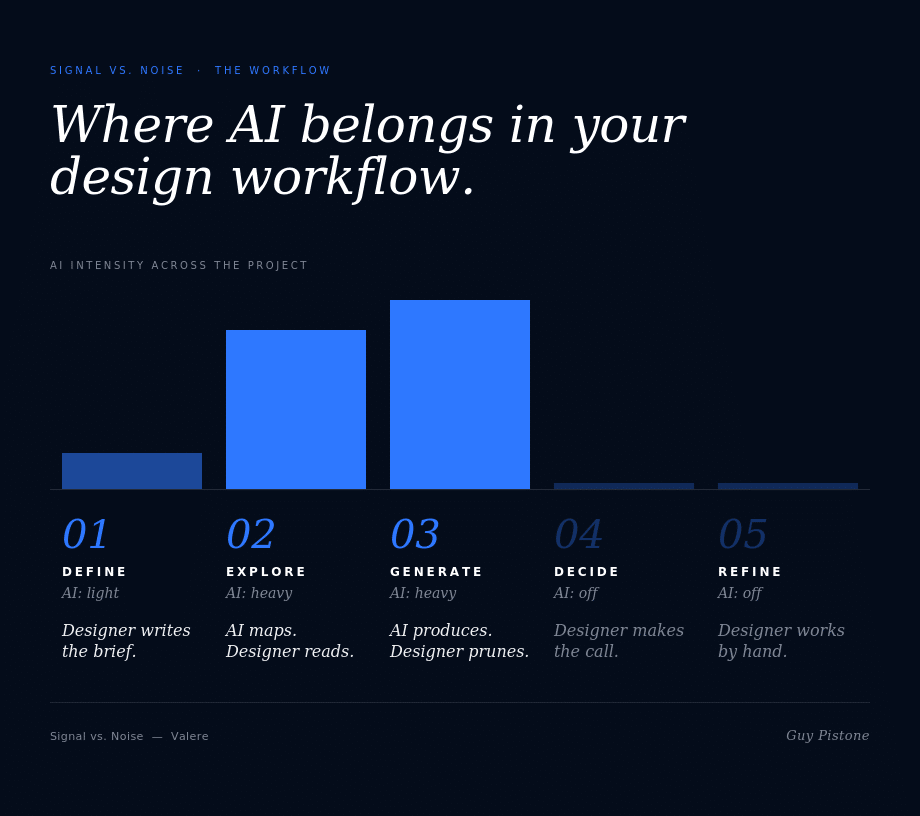
Question 1. Walk me through how AI showed up on our last big project. When did your team reach for it, and when did they put it down?
- The wrong answer is some version of “we used it throughout.” That means the tool is in the production stream, where it accelerates the wrong half of the work.
- The right answer sounds closer to: “We used it heavily in research and initial exploration. Then we put it down before the final decisions. The senior designer’s review didn’t run through it.” Heavy in the map-the-space phase, absent from the decide-what-matters phase.
Question 2. How many options does your senior designer generate per concept now? Of those, how many survive the first internal review?
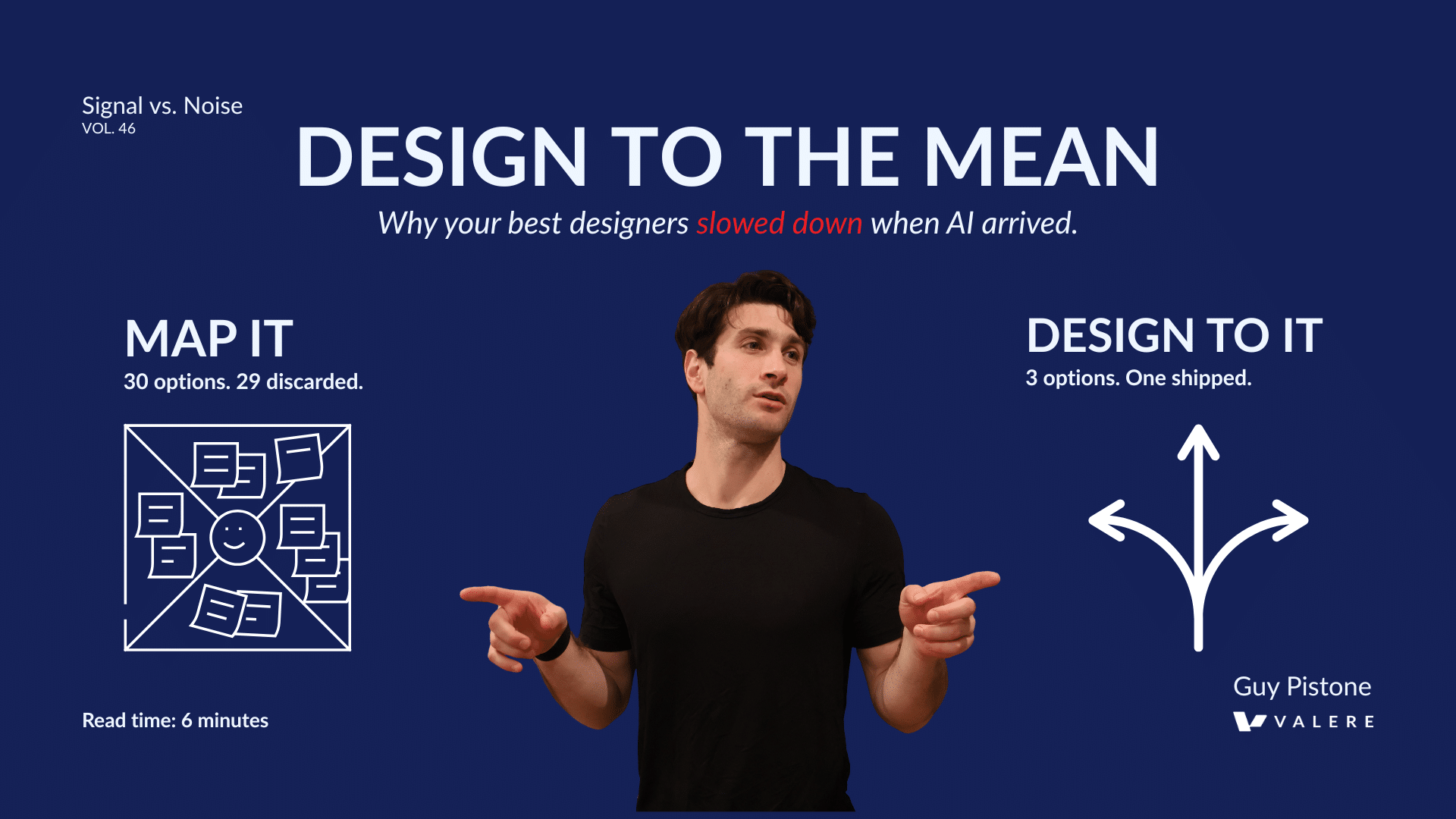
- If the answer is “three options, we pick one, two get discarded,” your senior designers are using AI like juniors. Generating just enough to choose from, picking from the median.
- If the answer is closer to “thirty options, twenty-nine get discarded, one gets heavily worked,” they’re using it as a map. The signal is in the ratio. Volume alone is misleading. A 1:30 keep-to-generate ratio is healthy. A 1:3 ratio is the warning.
Output signals
Question 3. Pull the three pieces of work you’re proudest of from this year and three from two years ago. Look at them side by side. Are this year’s pieces more recognizably ours, less recognizably ours, or about the same?
- The honest answer is what you want. The wrong answer is “more polished, but I have to admit they look more generic.” That’s design to the mean operating in your own work without you noticing.
- The right answer is some variant of “more distinctive on our best work, but we shipped some generic pieces under deadline pressure that I’m not proud of.” The first version means the average has won. The second means judgment is intact, but capacity is stretched, which is a different and more fixable problem.
Question 4. When clients pick from the options we show them, are they picking the safer option more often than they used to? This is the question your head of design has probably noticed and not flagged.
- The wrong answer is “yes, but I think it’s because clients are more risk-averse now.” Clients aren’t more risk-averse. The options they’re being shown have a tighter cluster around the median, so the safe option looks more reasonable by comparison.
- The right answer is either “no” or “we stopped including AI-generated baselines in the option set because they pulled the client conversation toward the average.”
Measurement signals
Question 5. What metric tells you a designer is performing well? What metric were you using two years ago?
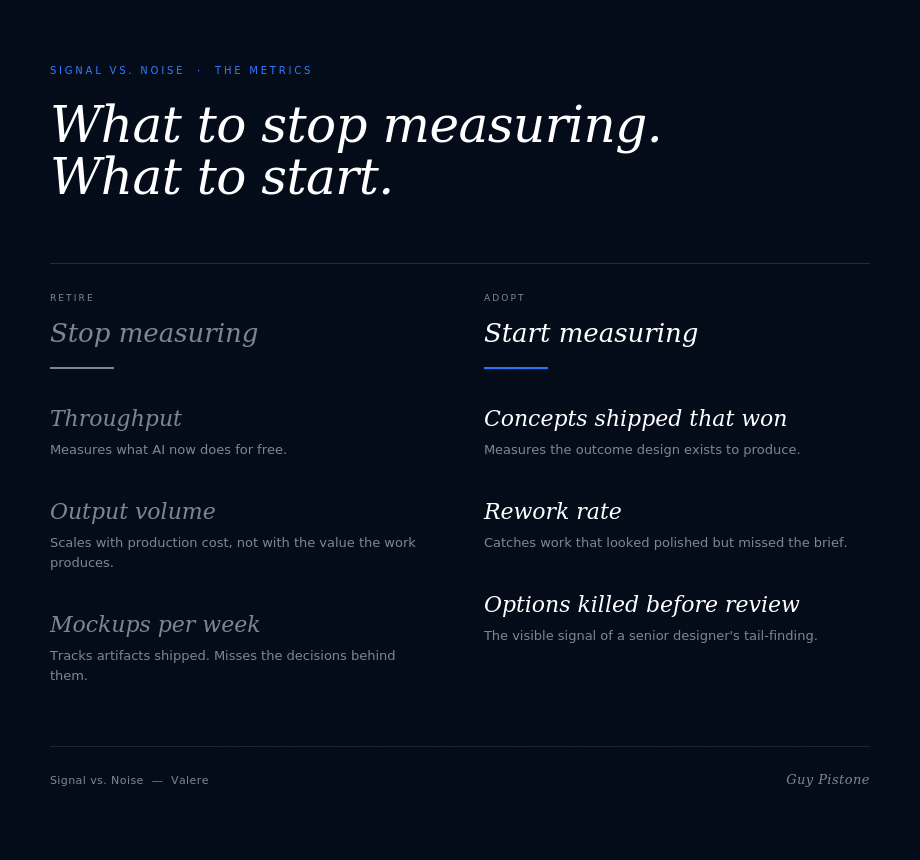
- If the answer is throughput, output volume, mockups produced per week, or anything that scales with AI-assisted production, you’re measuring the wrong thing now. Decision quality is the right metric now. The output count is misleading. Some metrics that hold up: concepts shipped that won, rework rate, number of options the senior designer killed before review, client requests that come back unchanged versus those that come back with major revisions.
- If the metric hasn’t been updated in the last 18 months, it’s been quietly incentivizing your designers to behave like juniors. Your seniors have either left or stopped trying.
Question 6. When a design project doesn’t compress on the timeline despite using AI, who internally pays the price? This is the structural question.
- The wrong answer points at the designer, who gets pushed for not using the tool well. That tells you the operations side of the company has decided AI should compress design timelines and is pricing the gap into your designers’ reviews.
- The right answer points to the brief. The team goes back to whoever wrote it and asks whether the problem was specified clearly enough. The design bottleneck is usually upstream, in the quality of the question being asked.
Until your operations team understands that, your designers will keep absorbing the timeline pressure, and the work will keep degrading.
What to do with what you find
If you got some of the right answers, your design org has adapted to AI without you having to do anything. Your job is to protect that adaptation. The operations team will keep pressing for compressed design timelines because everyone else’s timelines have compressed.
Hold the line.
Tell them the bottleneck is still there, just in a different part of the workflow now. If you got a majority of wrong answers, you have three moves, in this order.
- First, change the metric. Stop measuring output volume. Pick one of the alternatives above and run it for a quarter.
- Second, audit the briefs. If your senior designers are absorbing the cost of underspecified problems, the fix is upstream of design entirely.
- Third, stop the proprietary data investment if you have one running. More data sharpens the median. The output stays clustered there regardless.
If you got mixed answers, you’re in a common position. The seniors have learned to use AI as a map, the juniors are still using it for production, the measurement system rewards juniors, and the seniors are simply leaving. That’s the pattern I see most often at Valere when I look across mid-market design orgs. The fix is the same three moves above, with priority on the metric.
Saint-Exupéry wrote in 1939 that perfection is achieved when there is nothing left to take away. Design has always lived in that subtraction. AI lives in addition. The 1:1 above tells you which side of that gap you’re on right now.
Guy Pistone, CEO of Valere | AWS Advanced Tier Partner | Building meaningful things.
Guy Pistone is the founder and CEO of Valere, where he has spent six years building digital products for mid-market companies and the last four years putting AI into every workflow he can find. Signal vs. Noise is his field log from inside that work: what AI compresses, what it stalls, and where the bottlenecks have moved.
Valere is a product and engineering firm that builds software and AI applications for mid-market companies. Six years in and an AWS Advanced Tier Partner on the SMB Competency list, Valere works inside the digital transformation projects it writes about, with engineers and designers embedded in client teams from initial strategy through production deployment.