TL;DR
- Your AI pilot isn’t stuck because of technology. It’s stuck because you’re treating reversible decisions like irreversible ones. Five tech leaders (Jobs, Bezos, Hoffman, Ng) all say the same thing: Stop optimizing for certainty, start optimizing for speed.
- The pattern that separates shipping from stalling: Deploy imperfect v1 to ONE team in 90 days (not perfect v3 to everyone in 18 months), build mechanisms that force weekly demos of what shipped (not what’s “in progress”), and make decisions with 70% of the info you wish you had.
- Your Monday move: Pick the AI decision that’s been stuck >60 days (vendor selection? build vs buy? which workflow?), set a 1-week deadline to decide, and permit yourself to be embarrassed by v1. Your competitors already shipped theirs.
Your competitor just shipped their AI-powered demand forecasting tool. You’re still in month 7 of vendor evaluation. They’re not smarter. They don’t have better engineers. They just followed a different playbook (one that tech leaders have been screaming about for decades).
Here are 5 lessons from the people who actually built transformative technology. No motivation nonsense. Just the uncomfortable truths about why some companies ship, and others stall.
LESSON 1:
“Don’t start with the technology. Start with the problem.” — Andrew Ng
What He Actually Meant – Andrew Ng (founded Google Brain, Coursera, Landing AI) has worked with hundreds of companies on AI transformation.
His most repeated advice: Companies fail because they start with “We need AI” instead of “We need to solve X problem.” AI is a tool. Hammers are tools. You don’t walk around asking, “Where can I use my hammer?” You say, “I need to hang a picture,” and then grab the hammer.
Why This Matters for Your AI Project Right Now
Your board asked: “What’s our AI strategy?” You responded with: “We’re exploring GenAI, computer vision, and predictive analytics.”
The uncomfortable truth: That’s not a strategy. That’s a list of technologies.
Your move: Stop asking “What AI should we deploy?” Start asking:
- What costs us $500K+ annually?
- Where are our biggest operational bottlenecks?
- What’s preventing us from serving customers faster/better?
Then ask: “Could AI solve this specific problem better than our current approach?“
Andrew Ng would ask you: “What operational problem keeps your COO up at night? Start there.”
LESSON 2:
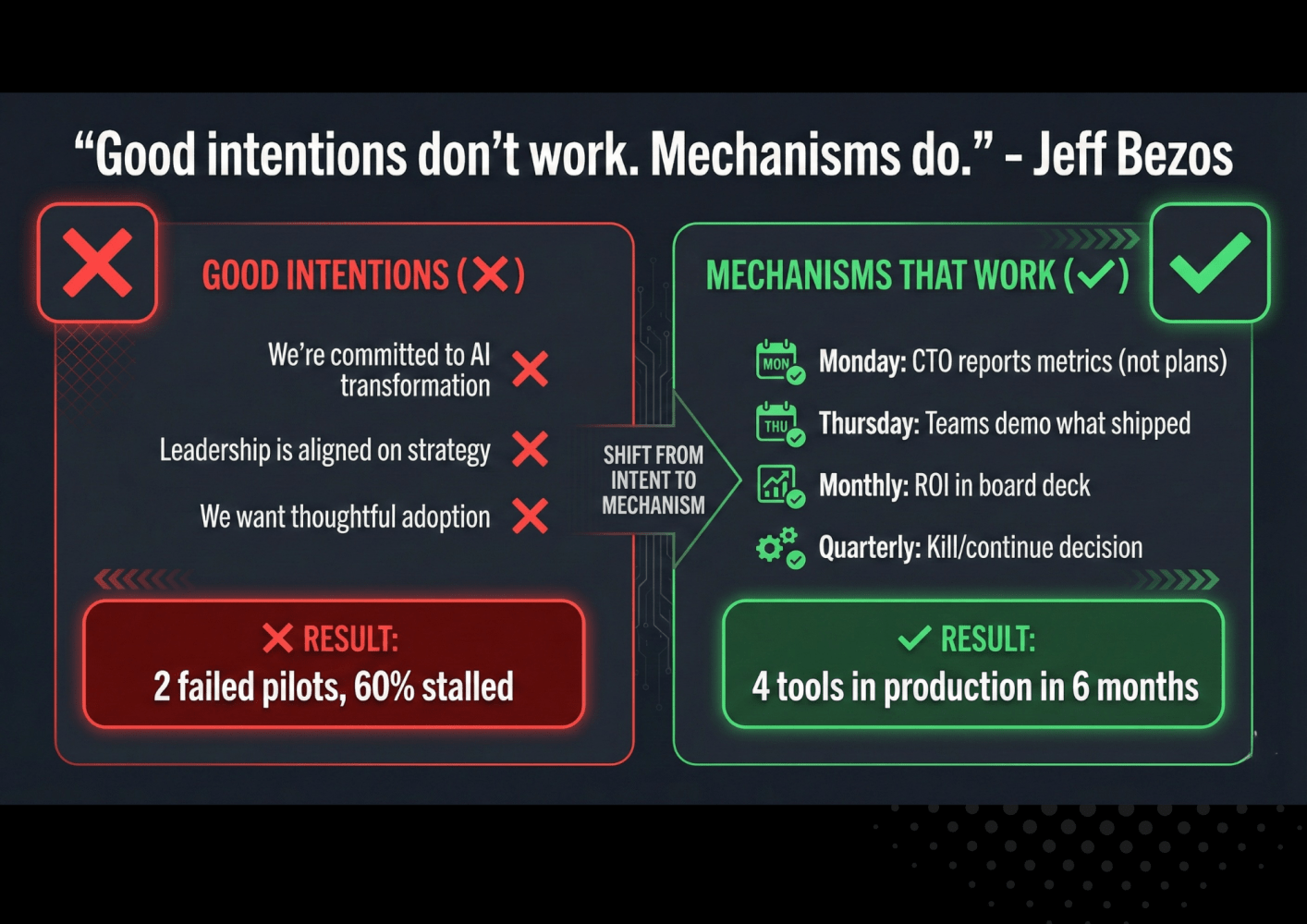
What He Actually Meant – Bezos doesn’t trust aspirations. He trusts systems that force the right behavior.
Amazon doesn’t hope for customer obsession. They built a mechanism. Every meeting starts with reading a 6-page memo in silence. No PowerPoint. No skipping ahead. The mechanism enforces rigorous thinking.
Why This Matters for Your AI Project Right Now
You have “good intentions” for your AI initiative:
- “We want to adopt AI thoughtfully.”
- “We’re committed to AI transformation.”
- “Leadership is aligned with the AI strategy.”
The uncomfortable truth: Good intentions got you 2 failed AI pilots and a third one stalling at 60% completion.
You don’t need better intentions. You need better mechanisms.
Real example: A $220M fintech company kept failing at AI adoption. Their mechanism fix:
- Every Monday: CTO reports AI deployment metrics to the board (not plans, metrics)
- Every Thursday: Product teams demo what shipped that week (not what’s “in progress”)
- Every month: AI ROI numbers go in the board deck alongside revenue and EBITDA
The mechanism forced shipping. Within 6 months, they had 4 AI tools in production.
Your move: Build the mechanism that forces deployment, not discussion.
- Weekly: What shipped? (Not what’s being discussed)
- Monthly: What’s the measurable impact? (Not “adoption is growing”)
- Quarterly: What gets killed if there’s no ROI? (Not “we’ll reassess”)
Bezos would ask you: “What’s the mechanism that ensures this actually ships, even if enthusiasm fades?”
LESSON 3:
If you’re not embarrassed by the first version, you’ve launched too late.” — Reid Hoffman (LinkedIn founder)
What He Actually Meant – LinkedIn’s first version was ugly. Limited features. Buggy. Hoffman shipped it anyway.
Why? Because the market teaches you what matters. Users don’t. Committees don’t. Competitive analysis doesn’t.
Only real deployment teaches you what actually works.
Why This Matters for Your AI Project Right Now
You’re running your third round of user testing before deploying your AI chatbot. You’ve polished the UI. Refined the training data. Planned the rollout communications.
The uncomfortable truth: You’re still going to be embarrassed by v1. Ship it anyway.
Real example: A $150M healthcare services company spent 9 months building the “perfect” clinical documentation AI. They finally launched to 50 doctors.
Week 1 feedback: “This is unusable. It doesn’t understand our specialty’s terminology.”
They’d optimized for the wrong problem. If they’d shipped at month 3 to 10 doctors, they’d have learned this in week 1 and iterated from there. Cost of perfection: 6 months and $200K wasted.
Your move: Cut your pilot scope in half. Ship it to 10 users, not 100. Give yourself permission to be embarrassed by v1.
The goal isn’t to impress people on launch day. The goal is to learn fast and iterate.
Hoffman would ask you: “What would you ship if you only had 30 days?”
LESSON 4:
“Most decisions should be made with 70% of the information you wish you had.” — Jeff Bezos
What He Actually Meant – Bezos categorizes decisions into two types:
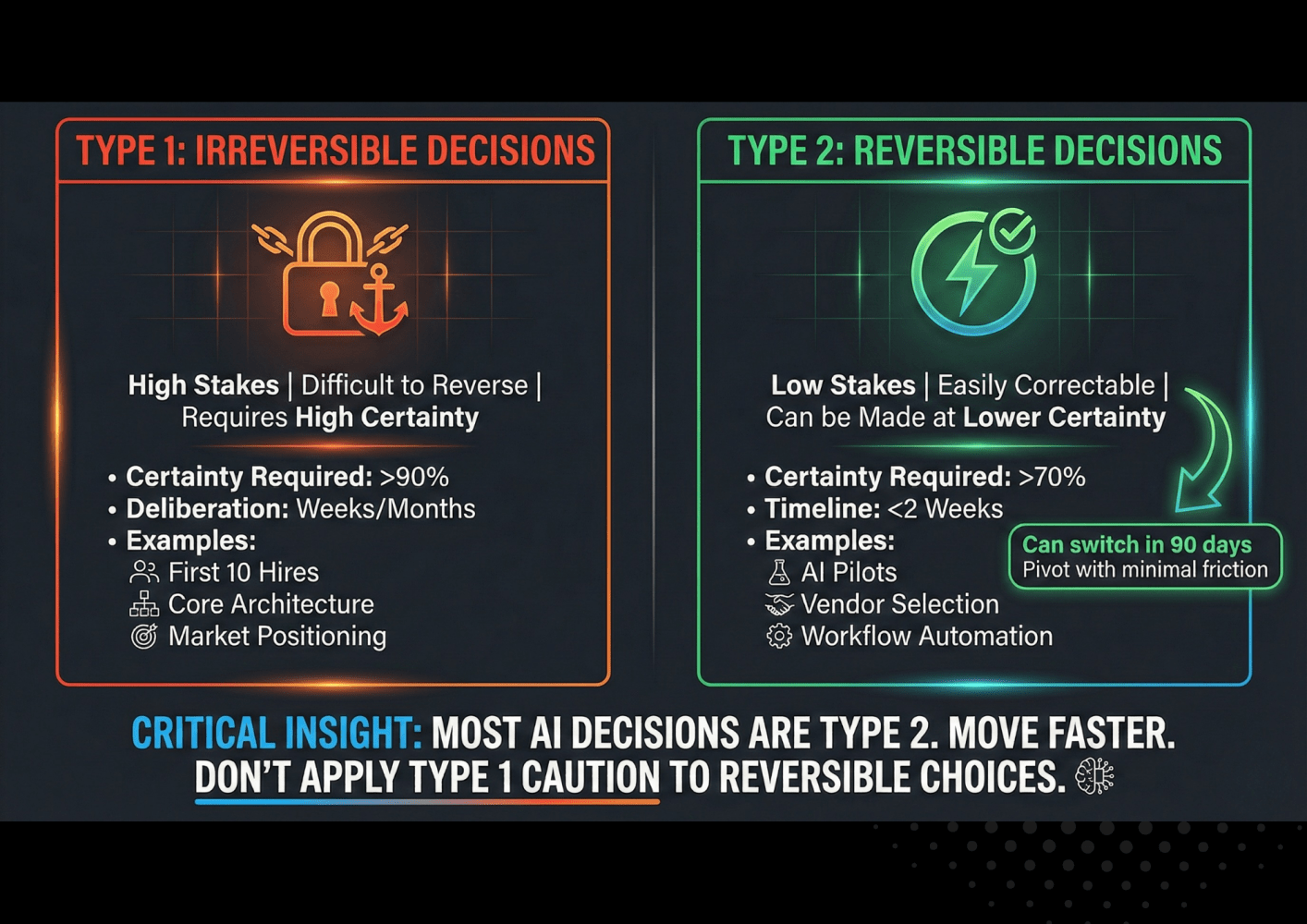
Make the call at 70%, move fast, course-correct if needed. You’re stuck in build-vs-buy paralysis. You’ve evaluated 6 vendors. You’ve scoped a custom build. You’ve run cost analyses. You’re waiting for certainty that will never come.
Why This Matters for Your AI Project Right Now
The uncomfortable truth: Your AI pilot is a Type 2 decision. If you pick the wrong vendor, you can switch in 90 days. If you build custom and it fails, you pivot. Waiting for 90% certainty isn’t reducing risk. It guarantees you move slower than competitors.
Your move: For reversible decisions, set a 2-week deadline. Gather 70% of the info. Make the call. Move.
Bezos would ask you: “Is this reversible? Then why are you still analyzing?”
LESSON 5:
“Real artists ship” — Steve Jobs
What He Actually Meant – In 1983, Jobs was furious that the Macintosh team kept adding features and delaying the launch. His response became legendary: “Real artists ship.”
Not “real artists perfect.” Not “real artists wait for ideal conditions.” Ship.
Why This Matters for Your AI Project Right Now
You’re sitting on an AI pilot that could reduce customer service handle time by 30%. But you’re waiting for:
- Perfect training data (you’ll never have it)
- 100% accuracy (you don’t need it)
- Complete team buy-in (you won’t get it before launch)
The uncomfortable truth: Your AI doesn’t need to be perfect. It needs to be deployed.
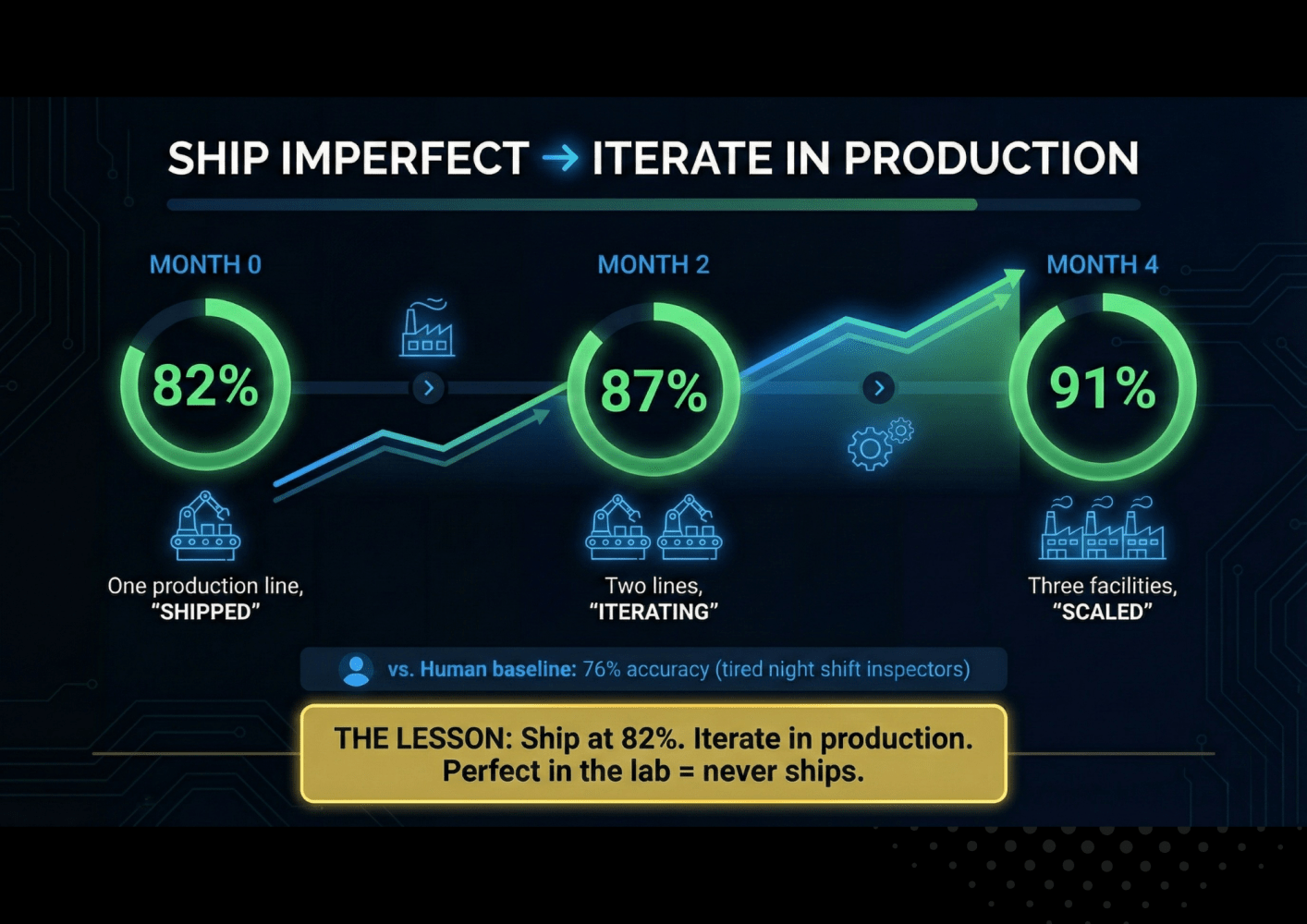
Real example: A $180M manufacturing company deployed computer vision for quality inspection at 82% accuracy. Was it perfect? No. Did it beat the 76% accuracy of tired human inspectors on night shift? Yes.
They shipped it to one production line. Iterated for 60 days. Now it’s at 91% accuracy across three facilities.
Your move: Pick ONE workflow. Deploy to ONE team. Give yourself 90 days to iterate in production. Stop waiting for perfection in the lab.
Jobs would ask you: “What are you afraid will happen if you ship it this month?”
The Pattern You’re Missing
Jobs, Bezos, Hoffman, Ng, they’re all saying the same thing in different ways:
Stop optimizing for comfort. Start optimizing for speed.
- Ship imperfect v1 (Jobs)
- Build mechanisms that force action (Bezos)
- Launch before you’re ready (Hoffman)
- Decide with 70% info (Bezos)
- Start with problems, not tech (Ng)
Your AI pilot isn’t stuck because of technology. It’s stuck because you’re treating Type 2 decisions like Type 1 decisions.
You’re waiting for certainty in a domain where speed is the only durable advantage.
Your Monday Morning Move
Here’s what to do this next week:
- Identify your Type 2 AI decision that’s been stuck >60 days (Vendor selection? Build vs buy? Which workflow to automate?)
- Set a 1-week deadline to decide Not to gather more info. To decide.
- Pick ONE deployment target One team. One workflow. 90-day timeline.
- Build the mechanism that forces shipping Weekly demo. Monthly ROI review. Quarterly kill/continue decision.
- Give yourself permission to be embarrassed by v1 You will be. Ship it anyway.
“What would you ship this quarter if failure wasn’t embarrassing?” That’s your AI roadmap.
Not the technology you should explore. Not the strategy that sounds impressive to the board. The problem you need to solve and are willing to ship imperfectly to learn from.
Real artists ship. Good intentions don’t work; mechanisms do. If you’re not embarrassed by v1, you launched too late. Decide with 70% info. Start with the problem.
Your competitors aren’t waiting for 90% certainty. Why are you?
The Question Steve Jobs Would Ask You Right Now
In 1997, Jobs returned to Apple. The company was 90 days from bankruptcy.
He looked at the product roadmap: 40+ products in development. He grabbed a marker and drew a 2×2 grid on the whiteboard:
CONSUMER | PROFESSIONAL
DESKTOP 1 | 2
PORTABLE 3 | 4
Four products. That’s it. Everything else got killed.
He asked the team: “Which 10% of what you’re working on actually matters?”
Now I’m asking you: Which 10% of your AI roadmap would you ship if you only had 90 days? That’s what you should be working on right now.
Everything else is expensive theater.
Guy Pistone, CEO @ Valere
P.S. Ready to turn your AI roadmap into deployed tools with measurable ROI? Let’s talk about what you’d ship if you only had 90 days.
Book a 90-Day AI Sprint Planning Session
Sources & References
- folklore.org/StoryView.py?story=Real_Artists_Ship.txt – “Real Artists Ship” by Andy Hertzfeld
- aboutamazon.com/news/company-news/2017-letter-to-shareholders – Good intentions don’t work. Mechanisms do.
- mastersofscale.com/reid-hoffman-expect-the-unexpected/ – Multiple interviews, notably in “Blitzscaling” (book, 2018) and the Masters of Scale podcast
- landing.ai/resources/ai-transformation-playbook/ – Ng’s guidance for enterprises beginning AI transformation,
- a16z.com/build-vs-buy-for-ai/ – Framework for when to build custom vs. buy vendor solutions
- gartner.com/en/documents/ai-vendor-selection – AI Vendor Selection
- gartner.com/en/newsroom/press-releases/2024-07-29-gartner-predicts-30-percent-of-generative-ai-projects-will-be-abandoned-after-proof-of-concept-by-end-of-2025 – 30% of GenAI Projects Will Be Abandoned
- venturebeat.com/ai/why-do-87-of-data-science-projects-never-make-it-into-production/ – 87% of Data Science Projects Never Make It
- deloitte.com/us/en/insights/focus/cognitive-technologies/state-of-ai-and-intelligent-automation-in-business-survey.html – Survey of 2,600+ enterprises