TL;DR: The Bottom Line Up Front
Here’s what 80% of AI leaders get wrong: They’re building agents to eliminate humans when the data shows human-AI teams outperform pure AI by 3x.
Everyone’s building AI agents to replace humans. The companies succeeding are building them to amplify human judgment.
The truth? Effective AI agents in production don’t think for you; they think with you.
While the industry obsesses over full automation, the real competitive advantage still lies in human-AI collaboration that makes both parties exponentially more effective.
What I’m Seeing This Week
1. UN AI for Good Summit Emphasizes Human-Centric AI – The UN’s AI for Good Global Summit in Geneva delivered a strong message: agentic AI’s potential to accelerate sustainable development goals is immense, but only with human-centered deployment.
The summit highlighted AI’s promise in climate action and healthcare while issuing strong warnings about fully autonomous systems. The most impactful AI solutions require “robust governance, clear ethical guidelines, and broad public understanding.”
Global leaders recognize that AI’s biggest wins come through collaboration with human expertise, not the replacement of it.
Guy’s insight: Even at the highest levels, the conversation is shifting from “what AI can do” to “what AI and humans can accomplish together.”
2. Nasdaq’s 80% Workload Reduction Through AI Partnership – Nasdaq Verafin’s launch of their “Agentic AI Workforce” shows human-AI collaboration in action. Their AI agents handle high-volume, low-value AML compliance tasks while human analysts focus on complex decision-making.
The results speak for themselves: over 80% reduction in alert review workload for sanctions screening. But here’s the key: humans remain in control of final decisions while AI handles the information processing.
AI doesn’t eliminate compliance analysts; it makes them more strategic and impactful.
Guy’s insight: The most successful enterprise AI deployments amplify human expertise rather than automate it away.
3. Xelix’s $160M Bet on Human-AI Finance Teams – Xelix’s massive $160 million funding round signals something important: investors are backing AI that transforms accounts payable from a “reactive cost center” into a “proactive, strategic force.”
But read the details carefully, their platform doesn’t replace finance teams. It eliminates manual workflows so humans can focus on fraud prevention, strategic analysis, and relationship management.
The biggest AI investments are going to companies that make humans more valuable, not more replaceable.
Guy’s insight: Smart money follows human-amplifying AI, not human-replacing AI.
Noticing the pattern?
All three stories this week point to the same reality: the most successful AI implementations preserve and enhance human expertise rather than eliminate it.
This isn’t a coincidence; it’s the market speaking.
What The Data Shows
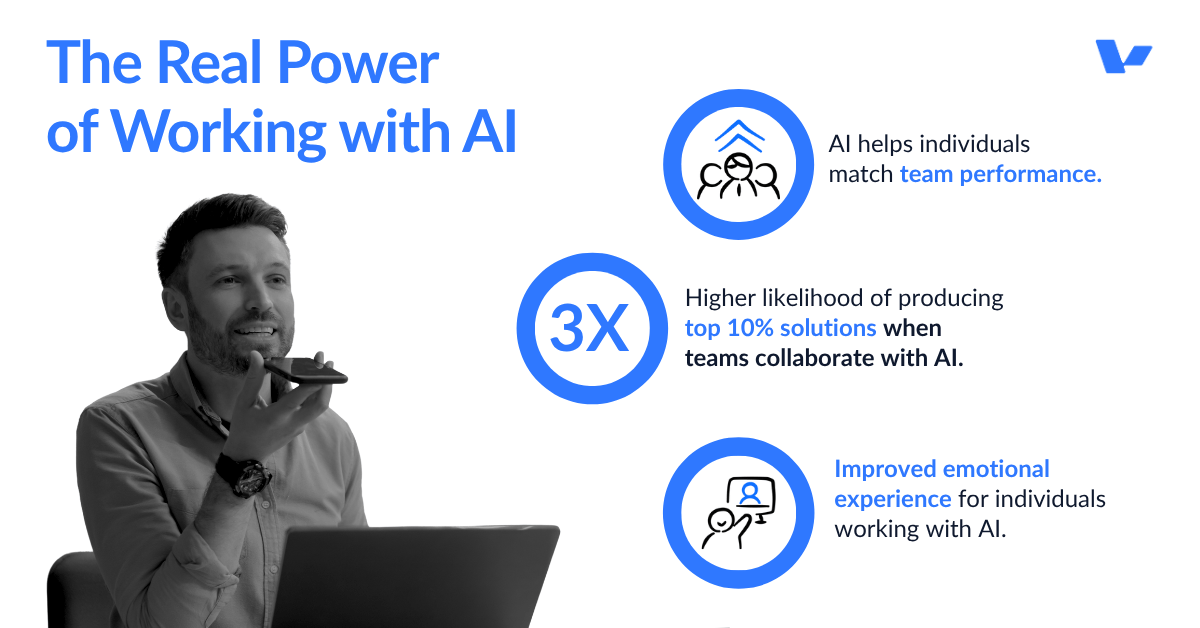
A Field Experiment on Generative AI Reshaping Teamwork and Expertise research reveals why human-AI collaboration outperforms pure automation:
- Individuals with AI matched the performance of two-person teams without AI, demonstrating AI can effectively replicate certain benefits of human collaboration.
- 3x higher likelihood of producing top 10% solutions when teams collaborate with AI versus control groups working without AI assistance
- Improved emotional experience for individuals working with AI, with positive emotions matching or surpassing those of traditional two-person teams
Quick diagnostic: Are you building to replace human workers or amplify human capabilities? Most companies we assess are stuck in replacement mode, missing the bigger collaboration opportunity.
The pattern is clear: collaboration beats automation.
Guy’s Perspective
I created a video breaking down the reality of AI agents.
The most successful deployments follow what I call the “Bicycle Principle.”
A bicycle doesn’t “replace human legs.” It amplifies a human’s capabilities, in this case, for mobility.
The best AI agents work the same way! They amplify human judgment, creativity, and expertise rather than replacing them. Think about it.
A financial analyst doesn’t want an AI to make investment decisions. They want an AI that can rapidly analyze thousands of data points, surface relevant patterns, and present clear options so they can make better decisions faster.
The magic happens when AI handles the cognitive heavy lifting (data processing, pattern recognition, scenario modeling) while humans handle the creative and strategic thinking.
5 Questions to Build Human-Amplifying Agents
Before you build any agent, ask these human-centered questions:
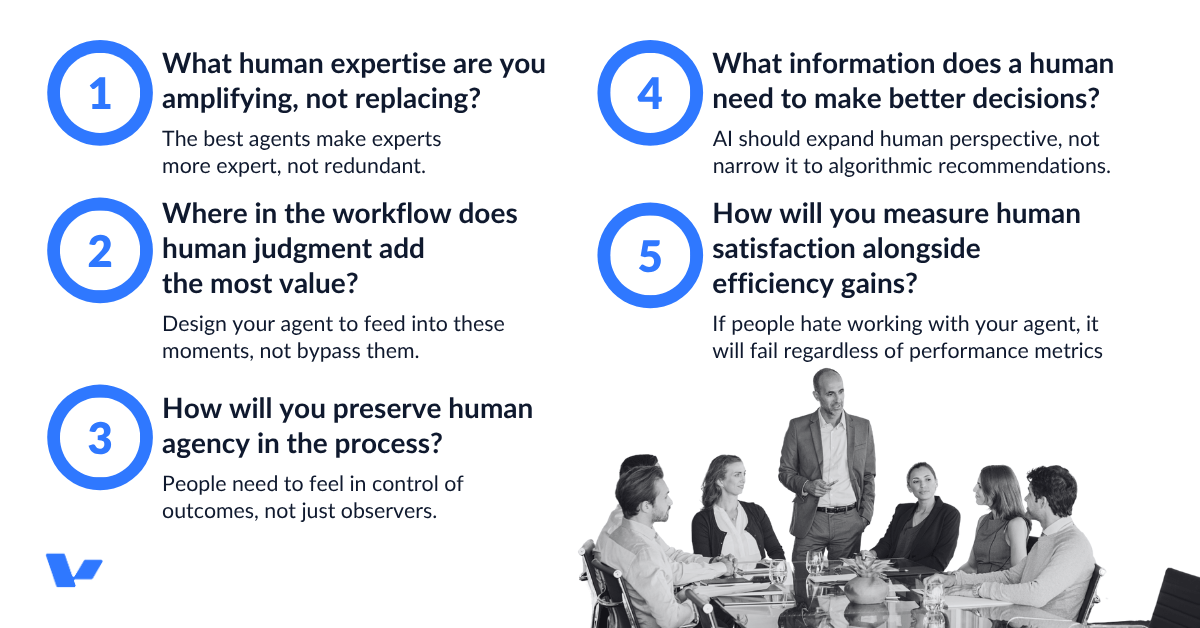
Most companies skip these questions and wonder why their agents feel like adversaries instead of allies. Try a few before your next AI implementation and compare the results.
Three Practical Recommendations
For Business Leaders: Stop asking “What jobs can AI replace?” Start asking “What human capabilities can AI amplify?” The companies winning with AI are the ones making their people more valuable, not more replaceable.
For CTOs: Design agent interfaces that enhance human decision-making rather than hide it. The goal isn’t to eliminate human involvement; it’s to make human involvement more strategic and impactful. If you’re struggling with the technical architecture needed to preserve human agency while scaling AI capabilities, we’ve developed frameworks that solve this across 100+ implementations.
For Product Teams: Build agents that feel like upgrading your team’s capabilities, not outsourcing them. People should feel more competent and creative when working with their agent, not diminished or threatened.
Worth Your Time
- The Cybernetic Teammate: A Field Experiment on Generative AI Reshaping Teamwork and Expertise
- A systematic review and meta-analysis (Nature Human Behaviour, 2024)
- Agentic AI Is Already Changing the Workforce (Harvard Business Review, May 2025)
- Quantifying GitHub Copilot’s impact on developer productivity and happiness (GitHub Blog, 2024)
Final Thought
The AI revolution isn’t about machines becoming more human. It’s about humans becoming more capable through partnership with machines.
Remember: the question isn’t “how can AI do this job better than humans?” It’s “How can AI and humans together do this job better than either could alone?”
That’s where the real value lies.
Ready to build AI that amplifies rather than replaces?
I’ve helped 100+ companies design human-AI collaboration systems that actually work in production. What’s your experience with human-AI collaboration? Are you building agents that replace or amplify?