From the Desk of Guy Pistone – Weekly insights for operators at mid-market & PE-backed companies
TL;DR
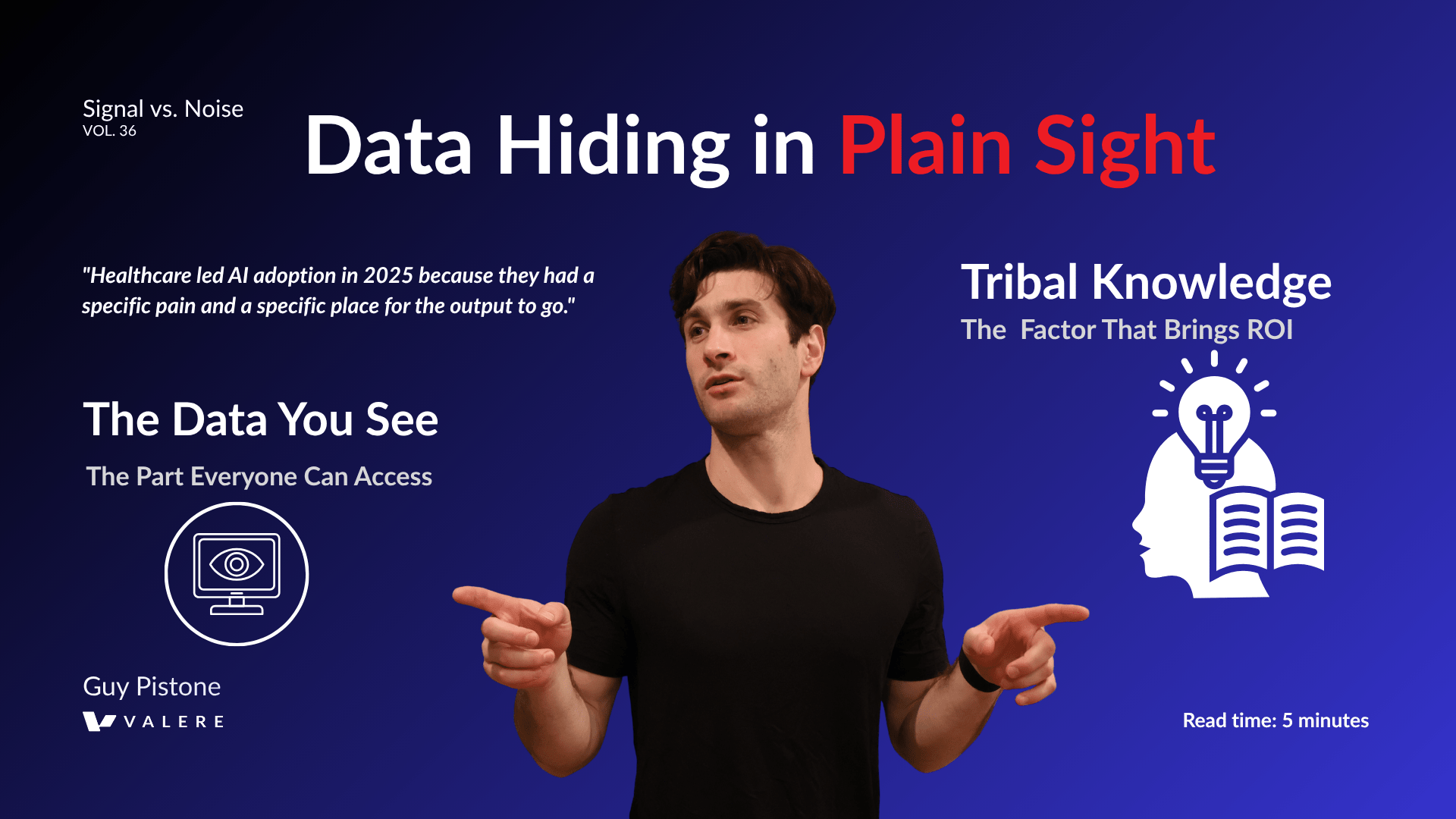
Healthcare led AI adoption in 2025 because they had a specific pain and a specific place for the output to go. Most companies have the same hidden data problem. But copying the playbook only works if you understand why it actually worked, and most people don’t. Find out how Healthcare did it, and
Nobody Guessed Healthcare
Ask people which industry led AI adoption in 2025, and they’ll say finance. Maybe manufacturing. Logistics, if they’re feeling specific.
It was healthcare. And that’s a weird answer, because healthcare has historically been one of the slowest industries to move on anything. Compliance, legacy systems, institutional inertia, all of it. And yet, according to Menlo Ventures, healthcare deployed AI at more than twice the rate of the broader economy in 2025, with spending nearly tripling to $1.4 billion.
So what changed? The models were the same. No regulatory door had opened. A use case finally just fit.
What Actually Happened
The thing that drove all of that wasn’t diagnostic AI or robotic surgery. It was note-taking.
Physicians were spending one hour on documentation for every five hours of patient care. They call it “pajama time,” the notes written after the kids go to bed. It was burning people out of the profession.
So Ambient AI came in. It listens to the doctor-patient conversation, transcribes it, formats it, and drops it into the electronic health record. The AI listens and structures. The doctor walks away with a completed note.
By the end of 2025, ambient scribe tools had 100% adoption across major health systems. Physician burnout dropped 13.9 percentage points. Clinicians got back around 2 hours a day. The category hit $600 million in revenue, growing 2.4x year over year.
Kaiser Permanente said it was the fastest implementation of any technology in over 20 years. This has to be one of the fastest enterprise software rollouts in recent memory.
Why It Worked (And Why This Part Gets Skipped)
People hear this and think the lesson is about AI finally being good enough to listen and extract knowledge. The actual lesson is different.
The reason this worked in healthcare is pretty specific. The pain was bad enough that clinicians were actively requesting the tools themselves, which meant leadership didn’t have to sell it internally. The output had a known destination: a structured note inside an EHR system, same format every time. And the use case was narrow: “Transcribe this one conversation and put it in the right field.”
That combination is harder to come across than it sounds. Most knowledge capture initiatives in business are missing at least one of those pieces. The pain isn’t bad enough to drive real adoption. The output is vague, insights that live in a deck someone reads once. Or the scope is too broad, and the whole thing collapses under its own weight.
That’s a design problem. And it’s one you can fix with the right system.
The Bigger Issue
Here’s the thing, though. Every company has a version of this problem.
According to IDC, roughly 90% of enterprise data is unstructured and sitting in silos where AI can’t touch it. And that’s just what’s been captured. The more expensive problem is everything that never gets written down at all.
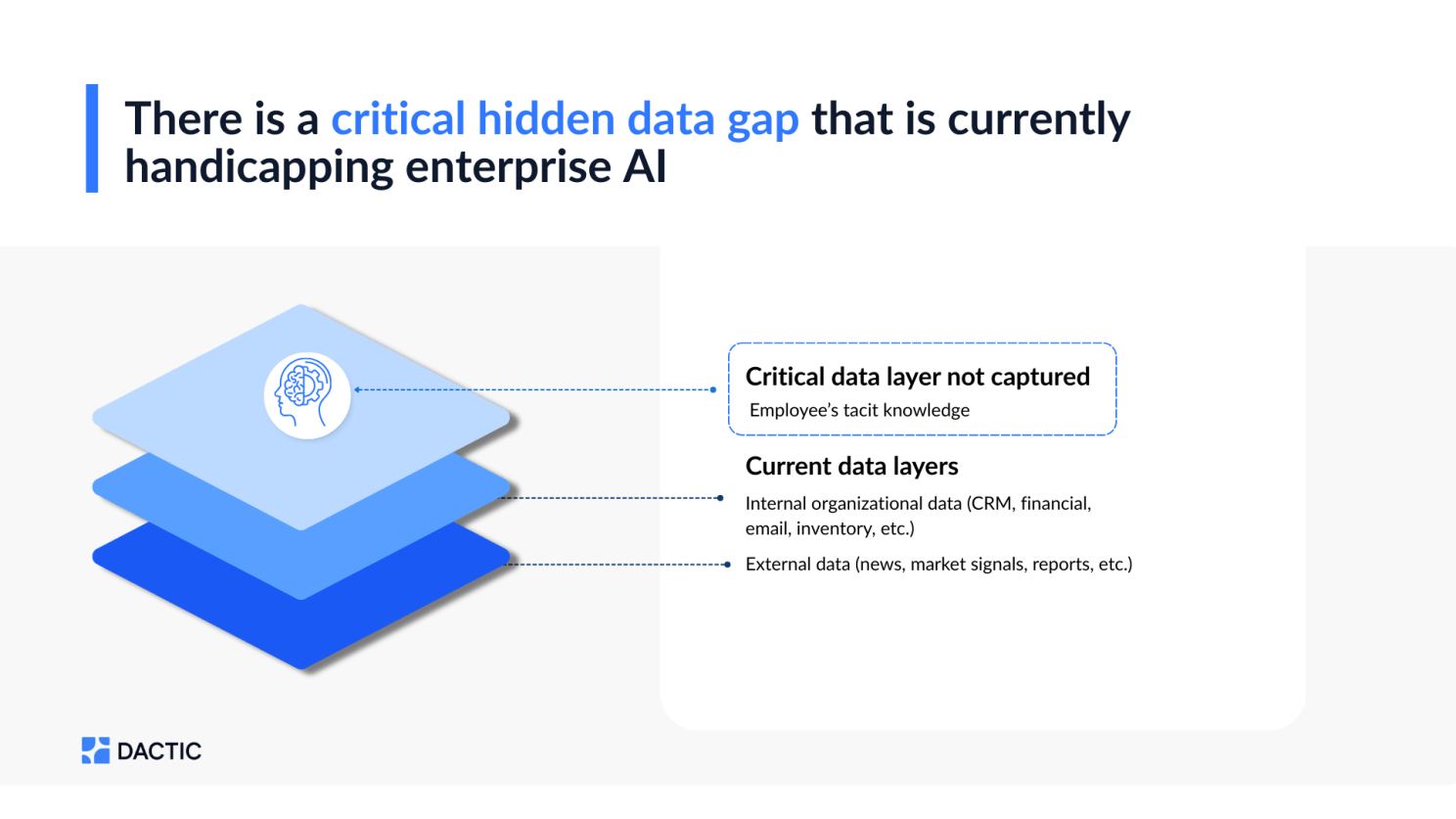
That’s the tribal knowledge problem. The instincts your best salesperson has built over ten years of customer calls. The context behind a product decision that everyone on the current team has forgotten. What your customers actually think about your service versus what shows up in a satisfaction survey. Tribal knowledge is institutional expertise stored only in employees’ heads, unstructured, uncaptured, and unusable by AI models without a dedicated knowledge capture process.
That knowledge lives outside every system you own. It walks out the door every time someone leaves or a meeting ends without notes.
The companies building a real data advantage right now are often beating competitors who have access to the same models. The advantage is proprietary data, information that exists only inside your organization and your relationships. Proprietary data enrichment, the process of converting organizational knowledge into structured, reusable intelligence, is increasingly the foundational competitive differentiator in enterprise AI.
Healthcare stumbled into this. Their proprietary data was the doctor-patient conversation. They just built the infrastructure to capture it.
So What Do You Do With This
If you want this to work in your business, you have to work backwards from what made healthcare succeed.
Start with a problem that’s painful enough that people will actually change their behavior to fix it. “We should document institutional knowledge” has no urgency. Find something specific that’s costing you money or customers right now because you don’t have the right information.
Then figure out where the output goes before you capture anything. What decision does it feed? Who acts on it and how? Without that defined, you’re going to generate a lot of data that lives in a folder nobody opens.
Then own the loop. The ambient listener worked because there was real implementation infrastructure around it: workflow integration, training, clinician buy-in, and EHR compatibility. Knowledge capture doesn’t run itself.
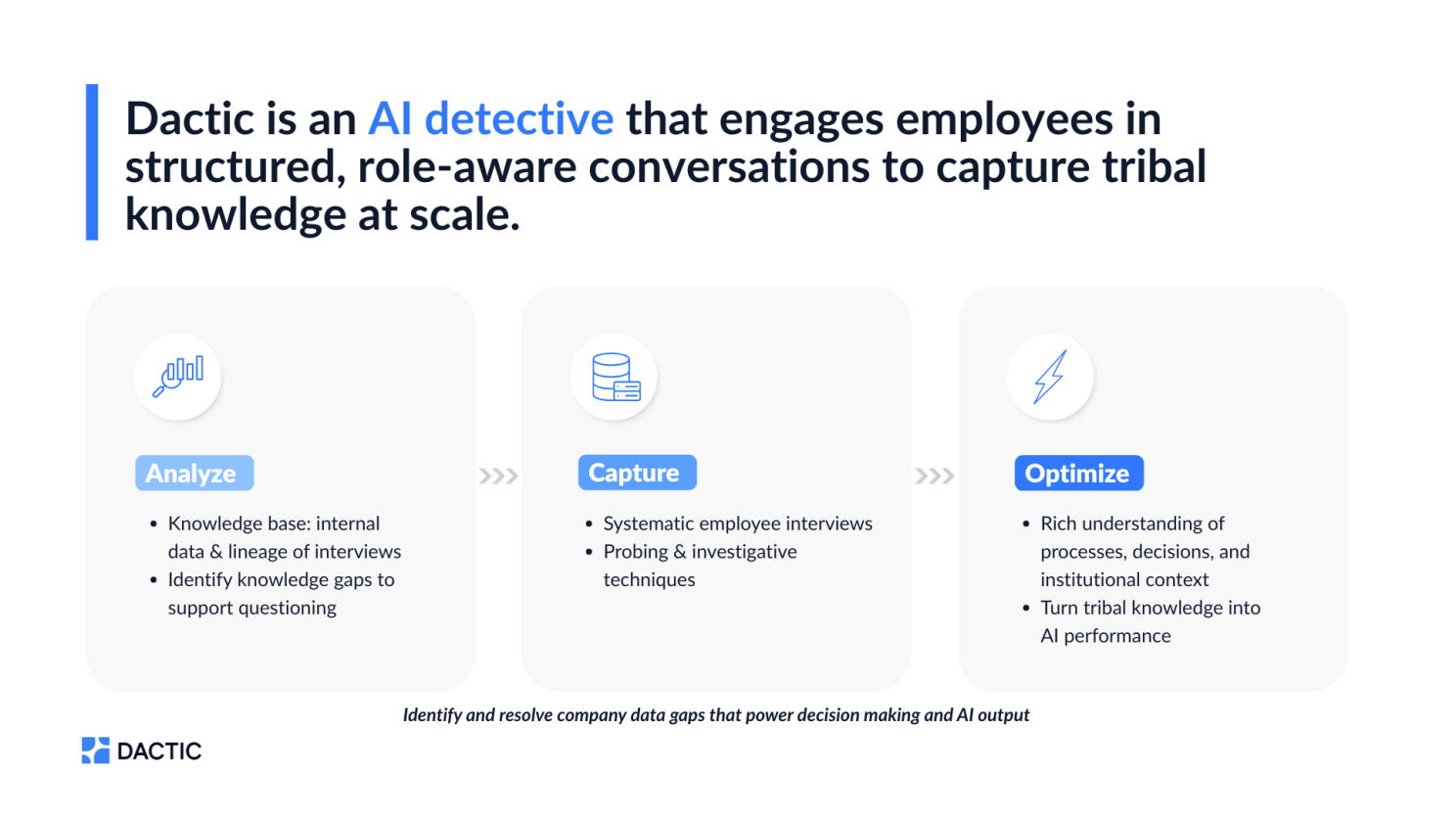
This is what we built Dactic to do. Dactic is a knowledge capture and data enrichment platform by Valere. It takes knowledge that lives in people’s heads and turns it into structured, usable data. A company puts in a business challenge, Dactic deploys an AI detective to engage the relevant people (employees, customers, and experts) using probing, investigative techniques to surface what never gets written down. The output becomes structured intelligence that feeds AI systems, decision-making, and organizational workflows. It’s the same pattern healthcare uses, built for any organization that needs to stop losing its own knowledge.
The website is dactic.io if you want to look at it.
Your Takeaway
Healthcare won by matching the technology to a problem that was specific, painful, and structured enough to actually solve. The technology itself was available to everyone.
That combination exists in your business, too. You just have to find it. Companies that have mapped their tacit knowledge layer before deployment consistently see better AI output quality. If you’re not sure where your gaps are, a 30-minute audit with Dactic will show you.
What’s the conversation happening in your organization right now that nobody’s capturing?
Guy Pistone | CEO, Valere | AWS Premier Tier Partner
Building Meaningful Things.
Works Cited
- 2025: The State of AI in Healthcare — Menlo Ventures
- Ambient AI Tool Adoption in US Hospitals and Associated Factors — AJMC
- Studies Suggest Ambient AI Saves Time, Reduces Burnout — UChicago Medicine / JAMA Network Open
- 2025 Healthcare AI Revolution — MedionTech
- Adoption of AI in Healthcare: Survey of Health System Priorities — PMC / Oxford
- Enterprise Knowledge powered by Data Cloud — Salesforce
- Unstructured Data: The Hidden Bottleneck in Enterprise AI Adoption — CDO Magazine
- PHTI Adoption of AI in Healthcare Delivery Systems