From the Desk of Guy Pistone – Weekly insights for operators at Mid-Market & PE-Backed companies
TL;DR
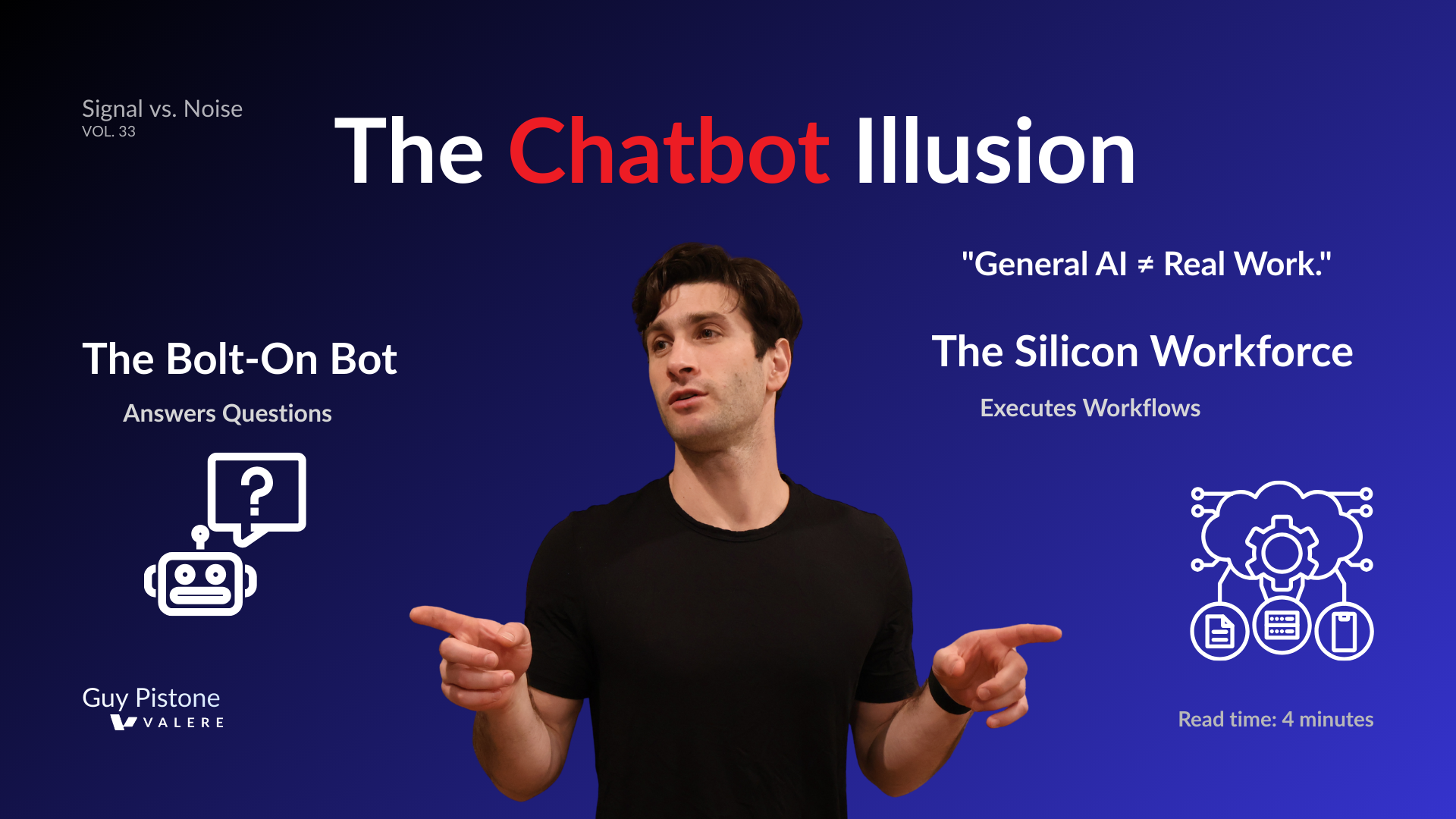
Everyone bought a corporate chatbot, handed it to their teams, and waited for productivity to skyrocket. It didn’t. Why? Because a general-purpose chatbot doesn’t do work, it answers questions. The enterprise AI market is shifting from “generalist chatbots” to a “Silicon Workforce” of specialized, role-based AI agents. The fix isn’t buying a smarter chat window; it is engineering-orchestrated multi-agent systems that have specific jobs, system permissions, and the autonomy to execute workflows from start to finish.
The Illusion of the Chatbot
Unless you’re living under a rock, you know that in enterprise AI right now, chatbots are just a stepping stone, and asking an employee to prompt an AI is still asking them to do work.
I see this pattern constantly. A company launches a general-purpose AI pilot. Everyone high-fives over a cleverly drafted email, but three months later, adoption drops because users are tired of constantly feeding the bot context. Gartner predicts that while 40% of enterprise applications will feature task-specific AI agents by 2026, many early agentic projects will fail because legacy systems lack the real-time execution capabilities required to support them.
If you treat AI like an encyclopedia instead of an employee, you aren’t automating processes; you are just creating a very expensive search engine.
From Generalists to Specialists (The Mechanics of Work)
When I diagnose a failing AI initiative, it usually comes down to one core issue: companies are relying on a single, isolated agent to do everything. The organizations actually scaling AI are building a Silicon Workforce. They use multi-agent systems where individual AI agents are assigned distinct roles, working collaboratively to achieve business objectives.
Let’s look at the difference between a bolt-on chatbot and a role-based agent across standard SaaS operations:
1. The AI Procurement Specialist
- The Chatbot: Drafts a generic email to a vendor asking for a quote.
- The Role-Based Agent: Monitors the ERP inventory autonomously. When it flags low stock, it triggers an API to request quotes from three approved vendors, compares the pricing, and surfaces the best option to a human for 1-click approval.
2. The AI IT Ops Manager
- The Chatbot: Gives an employee a link to a troubleshooting article.
- The Role-Based Agent: Detects a locked account, verifies the user’s identity via Okta, resets the password across three different systems, and resolves the Level 1 support ticket without human intervention.
3. The AI HR Onboarding Specialist
- The Chatbot: Summarizes the employee handbook.
- The Role-Based Agent: Reads a new hire trigger in Workday, provisions software seats, sets up the relevant Slack channels, and routes tax documents to payroll automatically.
3 Architectural Fixes for Production Stability
You don’t need a smarter language model. You need a better operating system around the models. Here is how I advise clients to build their workforce:
- Define the Role, Not the Prompt: Give agents a strict job description and system access to one specific workflow.
- Implement the Supervisor Pattern: Use a central “manager” agent that receives complex requests and delegates tasks to specialized sub-agents.
- Maintain Human-in-the-Loop Guardrails: True enterprise value happens when agents do the heavy lifting, but a human handles compliance and final approvals.
The 4-Step Blueprint: How to Build Your First Agent
Here is the exact framework we use to define an end-to-end agent:
- Map the “Shadow” Workflow: Don’t build for the official Standard Operating Procedure. Build for how the work actually gets done. What screens is the employee clicking through? What data are they copy-pasting?
- Define the Boundaries (The Job Description): Give the agent a strict role. What specific APIs does it have read access to? What systems does it have write access to? Restrict everything else.
- Establish the “Human-in-the-Loop” Hand-off: True enterprise value happens when agents do the 90% heavy lifting, but a human handles the final 10% for compliance. Define exactly where the AI stops and the human clicks “approve.”
- Deploy the Supervisor: Don’t expect the user to know which agent to talk to. Build a “Supervisor Agent” that acts as a router, taking the human’s broad request and delegating the sub-tasks to the right specialists in the background.
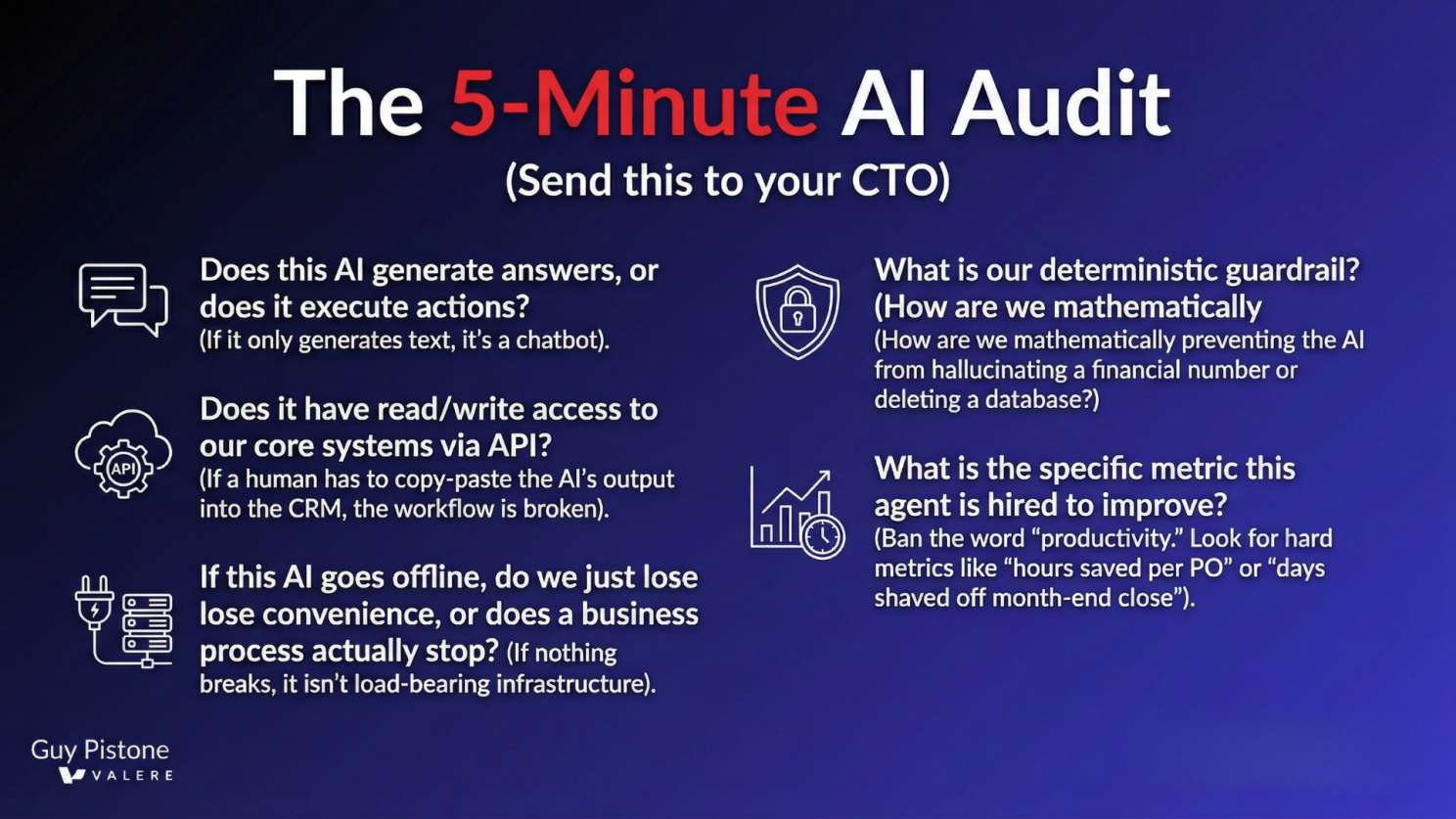
The 5-Minute AI Audit (Send this to your CTO)
If your team is currently pitching or building an internal AI tool, ask them these five questions. If they fail this audit, you are building a toy, not a tool:
The Operator Takeaway
The error most leaders make is thinking of AI as a standalone application. It is not an app. It is infrastructure.
To relate it to something we can all wrap our heads around, hiring an AI is like hiring a human. You would never hire a human, give them zero system access, no job description, and tell them “figure out how to help.”
If you want ROI, you have to orchestrate your AI agents exactly like you orchestrate your human teams.
To everyone budgeting for AI, here is my new rule of thumb: Stop paying for general intelligence. Start investing in specific integration.
Ready to stop the “pilot failure” and build a Silicon Workforce that survives the real world? Book a 30-Minute Audit.
Guy Pistone | CEO, Valere | AWS Premier Tier Partner
Building meaningful things.
Works Cited
- Gartner Predicts 40% of Enterprise Apps Will Feature Task-Specific AI Agents by 2026. Read the press release: https://www.gartner.com/en/newsroom/press-releases/2025-08-26-gartner-predicts-40-percent-of-enterprise-apps-will-feature-task-specific-ai-agents-by-2026-up-from-less-than-5-percent-in-2025
- The agentic reality check: Preparing for a silicon-based workforce (Deloitte Insights). Read the article: https://www.deloitte.com/us/en/insights/topics/technology-management/tech-trends/2026/agentic-ai-strategy.html
- Multi-Agent Setup and AI Ecosystems. Read the article:https://medium.com/data-science-collective/multi-agent-setup-and-ai-ecosystems-6c1470904175