By: Alex Turgeon, President at Valere
TL;DR: 3 Key Takeaways
- 80% of your organization’s intellectual capital exists as undocumented tribal knowledge — the experiential wisdom in employees’ heads that generic AI models cannot access, creating a critical barrier to achieving real ROI from AI transformation initiatives.
- Systematic tribal knowledge capture reduces implementation time from 3-5 weeks to 1 week while preventing the loss of $92 billion in annual productivity caused by undocumented expertise, turning institutional intelligence into a proprietary competitive advantage.
- AI-first organizations achieve measurable outcomes — including 20% churn reduction, 80% faster opportunity identification, and 15% operational efficiency gains — by training AI systems on proprietary knowledge rather than relying on generic public data that regresses to industry averages.
Every company investing in AI right now is chasing the same promise: unprecedented efficiency, better decision-making, and competitive advantage through intelligent automation. But there’s a critical problem that almost no one is talking about, and it’s not about the technology itself.
The real barrier to AI transformation isn’t compute power, model sophistication, or even budget. It’s something far more fundamental: the vast majority of knowledge that makes your organization actually work isn’t captured anywhere that an AI can access it.
The Invisible Knowledge Crisis
Think about the last time someone at your company solved a complex problem. Maybe it was navigating a difficult client relationship, handling an unusual procurement situation, or resolving a technical issue that didn’t fit the standard playbook. How did they know what to do? Chances are, they drew on institutional knowledge that exists nowhere in your documentation.
This is what we call tribal knowledge, and it’s the lifeblood of organizational effectiveness. It lives in Slack messages that scroll out of view. It sits in old email threads that only a few people remember. Most critically, it exists in the heads of your senior employees, the ones who understand not just how things are supposed to work according to the org chart, but how they actually work in practice.
Consider a government contracting firm we worked with whose sales and engineering teams possessed deep, siloed knowledge about Navy budget nuances and unstated priorities in government contracting. This expertise existed purely as gut feel decision-making. Senior team members could look at an opportunity and somehow know whether it was worth pursuing, but they couldn’t articulate exactly how they knew. New team members struggled to develop this intuition, and the company found themselves reactively chasing opportunities, often wasting capacity on poor-fit bids that veterans would have immediately recognized as dead ends.
This pattern repeats across industries. It’s the unrecorded conversation where someone explains why you always handle that particular client differently. It’s the workaround that everyone on the team knows but no one ever documented. It’s the context that separates a decent decision from the right decision, the difference between following the process and knowing when to break it.
Why Generic AI Gives You Generic Results
Here’s what happens when companies deploy AI without addressing this knowledge gap: they get impressive-sounding tools that deliver disappointing results. The AI can write emails, summarize documents, and answer general questions with remarkable fluency. But when it comes to the decisions that actually matter to your business, it falls flat.
Take a construction software company we worked with that needed to scale their email marketing to over 250,000 contacts without adding headcount. They knew standard large language models could generate emails. That wasn’t the problem. The problem was that generic LLMs produced generic messaging that their veteran sales and SDR teams would never send. The AI didn’t understand the specific buyer pain points in the construction software sector. It couldn’t replicate the successful messaging patterns that their best sellers had developed through years of experience.
Public large language models know everything about the internet, but they know nothing about your business. They’ve never seen your specific procurement contracts. They don’t understand your unique customer service philosophy. They have no context for why your finance team structured that particular workflow the way they did, or why you make exceptions for certain clients but not others.
The Deployment Gap Nobody Talks About
The AI industry doesn’t advertise its failure rate, but the data is stark. Research shows that:
- At least 30% of LLM-based enterprise projects will be abandoned after proof-of-concept
- Only 22% of solutions requiring fundamental architectural shifts reach successful deployment
- Generic models regress to the mean, producing outputs that gravitate toward industry averages rather than your unique competitive advantages
Without proprietary context, AI becomes just another generic tool giving you generic answers. It might sound sophisticated, but it doesn’t move the needle on what actually matters. You end up with regression to the mean. Your AI-powered solutions perform no better than industry averages because they’re built on industry-average knowledge.
This is the fundamental flaw in how most organizations approach AI adoption. They focus on implementing the technology while ignoring the fuel it needs to deliver real value.
The Silver Tsunami: A Ticking Clock
The urgency of this problem is amplified by an unprecedented demographic shift. Every month, over 250,000 Baby Boomers turn 65, taking decades of undocumented processes and institutional memory with them into retirement. This isn’t just a personnel challenge. It’s a massive liquidation of intellectual capital happening in real time.
The numbers tell a sobering story:
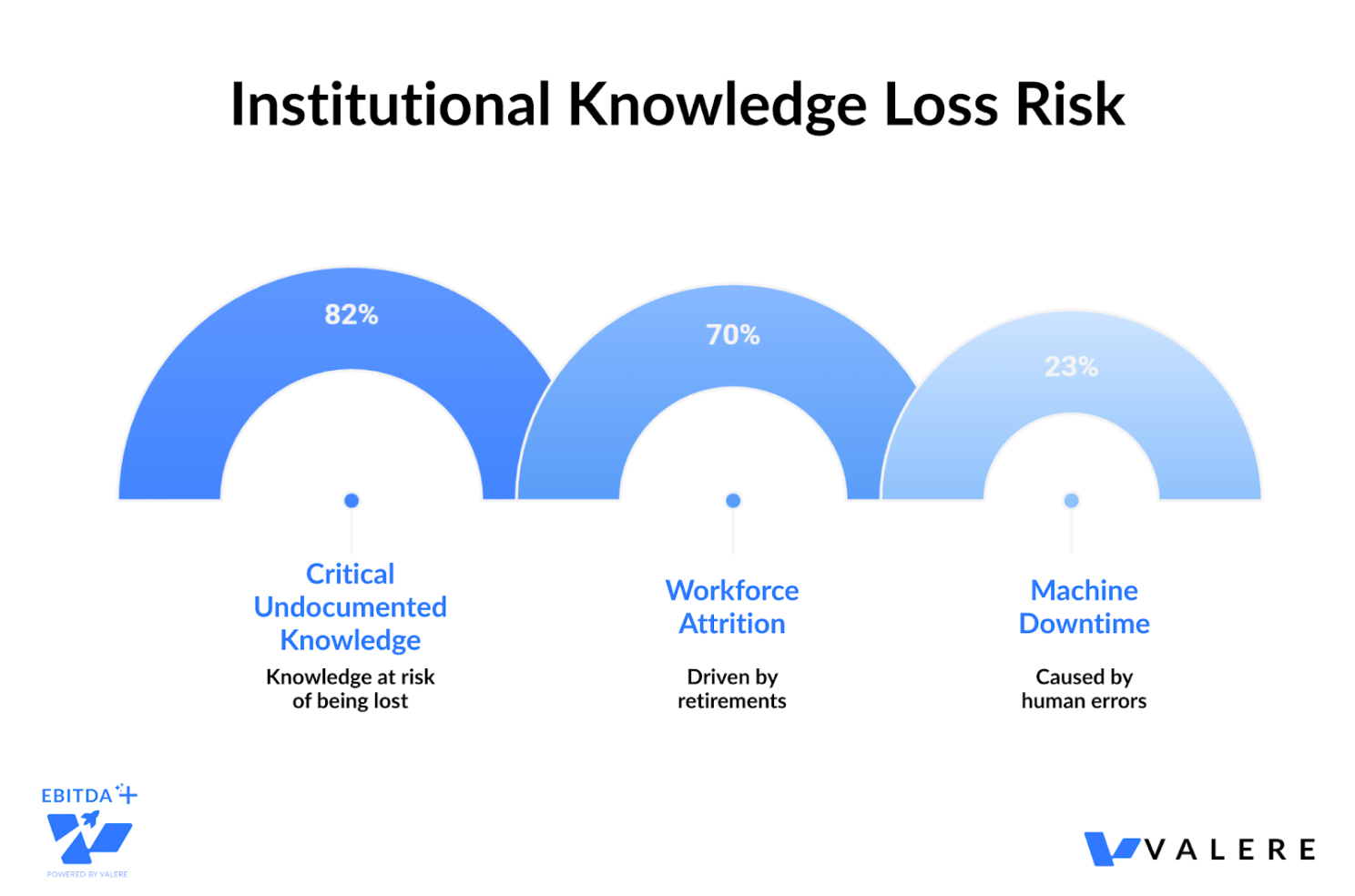
- In manufacturing alone, nearly 25% of the workforce is 55 or older
- Up to 70% of critical undocumented knowledge is at risk of being lost forever
- 82% of workforce attrition in many sectors is driven by retirements, not resignations
- 23% of machine downtime is caused by human errors stemming from lack of access to tribal diagnostic logic
The cruel irony is that this knowledge is simultaneously your most valuable asset and completely invisible to leadership. You can’t put it in a spreadsheet. You can’t find it in your CRM. It exists in fragments scattered across a dozen systems and locked inside the institutional memory of people who might retire, get promoted, or leave for another opportunity at any moment.
The Data vs. Wisdom Gap
Here’s a critical distinction that trips up many organizations: having data is not the same as having wisdom. Your systems are full of data. Your CRM tracks every customer interaction. Your project management tools log every task. Your analytics platforms measure everything that moves.
But data alone doesn’t tell you what actually indicates a customer is at risk before the numbers show it.
Understanding the Knowledge Spectrum
Not all knowledge is created equal. When we talk about tribal knowledge, we’re actually dealing with multiple layers:
Explicit Knowledge (easily documented)
- Standard operating procedures
- Database entries
- Training manuals
- Written policies
Implicit Knowledge (applied in practice)
- How explicit knowledge gets used in real situations
- Shared through informal communication
- Developed through social interaction
Tacital Knowledge (deeply experiential)
- Deep, experience-based understanding
- Intuition and pattern recognition developed over years
- Personal and context-specific
- Often unconscious and difficult to articulate
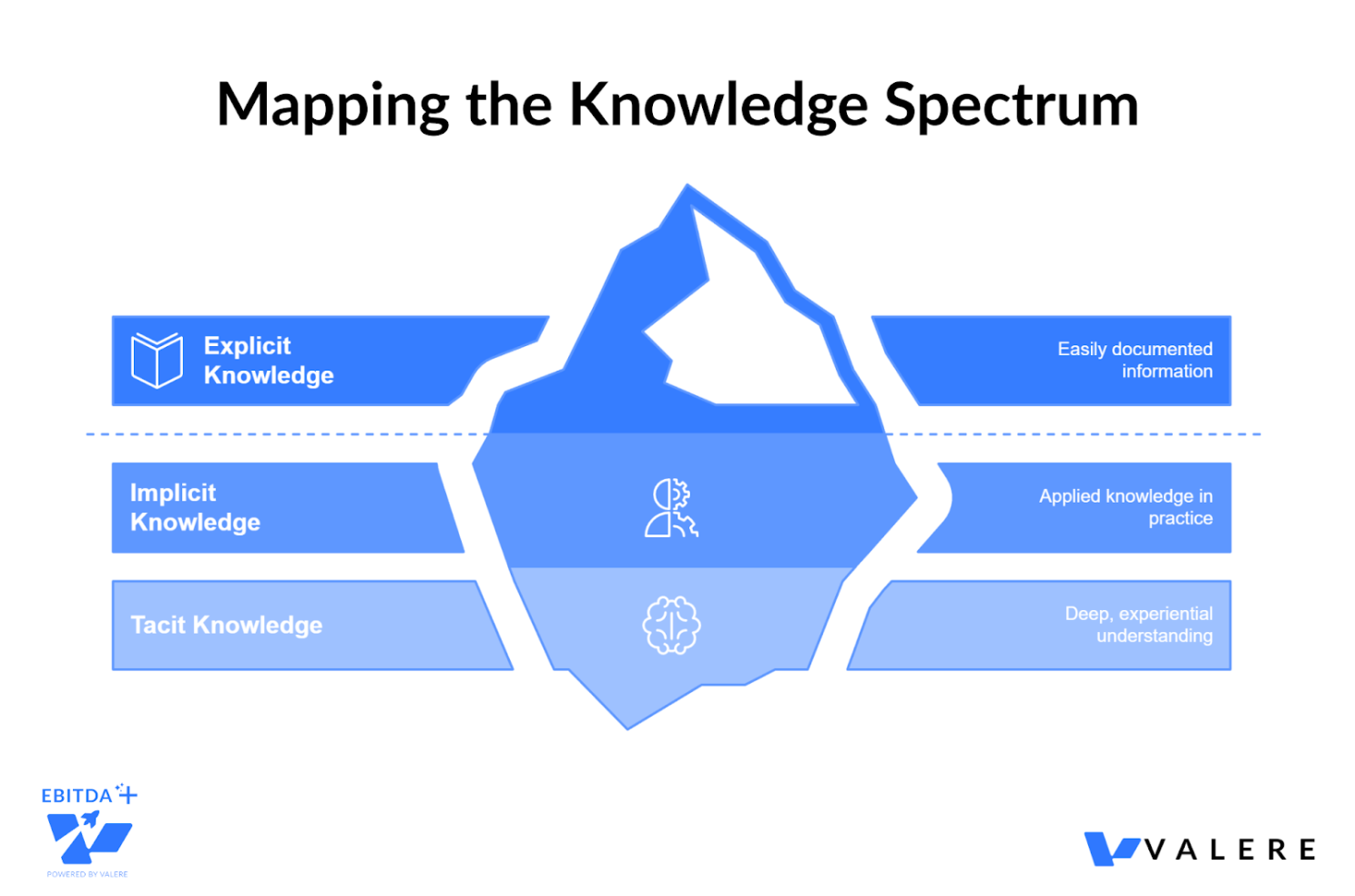
Here’s the challenge: tacit knowledge accounts for over 80% of an organization’s intellectual capital, yet roughly 50% of operational activities are documented only through word of mouth or unspoken habit.
When Numbers Miss the Story
An automotive technology company we worked with learned this the hard way. They had plenty of data and relied on reactive auditing to prevent customer churn. But their Customer Success teams possessed something more valuable: implicit, experiential wisdom about early warning patterns that the data didn’t capture. A CS rep could sense when a customer was heading toward churn based on subtle signals. The tone of communication. The types of questions being asked. The timing of certain behaviors. All of this happened long before usage metrics dipped.
This contextual intelligence existed solely in the heads of their best CS agents. They knew which intervention strategies actually worked for different customer profiles. They understood the nuances that separated a customer who needed hand-holding from one who needed space. But none of this was systematized. When a great CS rep left, that wisdom walked out the door.
The same pattern exists in your organization:
- Your best salespeople know which prospects are serious and which are tire-kickers
- Your senior engineers know which technical approaches will create maintenance headaches down the road
- Your operations managers know which vendors can be trusted to deliver in a crunch
- Your finance team knows when to push back on exceptions and when flexibility makes strategic sense
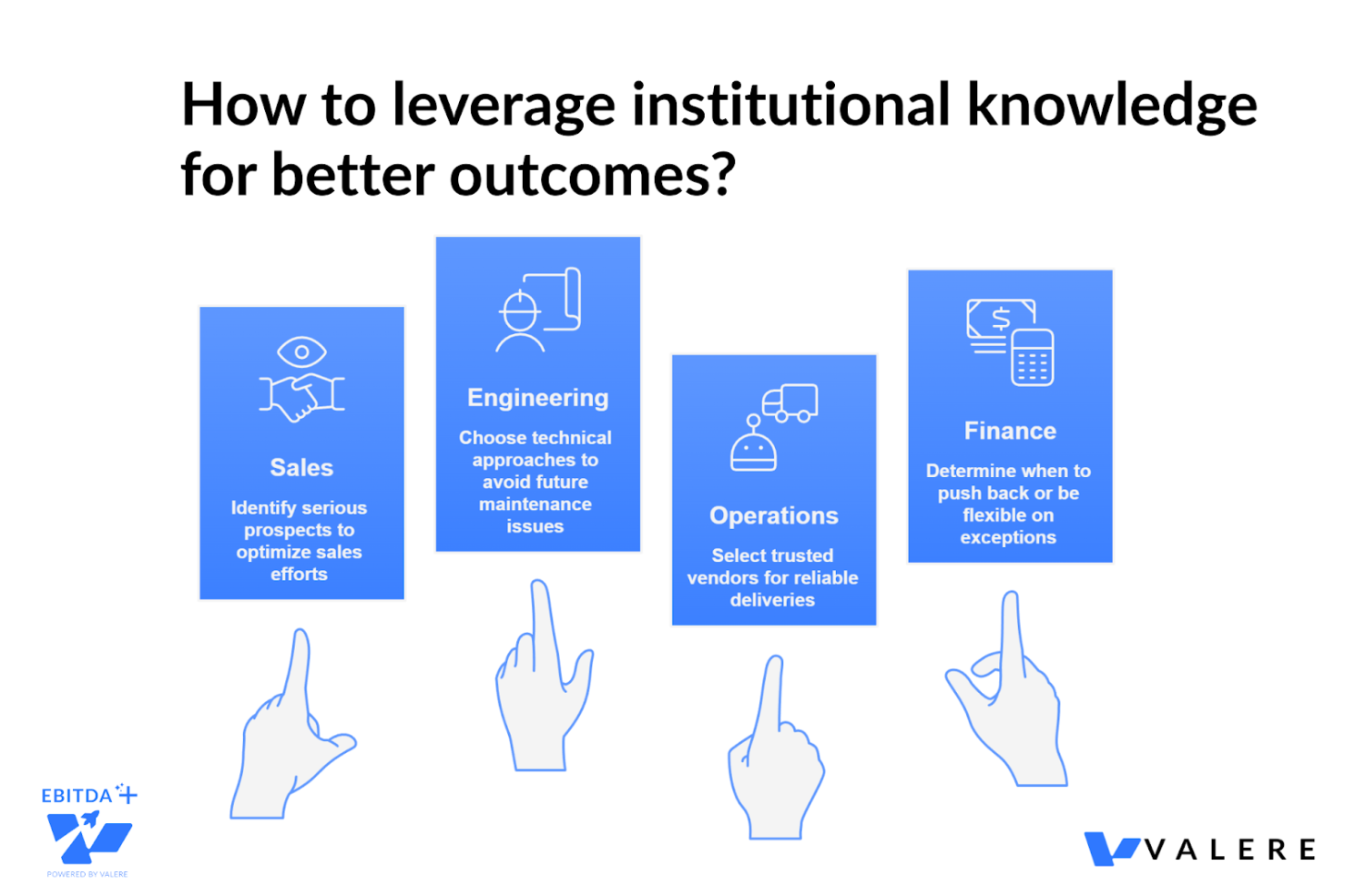
This is the knowledge that makes the difference between adequate and excellent outcomes, and almost none of it exists in a form that AI can leverage.
The Knowledge Capture Challenge
Understanding the problem is one thing. Solving it is another entirely. Traditional approaches to capturing institutional knowledge are painfully slow, expensive, and ultimately ineffective.
The Economic Cost of Inaction
The financial consequences of failing to capture institutional knowledge are staggering:
- $92 billion: Annual US manufacturing losses due to human error stemming from undocumented expertise
- $39,000 to $2 million: Hourly cost of machine downtime when tribal knowledge holders aren’t available
- $20,000 to $40,000: Average replacement cost for a skilled worker, not including knowledge transfer time
- 60% increase: Rise in downtime recovery time over five years as expertise dilutes across the workforce
When institutional memory remains siloed in individual minds, it creates a single point of failure within critical workflows. Employees may intentionally or unintentionally position themselves as indispensable by becoming the only person capable of resolving specific technical problems or navigating legacy systems. This creates a fragile operational environment where the departure of a single knowledge holder can lead to catastrophic downtime.
Why Traditional Methods Fall Short
Web scraping your internal documentation captures theoretical processes. The official version of how things are supposed to work. Documentation repository scanning finds the workflows that someone took the time to write down, which are usually the simple, straightforward ones. What both approaches miss is the messy reality of how your systems actually function end-to-end. They can’t extract the implicit, experiential wisdom that makes your operations effective. They don’t capture the judgment calls, the edge cases, or the contextual decision-making that separates good performers from great ones.
Manual knowledge capture through traditional interviews and documentation processes can work, but the timeline is prohibitive. We’re talking three to five weeks to properly document a single domain of expertise, and that’s if you can get busy stakeholders to prioritize the process. Scale that across an organization, and you’re looking at years of effort before you have a foundation comprehensive enough to power meaningful AI capabilities.
Meanwhile, the clock is ticking. Every day, experienced employees are making critical decisions based on knowledge that exists only in their heads. Every month, someone with decades of institutional expertise retires or moves on, taking irreplaceable context with them. The knowledge gap isn’t static. It’s growing.
Building AI on Your Unique Reality
In our work at Valere, we’ve seen firsthand that tribal knowledge capture isn’t a nice-to-have preparatory step for AI transformation. It’s the foundation that determines whether your AI investments deliver transformational value or disappointing mediocrity.
We built Dactic to solve this problem at the speed and scale that modern organizations require. Using advanced AI and automation, Dactic captures and codifies the proprietary institutional knowledge that public AI models simply cannot access, transforming scattered, unstructured tribal knowledge into a proprietary qualitative knowledge base.
The Externalization Challenge: Making the Invisible Visible
The knowledge management field has long recognized this challenge through what’s called the SECI model, which describes how knowledge flows through organizations:
Socialization: Sharing tacit knowledge through shared experience
- Increasingly difficult in remote, distributed workforces
- Requires physical proximity and time together
Externalization: Codifying intuition into explicit concepts
- The most difficult and critical phase
- Where tacit knowledge becomes accessible to systems
Combination: Connecting different bodies of explicit knowledge
- AI systems excel at this once data is properly captured
- Creates new insights from existing knowledge
Internalization: Embodying explicit knowledge back into practice
- Training and onboarding the next generation
- Closing the knowledge transfer loop
The bottleneck has always been externalization. How do you get a veteran machinist to articulate the subtle vibrations that tell them a machine needs maintenance? How do you capture the instinct that makes a senior sales executive know when to push and when to walk away?
This is where AI-powered interviewing changes everything.
How Knowledge Extraction Actually Works
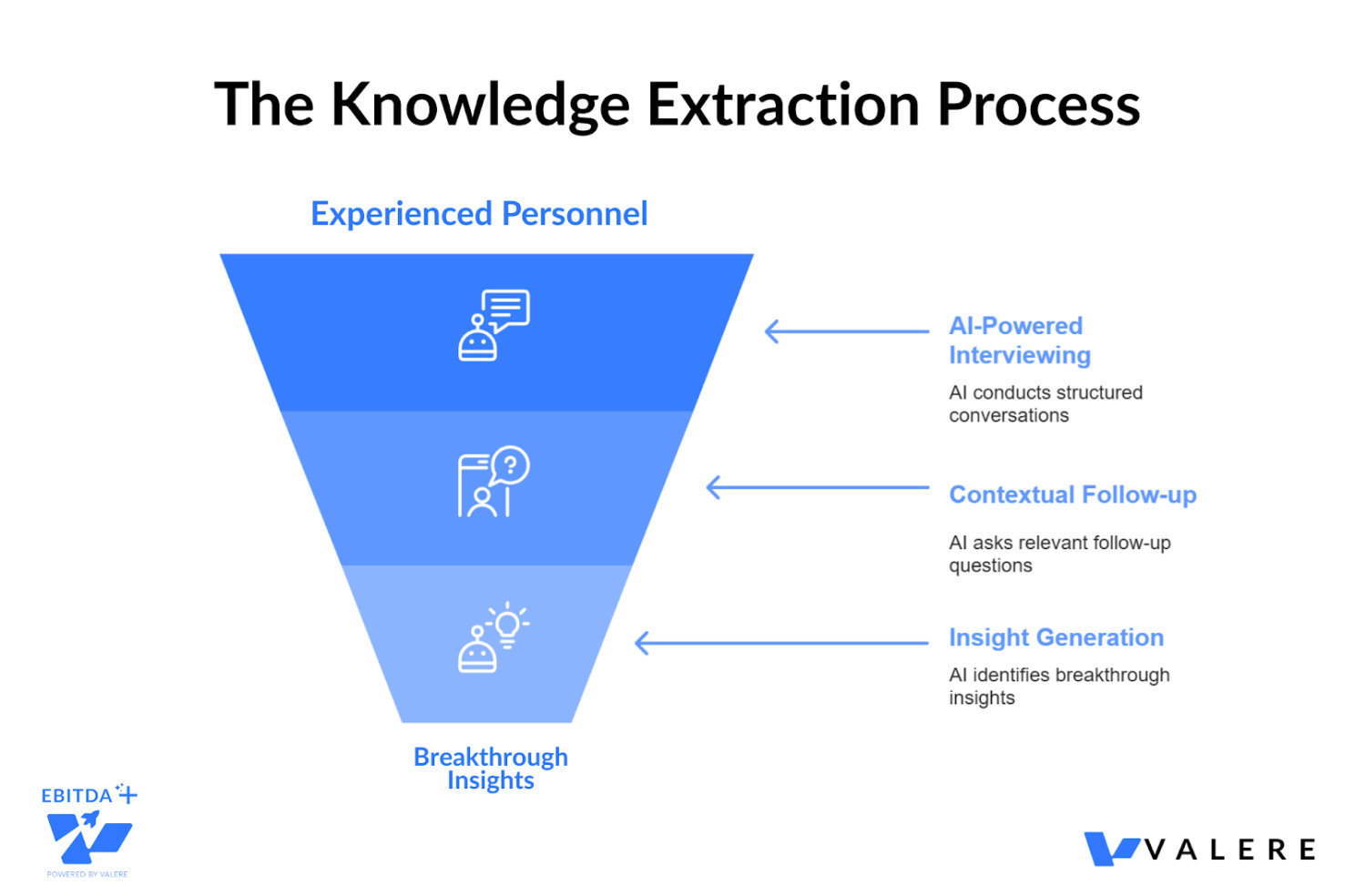
The process centers on AI-powered interviewing that captures knowledge directly from your experienced personnel. Unlike traditional documentation efforts that ask people to write down what they know (a task that rarely gets prioritized), Dactic conducts structured conversations that extract operational reality:
- How do things actually work when the standard process doesn’t fit?
- What contextual factors drive decision-making in ambiguous situations?
- What makes the difference between adequate and excellent outcomes?
- Why do certain approaches work while others fail in your specific environment?
The AI interviewer acts as a skilled co-interviewer, asking contextually relevant follow-up questions. Research shows this technique generates over 50% of breakthrough insights that static surveys and documentation requests completely miss.
Turning Gut Feel Into Quantified Intelligence
When the government contracting firm engaged with us, the goal was to transform their contracting knowledge from scattered intuition into structured intelligence. We conducted automated interviews with sales executives, engineers, and operations teams, systematically extracting specific win/loss patterns, technical capabilities, and those elusive unstated priorities of contracting officers that veterans understood but couldn’t articulate.
Instead of relying on generic government contracting data available to everyone, we codified the team’s experiential wisdom into a structured database of past performance narratives and relationship mapping. The result was a proprietary intelligence layer that captured not just what happened, but why certain approaches worked and others didn’t.
The impact was immediate and measurable:
- 30 to 90 days earlier opportunity identification compared to competitors
- 80% reduction in manual opportunity search time
- 100% elimination of poor-fit pursuits through quantified scoring
- Complete preservation of institutional knowledge against turnover
They had systematized the pattern recognition that previously existed only in senior team members’ heads. When a veteran team member left, their expertise remained accessible to the organization.
Capturing the Context That Data Misses
For the automotive technology company, our approach revealed something profound about the difference between information and wisdom. We interviewed their CS team members to extract the early warning patterns and proven intervention strategies that were never formally systematized. What emerged was a rich map of contextual nuances and qualitative insights that existed solely in individual experiences.
The system documented observable signals that the best CS agents instinctively recognized:
- Certain communication patterns that indicated frustration before it became explicit
- Specific types of questions that signaled deeper confusion or misalignment
- Timing anomalies in customer behavior that predicted churn risk
- Contextual cues that determined which intervention approach would work
More importantly, it mapped these signals to specific, successful retention playbooks that had been developed through trial and error but never codified.
This transformed their entire approach from reactive to proactive:
- 20% reduction in early-stage churn through earlier intervention
- 15% increase in CS bandwidth as teams focused on high-value activities
- Scalable asset created from the collective wisdom of best performers
- Resilience against turnover as individual expertise became institutional intelligence
The collective wisdom of their best CS agents became a scalable, automated asset rather than tribal knowledge vulnerable to turnover.
Creating Proprietary Training Corpora
The construction software company we worked with faced a challenge that illustrated another dimension of the tribal knowledge problem. They needed their AI-powered email marketing to reflect the quality and specificity of their best human sellers, but standard LLMs had no access to the institutional knowledge that made those sellers effective.
We interviewed marketing and sales staff to codify institutional knowledge regarding ideal customer profile characteristics and proven outreach strategies specific to the construction software sector. This created an enterprise-specific training corpus that didn’t exist anywhere else. Not in public data, not in their documentation, not even in their CRM.
The captured knowledge included:
- Nuanced understanding of how different buyer personas respond to messaging
- Which pain points resonate in different market segments
- How to adapt communication style based on buying journey stage
- Industry-specific terminology and references that build credibility
- Proven sequences and timing patterns that drive engagement
The result was a proprietary knowledge base that fueled autonomous agents capable of orchestrating compliant outreach across 210 to 300 inboxes. But what we’ve found most valuable is making it a living intelligence system. New learnings (what worked, what didn’t, emerging patterns) feed back into the knowledge base. The collective wisdom doesn’t just persist. It evolves and improves over time.
These interviews preserve institutional knowledge before it’s lost to turnover or retirement, creating enterprise-specific training corpora that don’t exist anywhere else. They capture:
- Company-specific business logic and decision frameworks
- Edge cases that matter to your specific operations
- Contextual wisdom that makes everything actually function
- The collective intelligence of your organization in AI-ready format
The speed advantage is significant. What traditionally takes three to five weeks of coordination and documentation effort gets completed in one week. The system conducts interviews at scale while maintaining the depth required for critical stakeholders. This dramatically accelerates the foundation building required for all other AI initiatives.
There’s also a significant operational benefit that often gets overlooked: asynchronous stakeholder interviews eliminate what we call the herding cats problem. Getting senior leaders and domain experts into the same room at the same time is often the longest pole in any knowledge capture effort. This approach saves management time while actually producing better outcomes, because people can contribute their expertise when they have the mental space to do it justice.
The Knowledge Is Power Paradox
This resistance is completely rational. For decades, job security came from being the person who knew things others didn’t. The IT operations leader who can fix the legacy system nobody else understands. The sales veteran who has relationships nobody else can replicate. The engineer who knows why certain processes exist even though they seem inefficient.
To convince these knowledge holders to share what they know, you need to reframe the narrative from replacement to augmentation:
For Individual Contributors:
- Sharing routine troubleshooting logic with an AI frees them to focus on higher-value strategic, creative, and interpersonal tasks
- Their expertise becomes amplified across the organization rather than bottlenecked in their calendar
- They transition from being the doer to being the teacher and architect
- Job security comes from growing capabilities, not hoarding knowledge
For Leadership:
- An AI-first model increases their status by allowing them to deliver bigger value to the organization
- They move from maintaining control over siloed systems to orchestrating intelligent systems
- Their impact scales beyond their direct reports
- They become known for building capabilities, not gatekeeping access
Organizations that fail to build a knowledge-sharing culture will find that even the best technology cannot prevent the loss of critical expertise or the deskilling of their workforce.
From Tool Adopters to AI-First Organizations
There’s a fundamental difference between companies that adopt AI tools and organizations that become genuinely AI-first. Tool adopters bolt AI capabilities onto existing processes and hope for incremental improvements. AI-first organizations restructure how they operate around intelligent systems that understand their unique context and constraints.
The differentiator isn’t the AI model itself. Those are increasingly commoditized. Your competitive advantage lies in teaching that model the things only your organization knows. It’s in the proprietary intelligence you build by structuring tribal knowledge into reusable, scalable institutional wisdom.
This transformation works for organizations across the entire spectrum. Startups can codify their early processes and insights, creating consistency and repeatability as they scale. Mid-market companies can capture the expertise that drove their initial success before it becomes fragmented across growing teams. Large enterprises can finally tackle the decades of accumulated knowledge that exists in isolated pockets throughout the organization.
In every case, the result is the same: enhanced operational efficiency and better strategic decision-making, because your AI solutions are built on your unique internal reality rather than generic best practices scraped from the internet.
The AI industry is shifting from what we call a tourist phase of experimentation to an operator phase where real outcomes are the only metric of success. Visionary slide decks without a clear path to profitability are being discarded. The companies investing in AI now are asking harder questions about return on investment, deployment success rates, and actual business impact.
This shift is clarifying what actually matters. The companies that win in an AI-enabled economy won’t be the ones with the most sophisticated models or the biggest technology budgets. They’ll be the organizations that:
- Systematically captured and structured the proprietary knowledge that makes them effective
- Transformed ephemeral tribal wisdom into persistent institutional intelligence
- Built AI systems on verified human expertise rather than probabilistic guesses
- Preserved their secret sauce as a strategic asset rather than letting it evaporate with turnover
The Foundation Everything Else Depends On
You cannot automate what you cannot document. You cannot train AI on knowledge that doesn’t exist in any accessible form. And you cannot achieve transformational ROI from AI investments if your systems are operating on generic, publicly-available context.
Tribal knowledge capture is the foundation that everything else depends on. Without it, you’re building your AI transformation on sand. With it, you’re creating sustainable competitive advantage because your AI actually understands your business the way your best people do.
Organizations can identify opportunities before their competitors see them. They can prevent churn before customers decide to leave. They can scale personalized outreach to hundreds of thousands of contacts without sacrificing quality. These outcomes aren’t the result of better AI models. They’re the result of better AI fuel.
The knowledge that makes your organization actually work is disappearing right now. Every month, a quarter-million experienced professionals retire. Every week, your best performers make decisions based on wisdom that exists nowhere but in their heads. Every day, the gap between what your AI could know and what it actually knows grows wider.
The only question is whether you’re going to do something about it.
Start Building Your Proprietary Qualitative Knowledge Base
Stop feeding your AI systems generic information from the internet. Dactic captures and structures the proprietary knowledge that makes your organization effective. What you’ll discover:
- Which critical expertise exists only in your team’s heads
- How to systematically document your unique processes and insights
- Your personalized path from tribal knowledge to institutional intelligence
Start mapping your knowledge: https://dactic.io/