From the Desk of Guy Pistone — Weekly insights for operators at mid-market & PE-backed companies
TL;DR
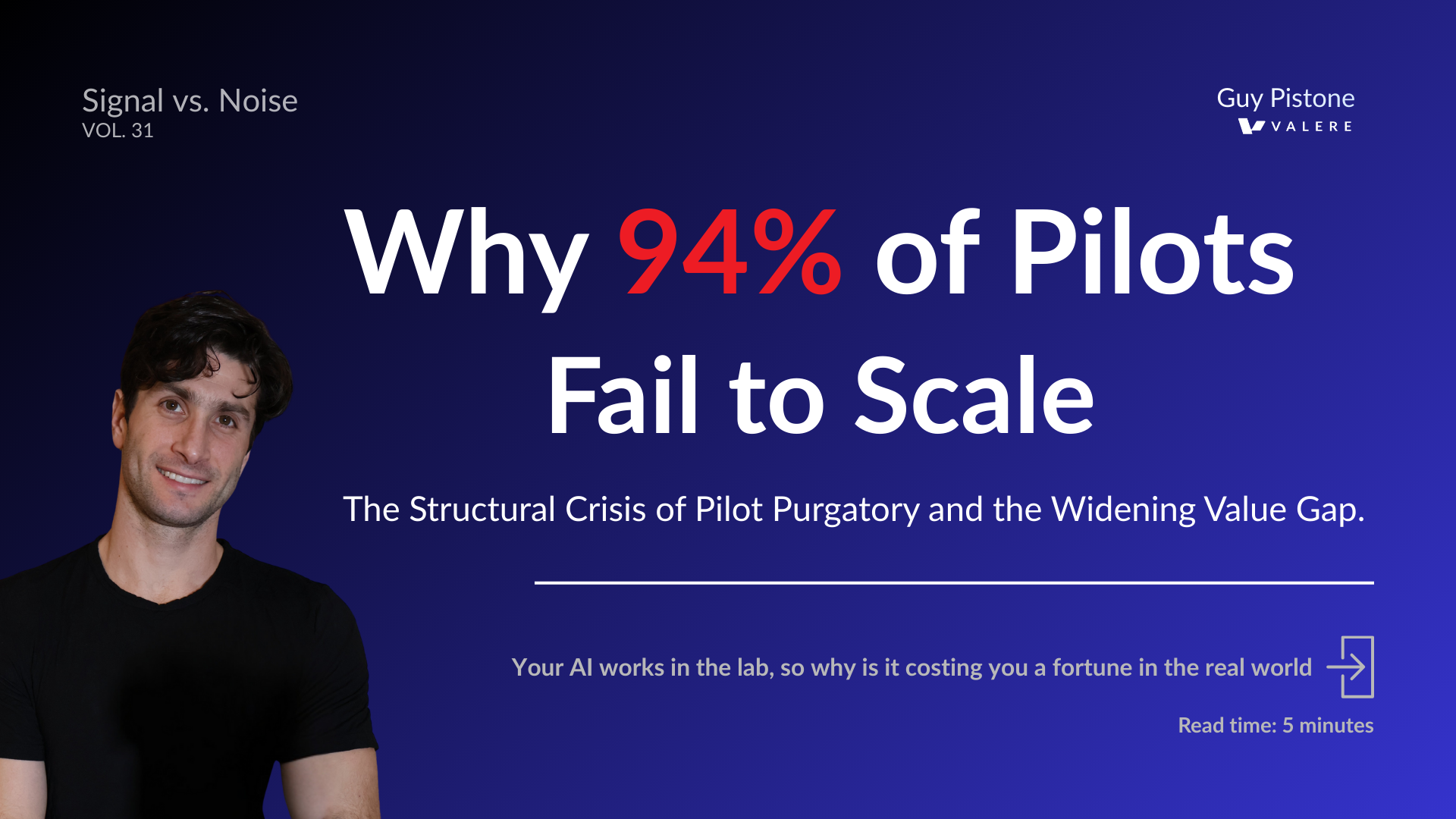
Most AI projects fail because the organization never changes around it. Pilots succeed because they live in controlled experimental environments, but when it is time to scale, the same workflows remain, incentives stay untouched, and decision rights are unclear. Without embedding AI directly into how work actually gets done, the system remains a demo rather than becoming part of daily execution. The real unlock is not deploying more models or tools; it is redesigning workflows and assigning clear ownership to drive decisions and adoption.
The Pilot Illusion
Almost every company today can run a successful AI pilot. Just like nearly every vendor can build a demo. A team deploys a copilot. An analyst builds a forecasting model. A support group launches a chatbot.
Early results look promising. Costs appear lower. Productivity spikes in isolated tests. Then the project stalls. Not because the model stopped working. Because the organization never changed around it. This is why nearly every executive I speak with says the same thing:
“We proved it works. We just can’t scale it.”
The issue is not capability. It is operational integration.
Why Projects Actually Stall
Across dozens of implementations, the pattern repeats with remarkable consistency. AI deployments fail at scale for three structural reasons.
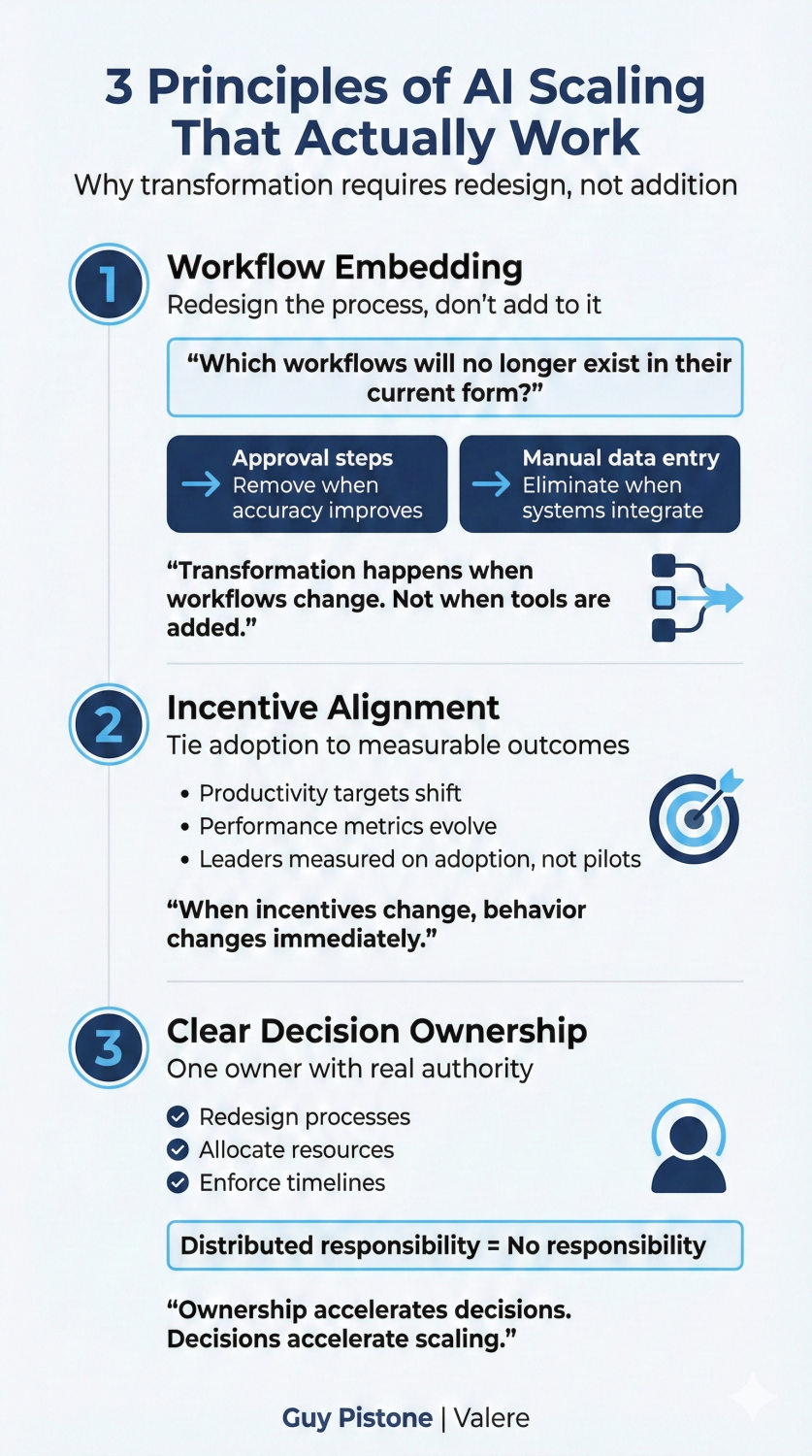
1. No Embedded Workflow
Most pilots live outside the real workflow, and they look like this:
- An analyst manually uploads files.
- A manager runs the model occasionally.
- A team consults the AI “when needed.”
Now comes one of those ugly truths we love on LinkedIn: That is not automation. That is optional software.
Optional systems do not scale because they compete with habit. And habit wins. Remember that. If an employee can complete their task without touching the AI, the AI will slowly disappear from daily operations. Because operational gravity pulls work back into existing systems.
AI only scales when it becomes the default path of execution, a.k.a., not an alternative path.
2. No Incentives to Change Behavior
Organizations often assume employees will adopt AI because leadership asked them to. But the truth is that they hardly do. Work adoption follows incentives, not announcements.
If compensation and KPIs do not change, behavior WILL NOT change. Teams will continue optimizing for the same outputs they were measured on yesterday, even if leadership declares a transformation initiative. This creates the most dangerous implementation outcome: “Shadow AI.”
Layman’s terms: Tools exist. Pilots succeed. Executives believe transformation is happening. Daily work remains unchanged. The organization looks transformed from the top. It operates the same from the ground.
3. No Decision Rights Assigned
One of the main issues is that no one owns the decision authority to redesign processes around AI. IT owns the tools. Business units own the workflows. Finance owns budgets. Operations owns compliance.
Everyone touches the initiative, but no one owns the transformation.
Without decision ownership, pilots linger in evaluation mode indefinitely. Every workflow change requires cross-functional approvals, which turns implementation into a negotiation rather than an execution process.
The result is nearly identical each time. Projects do not fail dramatically. They slowly lose momentum until they quietly disappear.
And that’s not the worst part.
The Hidden Cost of the Pilot Graveyard
When pilots stall, the immediate loss appears small. It was only a few months of testing and some licensing fees. Felt like limited engineering effort, right?
Did you think about the long-term cost or technical debt building up while you’re in pilot mode? Each stalled pilot teaches the organization a dangerous lesson:
AI doesn’t really move the needle here.
When I step in at this stage, I see confidence drop. And that leads to adoption slowing, with all your future initiatives being met with skepticism before they begin. Eventually, leadership concludes that the technology is immature, when in reality, the operating model was never updated to support it.
The failure is not technical maturity. It is organizational readiness.
The Operator Takeaway
AI pilots stall because they are treated as technology initiatives instead of operating-model initiatives and follow a similar pattern:
No embedded workflow. No incentives. No decision rights.
Fix those three elements, and adoption accelerates faster than most leaders expect. Ignore them, and even the best models remain impressive demos that never touch the P&L.
The next phase of AI transformation will not be won by companies running more pilots. It will be won by companies willing to redesign how work actually happens.
Ready to stop the “pilot failure” and start launching production-grade work? Book a 30-Minute Audit.
Guy Pistone, CEO, Valere | AWS Premier Tier Partner
Building meaningful things.
Works cited
- Key Takeaways from McKinsey’s 2025 AI Report, https://www.vao.world/blogs/mckinseys-2025-ai-report
- Scaling AI from Pilot Purgatory: Why Only 33% Reach Production and How to Beat the Odds, https://astrafy.io/the-hub/blog/technical/scaling-ai-from-pilot-purgatory-why-only-33-reach-production-and-how-to-beat-the-odds
- Many Companies Might Be Better Off Not Using AI Yet – wndyr, https://wndyr.com/blog/many-companies-might-be-better-off-not-using-ai-yet
- The Widening AI Value Gap – Boston Consulting Group, https://media-publications.bcg.com/The-Widening-AI-Value-Gap-Sept-2025.pdf
- The State of AI 2025: Why 94% of Companies Are Still Struggling | Aaron D’silva, https://aarondsilva.me/blog/state-of-ai-2025-why-94-percent-fail/
- Why you need an AI Strategy: 4 barriers preventing you from capturing value, https://www.boardofinnovation.com/blog/why-you-need-an-ai-strategy-4-barriers-preventing-you-from-capturing-value/
- The Gap Between AI Strategy and Organizational Reality – HyperRight, https://hyperight.com/the-gap-between-ai-strategy-and-organizational-reality/
- True Cost of AI-Generated Code. A Strategic Analysis of “Comprehension… | by Justin Hamade | Medium, https://medium.com/@justhamade/true-cost-of-ai-generated-code-f4362391790c
- The Platform Paradox: Why Engineering Excellence Kills AI Velocity | by Garvit Arya | Data Science Collective | Dec, 2025 | Medium, https://medium.com/data-science-collective/the-platform-paradox-why-engineering-excellence-kills-ai-velocity-a54f8f811d9a
- Digital adoption nirvana: 6 levers to achieve digital transformation success – CMap, https://www.cmap.io/guides/digital-adoption-nirvana-6-levers-to-achieve-digital-transformation-success
- Digital KPIs: The secret to measuring transformational success – CIO, https://www.cio.com/article/1296705/digital-kpis-the-secret-to-measuring-transformational-success.html
- AI’s mid-market moment: Why the next growth revolution will come from the middle, https://brightstarcp.com/ais-mid-market-moment-why-the-next-growth-revolution-will-come-from-the-middle/
- AI Momentum Is Accelerating for Private Equity | Crowe LLP, https://www.crowe.com/insights/ai-momentum-is-accelerating-for-private-equity
- Turning AI From Hype To Habit In Mid-Market Private Equity – Forbes, https://www.forbes.com/councils/forbesfinancecouncil/2025/12/11/turning-ai-from-hype-to-habit-in-mid-market-private-equity/
- The Emerging Agentic Enterprise: How Leaders Must Navigate a New Age of AI | BCG and MIT Sloan Management Review – BrianHeger.com, https://www.brianheger.com/the-emerging-agentic-enterprise-how-leaders-must-navigate-a-new-age-of-ai-bcg-and-mit-sloan-management-review/
- Executive Guide to Enterprise AI Governance and Risk Management – Appinventiv, https://appinventiv.com/guide/ai-governance-risk-management/
- AI governance in 2026: Frameworks and failures – IE, https://www.ie.edu/uncover-ie/responsible-ai-governance-master-in-public-policy/
- The Process-First Approach: Why Your AI Strategy Needs a Foundation – Startup Stash, https://blog.startupstash.com/the-process-first-approach-why-your-ai-strategy-needs-a-foundation-c7bc928a288f
- Distinct KPIs as a catalyst for transformation – and dos Santos GmbH, https://www.anddossantos.com/blog-posts-ens/distinct-kpis-as-a-catalyst-for-transformation
- HBR’s Year in Business and Technology: 2021 (2 Books) 1647820227, 9781647820220, https://dokumen.pub/hbrs-year-in-business-and-technology-2021-2-books-1647820227-9781647820220.html
- 10 Mistakes to Avoid as a New Founder Scaling Your Business – Wadhwani Foundation, https://wadhwanifoundation.org/10-mistakes-to-avoid-as-a-new-founder-scaling-your-business/