TL;DR
The “tourist phase” of AI is over. By 2027, the divide between AI-First Organizations and those simply AI-Enabled will be too wide for you to catch up. This isn’t about buying more SaaS tools; it’s about a fundamental Mid-Market AI Transformation that drives EBITDA expansion via AI. Escape Pilot Purgatory and secure your firm’s future before the clock runs out.
The 2027 Extinction Date
In the private equity world, we talk about the “J-Curve.” In AI adoption, we are looking at a cliff. For the last 24 months, mid-market companies have been in a “wait and see” holding pattern, piddling with ChatGPT licenses and calling it innovation. The wake-up call is here, and your window has closed.
The data is clear: by 2027, companies that have not achieved Value Creation Plan (VCP) integration with AI at the infrastructure level will face obsolescence. The market has divided into two distinct categories:
- Category 1: AI-Enabled (The Incrementalist): You bought Copilot for your devs and a marketing tool for your CMO. You are doing the same old things, slightly faster. This is incremental.
- Category 2: AI-First (The Transformer): You have re-architected your data stack to support Agentic AI Workflows. You are doing new things that were previously impossible. Result: EBITDA Expansion.
If you are still an Incrementalist, you are effectively shortening your own exit multiple.
The Great Divide: AI-Enabled vs. AI-First
The Third Lever of Value Creation isn’t financial engineering; it’s intelligence engineering.
- An AI-Enabled company uses AI to summarize meetings.
- An AI-First Organization uses AI to automate the entire invoice-to-cash cycle.
This isn’t a semantic difference; it’s an existential one that dictates capital allocation, hiring, and exit strategy.
AI-Enabled Organizations take existing processes, i.e., marketing copy generation, customer support ticketing, code drafting, and apply AI to make them faster or cheaper. The core business model remains unchanged. If the AI were removed, the business would slow down, but it would function essentially as it did before.
This approach typically yields productivity gains of 10-20%, which are often absorbed by the workforce rather than realized as bottom-line savings.
AI-First Organizations are constructed on the premise that AI is the primary engine of value delivery. The workflow is designed for the AI, with humans acting as exception handlers rather than primary operators.
In an AI-First company, the ratio of revenue to headcount decouples. Scaling revenue does not require a linear scaling of staff.
Here’s the Math That Matters to Your LP
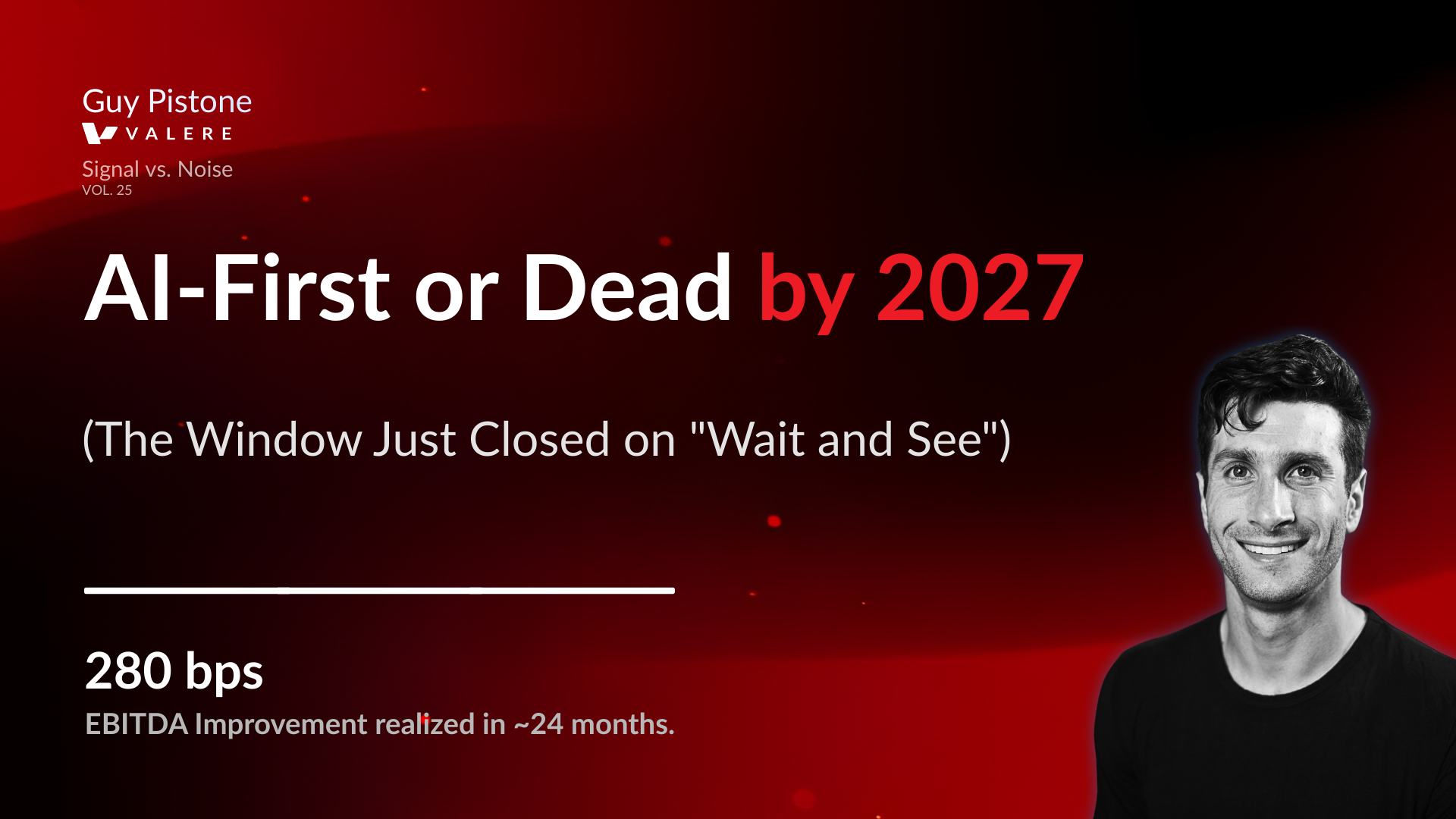
Organizations implementing comprehensive AI strategies are achieving 160-280 basis points of EBITDA improvement within 24 months. For your $200M PortCo with $20M EBITDA, that 280 bps translates to $5.6M in additional EBITDA. At 12x, you just created $67M in enterprise value, often exceeding your equity check.
This isn’t speculative future value. It’s bankable, realized value from labor productivity, infrastructure optimization, and revenue cycle enhancement.
The Exit Story That Matters
In the context of a PE PortCo, an AI-First approach changes your exit narrative. It moves you from “we have efficient operations” (a cost-saving story, valued at standard multiples) to “we have a proprietary intelligence engine that scales non-linearly” (a multiple expansion story).
Example: An AI-Enabled marketing agency uses GenAI to write copy faster. An AI-First marketing agency builds a platform where the client inputs a URL and budget, and the system autonomously generates, tests, and optimizes thousands of ad variations across channels, requiring human intervention only for strategy and creative direction. This requires moving away from the Modern Data Stack (siloed SaaS) to a Unified Intelligence Platform built on a Data Lakehouse.
This isn’t theory. We are seeing Private Equity AI strategy shift aggressively toward Vertical-Specific models that own entire workflows and integrate with Model Context Protocol for seamless tool orchestration.
Case Study: Escaping “Pilot Purgatory” (MeteorAI)
Most companies are stuck running experiments that never reach production due to data friction. We partnered with Caylent (AWS Premier Tier Partner) to solve this.
The Fix: We moved from “models” to an AI Orchestration Layer.
- RAG: Grounded answers in company data using Vector Databases to retrieve relevant context.
- Zero Trust: SOC2 readiness for enterprise security.
- Modular Backend: Solved the “Buy vs. Build” dilemma.
The ROI: Reduced GenAI time-to-market by 60% and development time by 50%. This is Agentic AI touching the P&L.
The CEO’s Dilemma: Buy vs. Build? (Here’s Your Decision Tree)
Most PortCo CEOs waste 6 months debating this. Here’s the 2026 answer: Follow the 80/20 Rule.
BUY (80% of Use Cases)
What to Buy:
- Back-office functions: HR chatbots, accounting automation, basic CRM entry
- Customer support platforms with embedded AI
- Standard cybersecurity and compliance tools
Why Buy:
- You cannot out-engineer specialized vendors on non-core functions
- Speed wins: Weeks to value vs. months or years
- Vendors have invested millions in their AI features; leverage that.
- Cost structure: OPEX (subscription) keeps it off the balance sheet
- Risk: Vendor lock-in, but that’s manageable
Talent Requirement: Business users and administrators can manage these tools
BUILD (20% – Only Your Secret Sauce)
What to Build:
- Core IP, where you have proprietary data that no vendor can access
- Proprietary pricing models
- Predictive logistics unique to your supply chain
- Vertical-specific workflows in niche industries
Why Build:
- Creates a defensible competitive moat
- Leverages data assets that competitors cannot replicate
- Differentiates you in the market
NOTE: “Building” in 2026 ≠ training models from scratch (pre-training). It almost always means Retrieval-Augmented Generation (RAG) or fine-tuning existing open-source models like Llama 3 or Mistral on your specific data. This costs a fraction of pre-training and delivers higher accuracy for specific business domains.
Cost Structure:
- CAPEX (development) + OPEX (compute/maintenance)
- Minimum viable AI engineering team: $600K+ annually (engineers, data scientists, DevOps)
Risk: Technical debt, project failure, talent churn
Example: Healthcare PortCo with 20 years of proprietary patient notes? Build the AI that predicts patient readmission based on your unique data.
The Decision Filter: If it doesn’t create a defensible moat AND you don’t have proprietary data, buy it. Full stop.
Why Your Current Data Stack is Killing Your AI Strategy
For the past decade, the “Modern Data Stack” (MDS) was the gold standard: Fivetran for ingestion, Snowflake for warehousing, dbt for transformation, Looker for BI. Modular, best-of-breed, supposedly “future-proof.”
The Problem
It was designed for human analytics, getting clean data into a dashboard for weekly executive review, not for Agentic AI that needs real-time, bidirectional data access.
Three Deal-Breakers:
- Complexity Tax: Requires 3+ senior data engineers to maintain the “glue” between disparate systems. That’s $600K+ annually for mid-market companies.
- Latency: Batch processing is too slow for real-time AI agents responding to customer inputs instantly.
- Brittleness: When an upstream schema changes (Salesforce adds a field), connectors break, pipelines fail, and AI agents stop working. You’re flying blind until someone manually fixes it.
Mid-market companies rarely have the engineering talent to manage the fragility of a sprawling MDS. In 2026, “brittle” infrastructure is the enemy of AI reliability.
The 2026 Solution: Data Lakehouse Architecture
The architectural winner for 2026, particularly for the mid-market, is the Data Lakehouse. It combines the cost-effectiveness of data lakes (stores raw, unstructured data like PDFs, call recordings, contracts) with the governance and performance of warehouses (structured SQL querying).
Why It Wins for AI:
- Unstructured Data Supremacy: Traditional warehouses can’t efficiently store PDFs, images, or audio. AI thrives on unstructured data. A Lakehouse stores these natively and cheaply.
- Unified Governance: One system instead of maintaining separate lake + warehouse. Reduces total cost of ownership (TCO).
- Real-Time Capability: Supports streaming ingestion. AI agents act on data seconds after generation, not after nightly batch loads.
The Mid-Market Play: For a $100M revenue company, buying a vertically integrated platform beats piecing together best-of-breed components that require constant maintenance. Focus on business logic, not plumbing.
Migration Reality Check:
- Timeline: 3-6 months for phased migration
- Cost: $200K-500K for mid-market implementation
- ROI: Reduction in data engineering overhead pays for itself in 12-18 months
Furthermore, we are seeing a trend toward Unified Intelligence Platforms, all-in-one solutions that bundle ingestion, storage, transformation, and AI orchestration. This shift parallels the move from custom-built servers to cloud computing; the complexity is abstracted away, allowing you to focus on business outcomes rather than plumbing.
Warning: You cannot run 2027 Agents on 2010 ERPs. Legacy code must be modernized to prevent “Shadow AI” risks.
The Shadow AI Crisis: Your IP is Already Leaking
Most CIOs don’t realize they already have an AI problem. Your engineers are feeding proprietary code into Claude. Finance teams are uploading customer data to ChatGPT for “quick analysis.” Every unauthorized interaction is a potential IP leak your Due Diligence process won’t catch.
The Scale of the Problem
In our audits, we typically find 40-60% of employees using unauthorized AI tools. One PortCo we worked with discovered their VP of Sales had uploaded their entire customer database to a public LLM for “territory analysis.”
Why Banning Doesn’t Work
You can’t ban AI. Employees will use it anyway. They’ll just hide it better. The black market always wins.
The Fix (3-Step Implementation)
1. Provide the Alternative
Deploy a private, enterprise-grade LLM instance (ChatGPT Enterprise or private Llama 3 deployment) where data isn’t used for model training.
- Cost: $30-50/user/month
- ROI: That’s insurance, not expense
2. Implement Zero Trust Data Ingestion
Update your security model to monitor what’s leaving your environment, not just what’s coming in. This is why AI Governance Frameworks aren’t compliance theater; they’re a competitive necessity.
3. Create AI Governance Frameworks with Human-in-the-Loop Protocols
- Define acceptable use policies
- Implement Human-in-the-Loop protocols for sensitive operations
- Establish AI Steering Committee (CEO, CFO, General Counsel, Tech Lead)
- Ensure SOC2 readiness for enterprise security
The Due Diligence Disaster
PE firms are starting to red-flag companies with unmanaged AI usage in diligence. One failed deal we’re aware of: The target company had no AI governance, and the buyer walked after discovering engineers had shared source code with public LLMs.
Deal value: $340M
Don’t be that company.
Death & Co: Bridging the Uncanny Valley
Hospitality brand Death & Co had 2,000+ proprietary recipes trapped in static PDFs. They risked alienating customers with robotic chatbots.
The AI-First Solution: We built a Vertical-Specific Model trained on the “voice” of their expert bartenders.
- Human-in-the-Loop: Prioritizes verified data before hallucinating.
- Brand Alignment: Captures the nuance of mixology.
Result: Static content transformed into an interactive revenue driver. Link: valere.io/case-study/death-and-co
The Business Case: How to Model AI ROI for Your Board
Your board doesn’t care about adoption rates or prompt volume. They care about EBITDA expansion and payback periods. Here’s how to build the business case:
Investment Benchmarks by Company Size
- $50-100M revenue: $500K-1M first-year AI investment (0.5-1% of revenue)
- $100-250M revenue: $1-2.5M first-year AI investment
- $250-500M revenue: $2.5-5M first-year AI investment
Expected Returns (24-Month Horizon)
- Finance/Accounting automation: 30-50% reduction in close time, 15-25% reduction in FTE costs
- Supply chain optimization: 1-3% immediate spend recovery from contract audits, 10-20% reduction in expedited freight
- Sales efficiency: 40-60% reduction in SDR headcount needs, 10-15% CAC reduction
- Development velocity: 40-60% faster development cycles, 50% reduction in time-to-market for new features
Simple ROI Model Template
STEP 1: Calculate Annual Savings
Current State Labor Cost: $X × Expected Efficiency Gain: 30-50% = Annual Savings: $Y
STEP 2: Calculate Payback Period
AI Investment (Year 1): $Z ÷ Annual Savings: $Y = Payback Period [typically 12-24 months]
STEP 3: Calculate EBITDA Impact
Annual Savings: $Y × 0.70 (assuming 30% reinvestment in growth) = Net EBITDA Uplift
Cost of Inaction
By 2027, AI-First competitors will operate at 15-20% lower cost structures. For a $200M revenue business at 10% EBITDA margins, that’s a $3-4M annual disadvantage.
Compound that over a typical hold period, and you’re looking at $20-30M in lost value by exit.
The Presentation to Your Board
- Lead with EBITDA impact projections, not technology
- Show payback periods (12-24 months is credible)
- Include “cost of inaction” scenario analysis
- Have 3 pilots ready: high-impact (stretch), medium-impact (likely), low-impact (conservative)
The Talent Gap: The Fractional CAIO
You likely do not need a full-time Chief AI Officer yet. But you do need the Chief AI Officer (CAIO) Responsibilities covered. I am seeing a surge in the Fractional CAIO Model.
Remember: This role is distinct from the CTO. The CTO manages uptime and LLMOps; the CAIO manages AI Governance Frameworks and EU AI Act Compliance for Mid-Market.
Key CAIO Responsibilities
- Arbitrating Buy vs. Build: Deciding where to rely on off-the-shelf SaaS and where to build proprietary capabilities
- Governance & Ethics: Navigating the complexities of the EU AI Act and liability frameworks
- Talent Orchestration: Managing the shift from a specialized workforce to a generalist, AI-augmented workforce
In many PE contexts, the CAIO function is being internalized at the fund level rather than the PortCo level. This “Fractional CAIO” model provides a shared resource that helps multiple portfolio companies navigate the transition without carrying the full cost of a C-suite executive. This is a pragmatic approach for companies in the $50M-$200M revenue range.
In 2027, Automated Invoice Processing and Predictive Logistics will be managed by agents, not junior analysts. The CAIO’s job is to oversee those agents.
The Roadmap: AI-First or Dead (The First 100 Days)
For new acquisitions or transformation initiatives, the first 100 days set your trajectory. This isn’t about deploying chatbots. It’s about creating conditions for success.
Phase 1: Diagnosis & Hygiene (Days 1-30)
Data Audit: Where is your data? Trapped in on-premise silos? Unstructured? “Bad data” is the #1 killer of AI projects. Assess the “readiness” of the data; is it accessible, clean, and structured enough for AI consumption?
Talent Assessment: Find the “AI Champions” within the org, usually mid-level managers already secretly using tools, not senior leadership.
Shadow AI Scan: Audit unauthorized AI usage before it becomes a diligence problem. Check for EU AI Act exposure.
Kill Metric: If an initiative doesn’t drive EBITDA or show up in VCP metrics visible in LP Reporting, kill it. No vanity projects.
Phase 2: Infrastructure & Quick Wins (Days 31-60)
Data Strategy Decision: Decide on Lakehouse vs. Warehouse architecture. Initiate cloud migration if not already there. Agents cannot work on fragmented data.
Pilot Selection: Choose ONE high-impact, low-risk use case that targets EBITDA directly.
- Criteria: Must be measurable within 90 days
- Example: Automated invoice matching to reduce DSO by 15%
- Why One: Focus forces execution. Multiple pilots create a distraction.
Governance Setup: Establish the “AI Steering Committee” (CEO, CFO, General Counsel, Tech Lead). This isn’t optional. Implement Zero Trust Data Ingestion and AI Governance Frameworks.
Infrastructure Selection: Finalize your Data Lakehouse platform selection and begin migration.
Phase 3: Scale & Roadmap (Days 61-100)
Launch Pilot: Deploy first agentic workflow (e.g., automated invoice matching). Measure results religiously; track impact on DSO, FTE hours saved, and error rates.
Value Creation Plan (VCP) Integration: Formally underwrite AI initiatives in your VCP with specific dollar values attached to EBITDA expansion. This makes AI a board-level priority, not an IT project.
AI Literacy Rollout: Company-wide training programs. Address the fear of replacement head-on. The narrative must be: “AI will not replace you; a person using AI will replace you.”
- Usually, growth without headcount addition is the goal rather than layoffs
- This is more palatable and often more profitable in the mid-market
By Day 100, You Should Have:
- One working agentic workflow showing measurable EBITDA impact
- A 24-month AI roadmap integrated into your VCP
- Full governance framework preventing Shadow AI risks
- Clear metrics on ROI and payback period
The Signal is Clear. Everything Else is Noise.
As we move deeper into 2026, the “AI-First” designation will stop being a marketing buzzword and become a rigorous operational standard. The noise of the past two years, the chatbots, the prompt engineering, the endless pilots, is fading.
What remains is the signal:
- Data infrastructure (Lakehouse architecture)
- Agentic workflows (not chatbots)
- EBITDA expansion (not adoption metrics)
- Governance-first approach (not bolt-on features)
For Private Equity firms and Mid-Market companies, the path forward is clear but demanding. It requires the discipline to stop chasing the “new shiny object” and start building the boring, robust plumbing of a data-driven organization. It requires the courage to restructure pricing models and org charts. And it requires the foresight to view governance not as a tax, but as a product feature.
The winners of 2027 will not be the companies with the most advanced AI models. They will be the companies that have most effectively integrated AI into the mundane, messy, and critical reality of their daily operations. They will have crossed the gap from “AI-Enabled” efficiency to “AI-First” advantage.
- Stop the Pilots. If a project hasn’t scaled in 6 months, kill it.
- Fix the Data. You cannot have an AI strategy without a data strategy.
- Hire the Fractional CAIO. You don’t need a full-time Chief AI Officer, but you need the governance.
- Kill Shadow AI Before It Kills You. Unauthorized AI tools = IP leakage.
- Embrace the Boring. The biggest ROI is in Finance, Supply Chain, and Coding—not in flashy consumer avatars.
The window to be an early adopter is closing. The window to be a dominant operator is just opening. The separation has begun.
Guy Pistone, CEO, Valere | AWS Premier Tier Partner
Building meaningful things.
Resources & Further Reading
For the Operator: Stop Guessing, Start Measuring
• Valere AI Maturity Assessment: Our free 3-minute diagnostic helps you identify whether you’re ready for Agentic AI Workflows or still stuck in Pilot Purgatory. Take it here: valere.io/ai-maturity-assessment/#assessment
• AI in Private Equity: From Portfolio Management to Value Creation: Our deep dive into how PE firms are moving beyond basic due diligence to using AI for real-time EBITDA expansion and deal sourcing.
For the Investor: The Market Signal
• Bain & Company – Private Equity in the AI Era: Essential reading on why the best firms are shifting from “testing” to “operationalizing,” with data on cost reductions of 40% in content and 15-20% in customer care.
• Accenture – Unlock AI Value in Private Equity Mid-Market: A breakdown of why Mid-Market AI Transformation is focused on core processes (R&D, Manufacturing) rather than just back-office support.
The Technical Reality Check
• MIT CISR – The GenAI Divide: State of AI in Business 2025: The data behind why companies that treat AI as a “tech upgrade” rather than a “business transformation” are seeing zero ROI.
• Agentic Artificial Intelligence by Pascal BORNET: The definitive guide to understanding why autonomous agents, not chatbots, are the inevitable future of enterprise work.