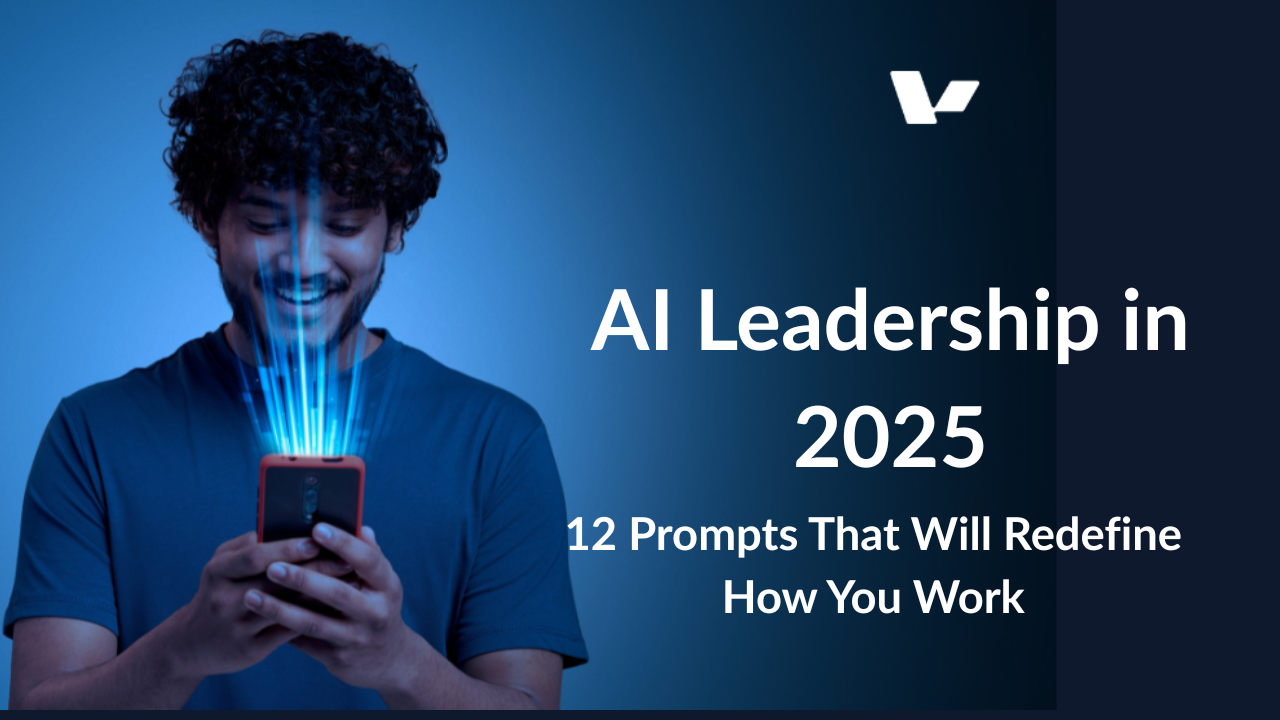
Stop trying to plan your quarter with AI prompts that were engineered back in 2023. The game has changed dramatically, and the difference between good and great AI outputs now directly impacts your bottom line.
I’ve transformed Rachel Wells’s foundational leadership prompts from Forbes into something far more powerful for today’s executive challenges. These prompts pull predictive insights, integrate human-AI collaboration patterns, and build adaptive frameworks that evolve with your business needs.
Decision Making
AI-Enhanced ROI Analysis
Prompt – Generate an AI-enhanced ROI analysis for [situation] that incorporates both quantifiable metrics and second-order impacts across our digital ecosystem. Include predictive modeling for 6, 12, and 24-month horizons and suggest implementation pathways that leverage our existing tech stack.
What you’ll get – Instead of basic cost-benefit analysis, this prompt delivers multi-horizon forecasting that captures cascading effects across your organization’s systems, with implementation strategies tailored to your current capabilities.
Stakeholder Sentiment Prediction
Prompt – I am proposing [decision] to [stakeholders]. Use sentiment analysis frameworks to predict reactions across different organizational levels. Generate pre-emptive responses that address both rational and emotional objections, with specific attention to AI ethics concerns and automation anxiety factors.
What you’ll get: Move beyond simplistic objection handling to preemptively address the unspoken concerns that typically derail initiatives, with specific strategies to understand the human factors of technological change.
Problem-Solving
Breakthrough Solution Architecture
Prompt – I’m facing [challenge] after trying [previous approaches]. Generate five breakthrough solutions incorporating generative AI capabilities, adaptive workflows, and cross-functional intelligence sharing. For each solution, provide implementation complexity ratings and specific impact metrics to track.
What you’ll get: Rather than incremental improvements, this prompt creates entirely new solution architectures with built-in measurement frameworks. Exactly what you need when conventional approaches have failed.
Immersive Hybrid Collaboration
Prompt – Design an immersive brainstorming session for our hybrid team that leverages both synchronous and asynchronous collaboration tools. Include AI-facilitated ideation exercises, digital-physical integration touchpoints, and automatic prioritization frameworks that give equal voice to remote and in-person participants across time zones.
What you’ll get: Eliminate the productivity gap between in-office and remote team members with sophisticated engagement techniques that blend physical and digital interaction for maximum creative output.
Meetings
Psychological Intelligence Gathering
Prompt – Generate psychologically safe questioning sequences for our upcoming discussion on [topic] that will elicit insights from both vocal and quiet team members. Include real-time sentiment prompts that can be deployed through our meeting intelligence platform to capture unspoken concerns and hidden opportunities.
What you’ll get: Transform standard feedback sessions into strategic intelligence operations that surface the critical insights people typically withhold in group settings, with specific attention to power dynamics.
Attention-Optimized Meeting Architecture
Prompt – I’m convening decision-makers to address [issue]. Attendees include [job titles]. Create a dynamic agenda incorporating pre-meeting AI insight gathering, attention-optimized discussion blocks, and automated decision-capture protocols. Include specific engagement metrics to track meeting effectiveness across in-person and distributed participants.
What you’ll get: Escape the trap of standard meeting formats with a neuroscience-informed structure that maximizes cognitive engagement and decision quality, with built-in accountability mechanisms.
Employee Performance
Contribution Pattern Recognition
Prompt – Based on our continuous performance data for this employee, attached in a CSV, identify their top contribution patterns and growth indicators to highlight before we discuss development areas. Include specific examples where their work intersected positively with our systems and where their human capabilities complemented our automation processes.
What you’ll get: Replace subjective feedback with data-driven recognition that specifically values the uniquely human skills becoming critical in an AI-augmented workplace.
Predictive Career Trajectory Modeling
Prompt – My employee excels at [strengths]. Using predictive career modeling, recommend optimal role transitions that balance their growth trajectory against our organization’s evolving needs. Include both traditional advancement paths and emerging hybrid roles at the human-AI intersection, with specific skill enhancement recommendations for each pathway.
What you’ll get: Move beyond limited, linear career planning to identify emerging opportunities at the intersection of your talent’s capabilities and tomorrow’s organizational needs.
Stakeholder Relations
Digital-Physical Ecosystem Mapping
Prompt – Our business provides [offering] to [target market]. Map our complete stakeholder ecosystem, including both traditional actors and emerging digital entities (AI systems, digital twins, and autonomous organizations). For each stakeholder category, provide influence ratings and relationship interdependencies that would be affected by our AI transformation initiatives.
What you’ll get: Expand your stakeholder understanding to include the critical non-human influencers now shaping market dynamics, with specific attention to how AI deployment ripples through your entire ecosystem.
Multi-Channel Feedback Intelligence
Prompt – Design a comprehensive feedback intelligence system for [project] that integrates real-time sentiment analytics, implicit behavioral indicators, and traditional explicit feedback channels. Include specific deployment strategies across digital, physical, and mixed-reality touchpoints, with automatic insight synthesis capabilities.
What you’ll get: Replace simplistic surveys with a sophisticated sensing network that captures both what stakeholders say and what they do, with automatic pattern detection across interaction channels.
Goal-Setting
Human-AI Performance Framework
Prompt – I’m launching an initiative to [goal/purpose]. Create a dynamic performance framework that includes both traditional KPIs and new-generation success metrics for human-AI collaboration. Map specific objectives for each [team member role], with automated tracking triggers and real-time adjustment thresholds based on emerging data patterns.
What you’ll get: Build performance systems that balance measurable outcomes with adaptive response capabilities, ensuring your teams can shift priorities as new data emerges without losing accountability.
Adaptive Milestone Architecture
Prompt – Create an adaptive goal decomposition for my employee’s objective of [goal] within [timeframe]. Include smart milestones that flex based on progress patterns, AI-assisted acceleration opportunities for routine components, and augmented decision points where human judgment should be emphasized. Build in continuous learning feedback loops that optimize their development pathway.
What you’ll get: Replace rigid project structures with intelligent goal frameworks that identify when to accelerate with automation and when to leverage uniquely human capabilities.
The Competitive Edge of Advanced Prompting
The gap between leaders who know how to direct AI systems and those who don’t is widening daily. And you can stay on the winning side of that gap by simply following me on LinkedIn.
I will be constantly sharing strategic frameworks that can fundamentally change how decisions get made and executed.
Right now, what separates winning organizations isn’t just having AI tools; it’s the ability to extract specific, actionable intelligence from these systems that directly maps to your strategic objectives. Companies that master this capability are making faster, more informed decisions while their competitors are still sorting through basic information dumps.
Valere is helping forward-thinking executives build these integrated intelligence capabilities that blend human insight with computational power. As the line between human and artificial intelligence continues to blur, those who can effectively direct these hybrid systems will consistently outperform those who can’t.
The future belongs to leaders who don’t just use AI but who know exactly how to instruct it.