TL;DR
Leaders are good at making decisions about change. The strategic vision, the AI rollout, the new operating model. All of these decisions get made in conference rooms on Tuesday afternoons. What fails is the six to twelve weeks after the announcement, when the novelty is gone, and the results haven’t arrived. Lally’s research puts habit automaticity at 66 days. Organizational change lives in that same window. The leaders who close the gap design better systems.
The decision
Every leader knows how to decide. You see the problem, align the team, and announce the direction. The five-year strategy. The AI adoption plan. The decision is a Tuesday afternoon’s work.
The first three weeks feel like evidence it’s working. Teams are engaged. The new behavior is visible. Leaders see what they asked for. Then, somewhere around week four, the novelty wears off. The old workflows reassert themselves. The results haven’t shown up yet because compounding doesn’t work that fast. And the change, which looked durable three weeks ago, starts losing ground.
That window, week four to roughly week twelve, is where the behavior meets the ordinary friction of daily operations for the first time, without novelty to carry it. The initiative doesn’t get cancelled. It just stops being mentioned at all-hands.
What the research says
Phillippa Lally’s group at University College London tracked habit formation in real conditions and found that the average time to automaticity was 66 days. Easy habits are automated quickly. Hard ones, you know, the kind that require changing how work gets done, are often never automated at all.
The 21-day rule is a marketing artifact, not a finding. Sorry to be the one to bring that up, but the window where change becomes durable is months, not weeks. The period when organizations need the most structural support is the middle, where they’re getting the least of it.
This is a design problem, and it belongs to the leader.
The two failure modes
Change initiatives fail for one of two reasons.
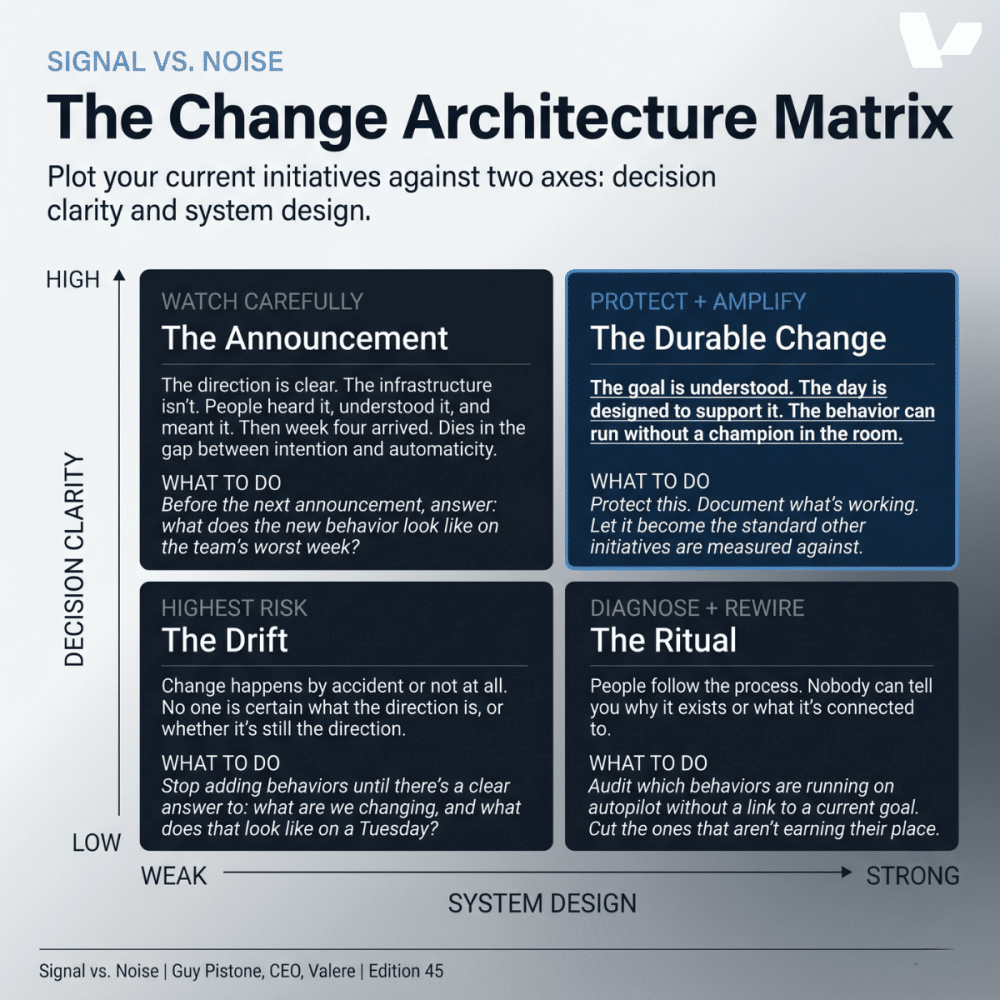
The first is designing for best-case conditions. The new behavior works when people have time, a clear direction, and a willing manager. It breaks down when the team is behind, a key person is out, and the quarter is creating pressure. If the change only runs in good conditions, it won’t survive ordinary ones.
The second is measuring outcomes instead of inputs. Leaders track whether the change is working by looking at results. But results don’t move in month one. When the outcome metric is flat, the natural conclusion is that the initiative isn’t working, and support erodes before the behavior has had time to become automatic.
Three characteristics to get there
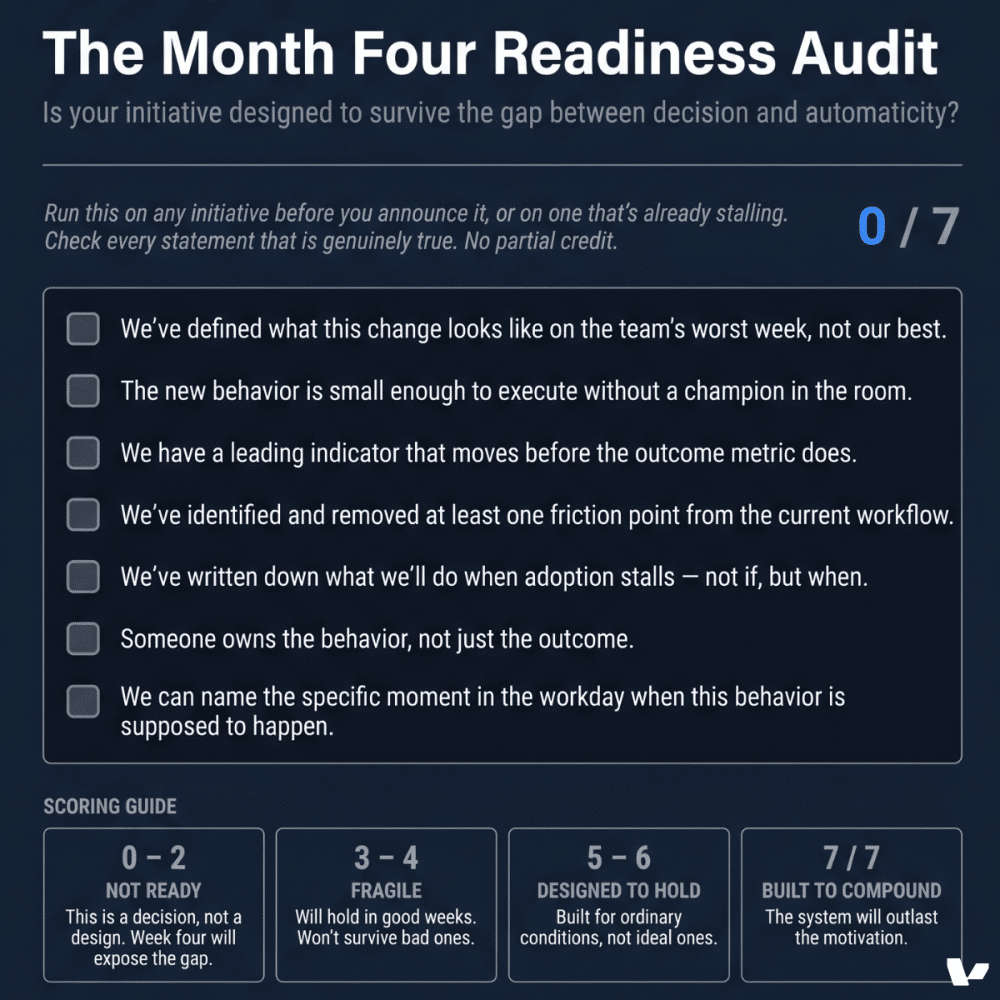
Three things that keep a change initiative running in month four include a behavior small enough for bad days, a metric that moves before results do, and a written plan for when adoption drops.
The behavior has to be executable on the day when three things went wrong before 9 a.m. If it only works when conditions are good, it will fail the first time conditions aren’t. The test is not whether the team can do it when they’re motivated. It’s whether they can do it when they’re behind.
Results won’t appear in month one. So stop tracking whether it’s working and start tracking whether the behavior is happening. Who ran the new process? How often this week? What changed in the cycle time? A record of consistent inputs is the only honest evidence available when the compounding hasn’t shown up yet. A flat outcome metric in month two is not a signal to stop. It’s expected.
Every change initiative hits a week where the behavior drops off. The teams that recover are the ones that have already decided what happens next. Put it in writing before you need it. If adoption drops below X, we do Y. That decision, made in advance, removes the negotiation at the moment when organizational will is lowest.
The question to bring to your leadership team
This is mainly a story about the gap between deciding and designing.
Every time a change initiative stalls, the instinct is to re-announce, add accountability, or replace the person leading it. Those moves address the symptom. The gap between the decision and the system is the cause.
Bring this to your next leadership conversation.
When we launched our last major initiative, what did we design to keep the behavior running in month four, before the results showed up?
If you can’t answer that quickly, start there.
FAQ
- How do you shrink an organizational change without losing the ambition? Separate the goal from the behavior. The goal can be large. The daily behavior that moves toward it should be the smallest executable version. “We’re becoming an AI-native organization” is a goal. “Every proposal goes through one AI review step before it leaves the team” is a behavior. Start with the behavior.
- What counts as a leading indicator for a change initiative? Something you can measure before the outcome moves. Adoption rate, frequency of the new behavior, and reduction in time spent on the old workflow. If your only metric is the outcome you’re trying to change, you have no signal in months one through three.
- What do you do when month four arrives and adoption has already stalled? Don’t re-announce. Diagnose. Is the behavior too complex to run in difficult conditions? Is there a friction point you haven’t removed? Is there a measurement gap, as in, people don’t know whether they’re doing it correctly? Fix the design problem before you add accountability pressure.
- How is this different from standard change management? Traditional change management focuses on communication, stakeholder alignment, and training. Those matter. But they’re front-loaded, strongest in the first three weeks, which is when the change is already running on novelty. The design work described here targets the middle. The period that traditional change management doesn’t reach.
Key takeaways
- The decision to change is easy. The design that keeps it running is the hard part.
- Week four to week twelve is when organizational change dies.
- Lally’s research puts automaticity at 66 days. Your initiative lives in that window.
- Initiatives designed for best-case conditions fail the first time conditions aren’t met.
- Measure inputs before you can measure outputs.
- Write down what happens when adoption stalls. Before it does.
- The leader’s job is not to sustain motivation. It’s to design a system that doesn’t need it.
Resources
Phillippa Lally, Cornelia H. M. van Jaarsveld, Henry W. W. Potts, and Jane Wardle, “How are habits formed: Modelling habit formation in the real world,” European Journal of Social Psychology 40, no. 6 (2010): 998–1009.