Key Takeaways
- The shift from AI assistants to autonomous agents is changing how companies are staffed, with the biggest gains coming from narrow, multi system workflows where agents act as connective tissue across fragmented platforms.
- Most agent programs fail from governance gaps rather than model limitations, with data quality, evaluation budget, and identity infrastructure determining whether a pilot reaches production.
- The right success metric is people amplification, not headcount reduction, measured through frameworks like Agent Value Multiple, containment rate, and verification latency.
From Tools to Teammates
Enterprise AI is shifting from assistive tools to autonomous agents. An assistant accelerates a person. An agent owns a multi step process and reports back. That second model changes how companies are staffed, how processes get designed, and how leaders measure return.
What follows comes from our client work across this transition. Field notes on what ships, what breaks, and what separates pilots that stall from deployments that hold up in production.
Three Tiers Worth Distinguishing
The market has settled on three tiers. Conflating them is why programs end up over engineered for simple problems or underpowered for complex ones.
AI Assistants are reactive. They draft emails, summarize documents, and accelerate individual productivity. A person drives every step.
AI Agents are proactive and goal oriented. Give one an objective. It gathers information, calls APIs, makes bounded decisions, and works through a multi step process. An assistant helps a sales rep write an email. An agent identifies the lead, researches the company, drafts the message, routes it for approval, logs the activity, and schedules the follow up.
Agentic AI sits at the advanced end. These systems plan, adapt, and dynamically sequence tools to pursue broader goals. Rather than following rigid scripts, they reason about context and choose strategies as they go.
A Real Example
A higher education advancement office we worked with runs seven specialized agents across the gift lifecycle. A single major gift triggers compliance validation, stewardship drafts, analytics updates, and leadership notification in one flow. Staff approve and finalize what the system proposes from CRM sidebar widgets and Outlook plugins. A coordinated digital team, not a chatbot.
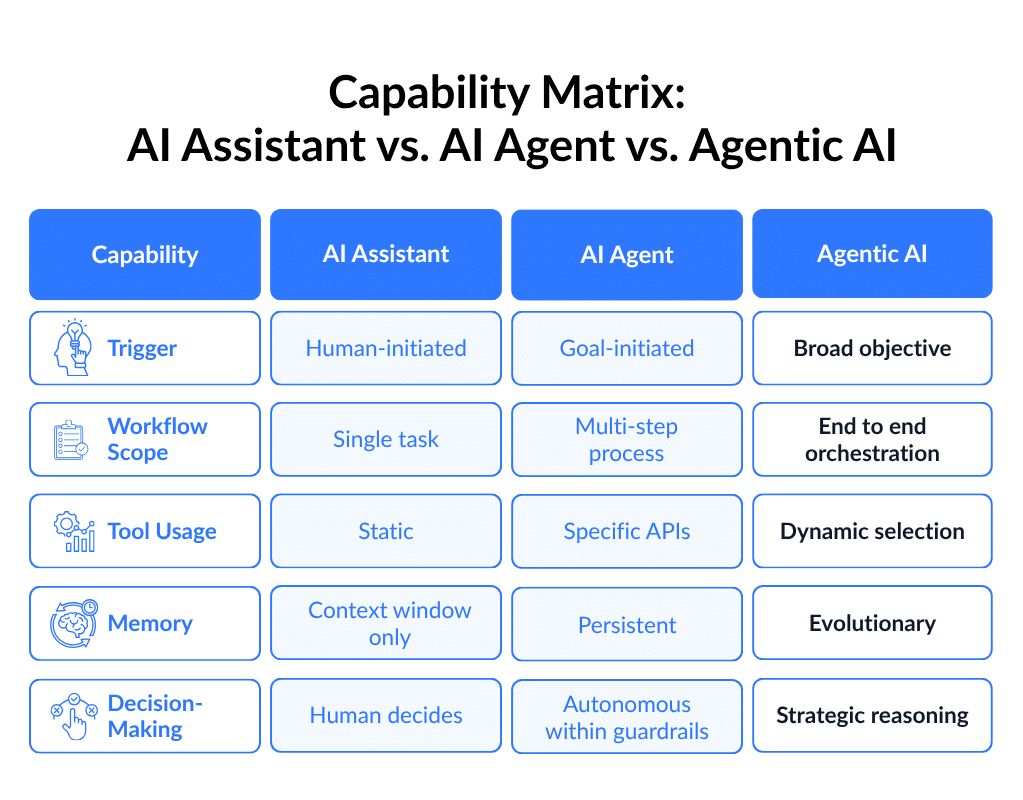
Knowing where on the spectrum a workflow belongs is the first decision in any engagement. Organizations regularly spend serious budgets on agentic systems for problems that better automation, or a well designed assistant, would have solved faster.
Why the Shift Is Happening Now
Fragmentation is the honest answer. Large companies run on hundreds of disconnected platforms. Employees spend a real slice of every workday moving information between them. That hidden tax is what most leaders underestimate, and agents solve it well. The volume of signal each business generates has outrun what humans can sift in real time. Agents become the filter.
The market data tracks the urgency. Enterprise AI spending will grow from $24 billion in 2024 to between $150 and $200 billion by 2030. Agent software alone will jump from $86.4 billion in 2025 to $206.5 billion in 2026. Enterprise adoption is climbing from roughly 45% in early 2025 toward 90% by 2027. Forrester expects the top five HCM platforms to add digital employee management by 2026, formalizing agents as workforce rather than IT assets.
Where Agents Are Delivering Value
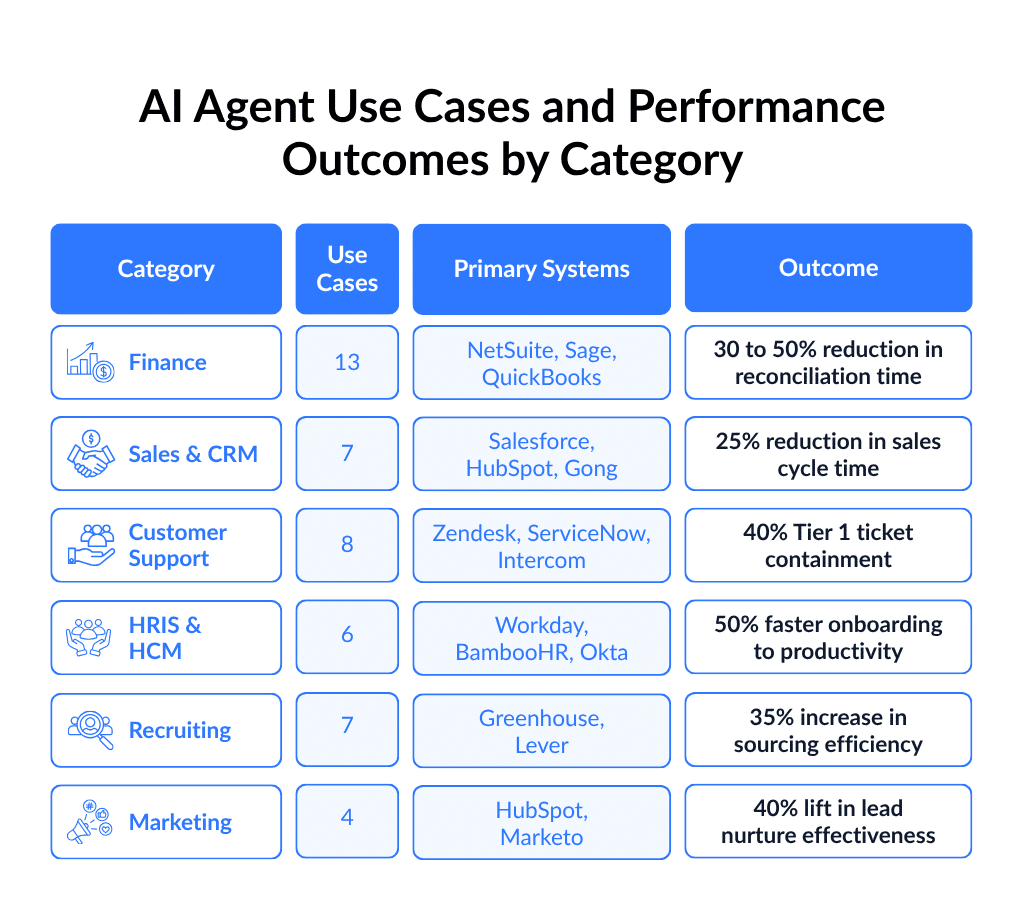
Across our engagements, we see roughly 45 ROI patterns. They cluster into a few high value categories. The pattern: agents earn their keep where workflows are high volume, rules based, and span multiple systems. Narrow, measurable, multi system. That’s where we tend to start.
In finance, agents process invoices, run accounts receivable dunning, and flag transaction anomalies in real time. A 401(k) provider we worked with had manual rollover processing as the bottleneck. We replaced it with an Intelligent Document Processing pipeline on AWS Lambda, Step Functions, and Amazon Bedrock. Roughly 100 financial packages a month flow through it now under SEC fiduciary audit.
In sales and CRM, agents handle lead qualification, post demo follow up, and stalled deal detection. A B2B sales tech company we work with scaled outbound to over 250,000 contacts with a three person team. Autonomous agents pull from Snowflake, ZoomInfo, and HubSpot to orchestrate compliant outreach across 210 to 300 inboxes. Not a faster assistant. A different operating model.
- In customer success, agents watch usage signals continuously and trigger interventions before churn becomes obvious.
- In government services, monitoring agents scan SAM.gov and USAspending around the clock to score new opportunities.
- In HR, agents handle onboarding orchestration, role aware policy Q&A, and payroll discrepancy resolution.
The Technical Foundation: Platforms and Protocols
Choosing where your agents live is one of the more consequential decisions in this transition. The market has bifurcated into a few platform strategies, and two open protocols are reshaping what’s possible across them.
Platform Choices
Salesforce Agentforce is deep and CRM centric. It gives agents zero copy access to unified CRM data through Data Cloud. The Atlas Reasoning Engine handles multi step orchestration grounded in business records. Salesforce heavy organizations can stand up agents in around three weeks. The trade off shows up the moment agents need to reach outside the ecosystem.
Microsoft Copilot Studio is the horizontal option. It connects to over 1,300 third party systems through M365, Azure, and the Power Platform. Big extensibility, but real complexity. Gartner reported that as of early 2026, only 6% of Copilot pilots had reached large scale deployment. The path from low code prototype to production grade agent takes more Power Platform expertise than most teams have on hand.
ServiceNow Now Assist owns the back office: ITSM, HR Service Delivery, structured customer service. Tight coupling to its existing process engine makes it strong for internal employee support. Less so for front office sales work.
Sometimes the right platform doesn’t exist. A government contracting client needed something purpose built. We built an AI native SaaS platform that automates the entire capture lifecycle on a multi stage RAG pipeline on Amazon Bedrock. Reports that used to take senior managers four to six weeks now come back in about an hour. Custom software still has its place when vertical depth exceeds what packaged platforms can model.
The Protocol Layer
Integration cost has been the biggest technical drag on scaled deployments. Two protocols are dissolving it. Model Context Protocol (MCP), launched by Anthropic in late 2024 and adopted by OpenAI, Microsoft, and Google by early 2025, standardizes how agents connect to tools and data. Build one MCP server and any compliant agent can use it. The ecosystem hit 5,800 community servers by March 2026, and integration costs have dropped an estimated 60 to 70%.
Agent to Agent (A2A), introduced by Google in April 2025, lets agents collaborate across frameworks through a machine readable Agent Card. MCP plus A2A is what people mean by the Internet of Agents: orchestrators managing fleets of specialized sub agents.
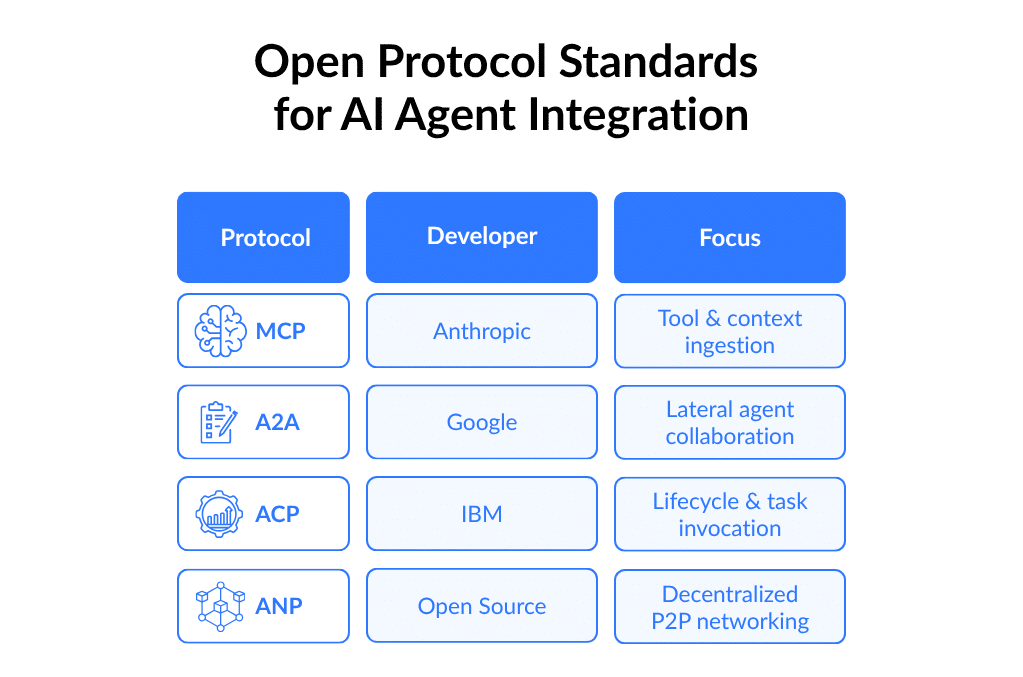
Open standards from day one is the consistent recommendation. Lock in is easy to create and expensive to undo.
Governance and the Digital Workforce
A handful of pilot agents can be managed informally. A few hundred can’t. The traditional perimeter security model doesn’t apply either. Published estimates put agent data movement at roughly 16 times that of human users. The agentic enterprise has to run on identity, visibility, and behavioral monitoring.
Prompt Injection and Identity First Security
Prompt injection keeps showing up in our work. Direct injection means a malicious instruction inserted into a user input field. Indirect injection, the more dangerous version, hides instructions inside an external document or webpage the agent reads. Multi agent systems compound the risk. A malicious instruction can propagate through several agents and lose its untrusted tag along the way.
A workable governance model rests on five things:
- Unique agent identity, verifiable, bound to organizational policy.
- Least privilege by default, minimum permissions for the specific task.
- Ephemeral credentials, short lived for high risk tasks.
- Continuous observability, real time behavioral monitoring to catch shadow AI.
- Immutable audit logs, capturing tool invocations, authorization decisions, and reasoning chains.
When a loan applicant disputes an AI driven rejection, and someone will, you need to reconstruct what the agent saw, what logic it applied, and under whose authority.
The Digital HR Model
Beyond security, agents need to be managed as a workforce. The shift we keep helping clients make is toward what some call the Digital HR model. Treat agents like digital coworkers with a real lifecycle.
A new role tends to show up at the center of it: the Digital Workplace Manager or AI Agent Supervisor. Responsibilities mirror an HR manager’s. Selecting models for each operational need. Defining digital job descriptions and escalation triggers. Monitoring accuracy, cost efficiency, and reasoning instability. Decommissioning agents that have become obsolete.
Coordination patterns matter just as much. Human in the Loop for high stakes decisions like loan approvals or medical recommendations. Human on the Loop for monitored automation where humans intervene at exception triggers. HILA workflows quietly guide AI through ambiguous decisions so the customer never feels the failure. The goal isn’t maximum autonomy. It’s controlled automation. Most of the value comes from getting that calibration right.
ROI, Org Structure, and Why Programs Fail
People Amplification Over Headcount
Headcount reduction is the wrong frame. Gartner expects 50% of companies that cut customer service staff because of AI to rehire those roles by 2027. Over automation has reputational consequences, and it tends to surface new bottlenecks. The real return is people amplification: more capacity for work that requires judgment, lower cost per outcome.
That requires different KPIs:
- Agent Value Multiple (AVM): cost savings, incremental revenue, and margin gains relative to total cost of ownership.
- Agent Cost per Completed Task (ACCT): total expense per successful completion.
- Containment Rate: share of workflows resolved without human escalation. Mature deployments in customer ops see 30 to 45% productivity gains.
- Verification Latency: time between agent completion and human approval. If review takes longer than the original manual task did, the workflow is creating friction.
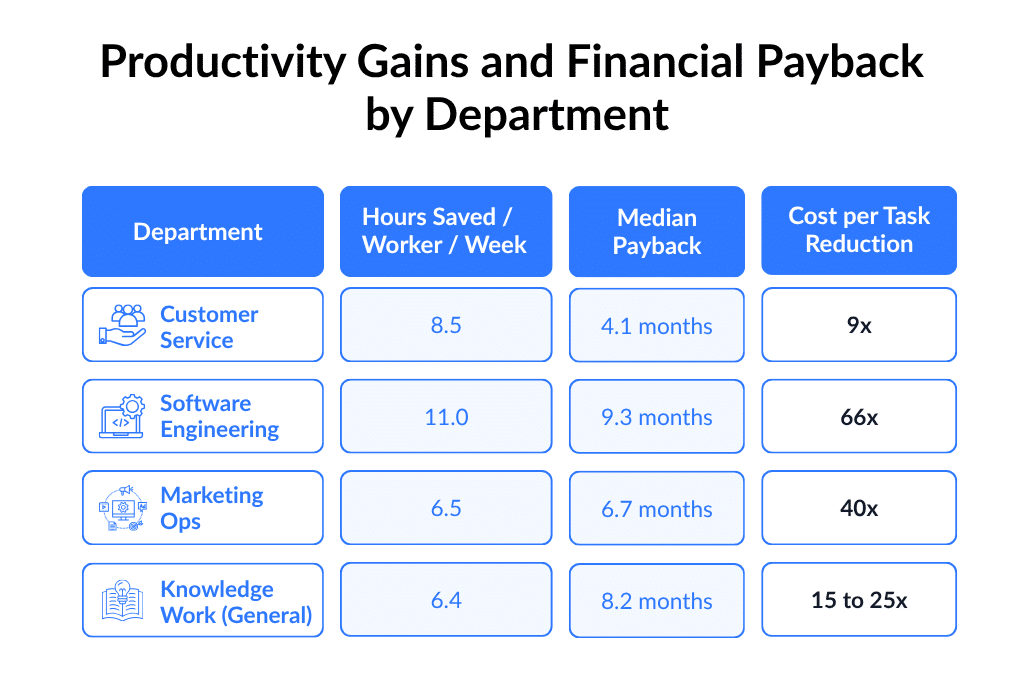
The median knowledge worker now saves 6.4 hours a week using production agents, up from 3.9 hours the year before. Both reasoning quality and integration plumbing are still trending up.
Org Chart Effects
Through 2026, Gartner expects 20% of organizations to flatten their structure with AI, eliminating more than half of middle management positions focused on routine coordination. The skills that gain value are the human ones: creative thinking, resilience, emotional intelligence. Employers expect 39% of workers’ core skills to change by 2030, and an estimated 120 million workers are at risk without targeted upskilling.
Why Programs Fail
Roughly 19% of agent rollouts never reach payback, and 95% of generative AI pilots don’t deliver measurable P&L returns. The failure modes are remarkably consistent. They’re almost always governance gaps, not model limitations.
AI washing. Companies announce AI driven layoffs without mature applications ready to fill the gap. Forrester expects more than half of those layoffs to be quietly reversed.
Evaluation drift. Agent behavior changes when models or prompts get updated. Without a real evaluation budget, typically 18 to 24% of total project spend, agents quietly become inaccurate or non compliant.
The data quality trap. Messy data is the most reliable ROI killer in this space. Data preparation routinely consumes up to 80% of project effort. Skipping the readiness assessment is the most common reason a transformation stalls.
How We Approach It: Build, Learn, Scale
Our approach comes from watching programs fail. Build, Learn, Scale is less a methodology than a sequence of habits.
Build. Start with the workflow problem, not the technology. The best early candidates are high volume, rules based, and measurable. Narrow deployments produce early ROI you can defend, and the wins fund the broader work. Open standards from day one.
Learn. Most teams bolt on governance and observability too late. We put it in early: agent registries, unique identities, immutable audit logs, evaluation pipelines, and human in the loop patterns matched to each risk tier. In regulated environments, compliance is an architectural input, not an afterthought.
Scale. Once the foundation holds, expansion gets easier. Conducto and Dactic, our internal frameworks for safely orchestrating agentic systems, take clients from a handful of agents to a coordinated digital workforce. The metrics are AVM, ACCT, containment rate, and verification latency. Vanity numbers don’t count.
The Road Ahead
The agentic workforce layer is the next chapter of enterprise evolution, and production environments are writing it now. Managing a company increasingly means managing a unified team of humans, software, and autonomous agents. The organizations that come out ahead will build solid systems for supervision, coordination, and accountability, and treat their digital workers with the same rigor they apply to their human ones.
The pattern across engagements is straightforward. Start narrow. Govern early. Measure honestly. Let the wins fund the broader work. The technology will keep moving. The discipline is what separates deployments that compound from ones that quietly stall.
Ready to Build an Agent Workforce That Holds Up in Production?
Valere works with companies to design, build, and scale agentic AI systems that deliver measurable outcomes. Whether you are running your first pilot, scaling agents across multiple business functions, or untangling a deployment that has stalled, Valere brings the expertise, platforms, and partnership model to turn agentic potential into operational performance.
- An AI Agent Readiness Assessment identifying where in your operation autonomous agents will produce defendable ROI, what governance and data infrastructure needs to be in place first, and which workflows are most likely to fail without the right architecture
- A clear path from isolated agent pilots to a coordinated digital workforce, with identity first security, immutable audit logs, evaluation pipelines, and human in the loop patterns matched to each risk tier
- A personalized value creation roadmap from disconnected automation experiments to production grade agent orchestration, anchored on open standards like MCP and A2A so your architecture compounds in capability rather than locking in to a single vendor
Start building your agentic workforce: https://www.valere.io/
Frequently Asked Questions
How do mid market companies start with AI agent implementation without an enterprise budget?
Start with one workflow that is high volume, rules based, and crosses multiple systems. Finance reconciliations, customer service triage, and lead qualification are where measurable ROI shows up fastest. Median payback periods run 4 to 9 months when scope stays narrow. The common mistake is picking a platform before defining the workflow.
What does an AI readiness assessment actually include?
Four areas: data quality and accessibility, integration architecture, governance posture, and workflow inventory by automation suitability. Data preparation alone consumes up to 80% of project effort, so understanding the data layer first prevents the most common stall point. The output should be a prioritized list of workflows ranked by feasibility and expected return.
How do AI agents differ from traditional automation tools like RPA?
RPA executes predetermined scripts and breaks when interfaces change. Agents reason about goals, select tools dynamically, and recover from input variation. RPA suits stable, high volume tasks with rigid inputs. Agents handle workflows where inputs vary or judgment is required. Many production deployments combine both.
Why do most AI agent pilots fail to reach production?
Only 6% of Microsoft Copilot pilots had reached large scale deployment as of early 2026, and roughly 95% of generative AI pilots fail to deliver measurable P&L returns. The failure modes are consistent: governance built late, evaluation underfunded, data quality unaddressed. Successful programs allocate 18 to 24% of project spend to evaluation infrastructure.
When should companies build a custom agent platform versus buy a packaged one?
Packaged platforms work when the existing system of record is also the source of work. Custom builds make sense when vertical depth exceeds what packaged platforms model, or when proprietary data structures need bespoke ingestion. Integration cost and lock in profile usually drive the decision more than feature parity.