From the desk of Guy Pistone, CEO Valere
TL;DR
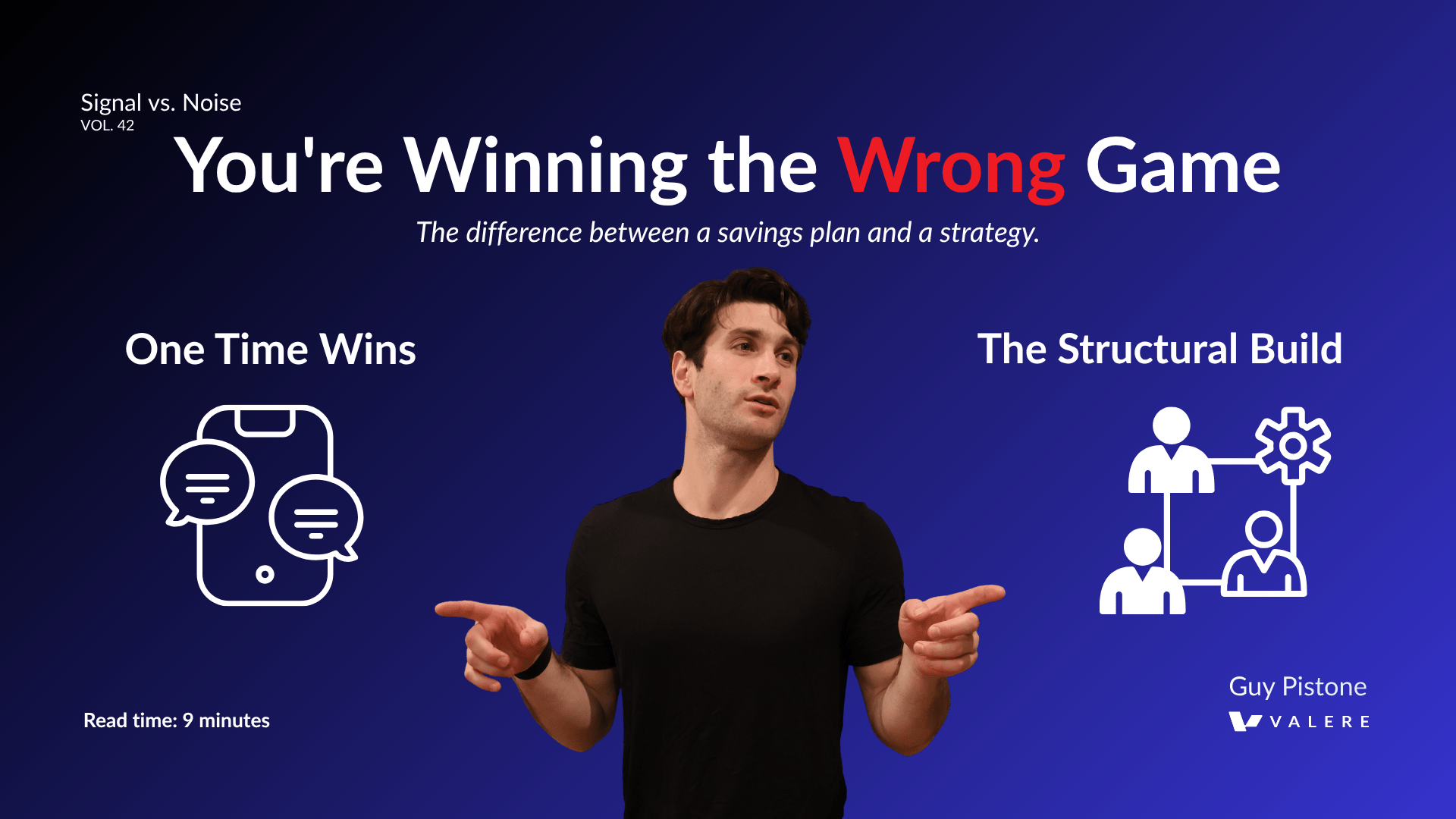
Mid-market AI deployments are delivering measurable ROI right now. Chatbots are cutting support costs, marketing teams are tripling output. The wins are not fake. But one-time efficiency captures have a hard ceiling, and the difference between those and compounding investments isn’t being named. The argument here is that the gap between “AI is working for us” and “AI is making us stronger every quarter” is an ego gap, and it’s about to define which mid-market companies survive the next 24 months.
The Problem You Aren’t Seeing
Watch a tennis player who’s losing a match. Around the third set, they start shortening their swing. The follow-through gets clipped. They stop hitting through the ball. And it works. The ball stops going long, and they start winning points. They might even win the match.
But ask any coach what happens to that player over a season. They usually answer that their ranking plateaus, and their game gets smaller. The shortened swing that won today’s match is the thing that caps their ceiling.
This is what’s happening in mid-market AI strategy right now.
And your CFO has receipts. AI is cutting customer service costs by 30%, and marketing teams are producing triple the content with the same headcount. Boards see the numbers. Nobody is making this up.
But did you notice what’s not happening underneath those wins? No proprietary data advantage is being built, and the infrastructure decisions compound nothing. The ball is going in. The swing is getting shorter.
The Solution to Stay Ahead
Efficiency wins have a floor. There, I said it. You can try to change my mind, but once you’ve captured the savings, the well is dry. Next quarter, you can’t cut the same costs again. The ROI is documented and finished. And only so many one-off wins exist.
This happens because capability investments behave differently. A team that learns AI, or a data layer built to be queryable by language models, neither of these pays back just once. They pay back every month, and the curve gets steeper as the surrounding ecosystem matures.
The pattern showing up across mid-market right now is leaders confusing the first kind of investment with the second. The chatbot is our AI strategy. The marketing automation is our AI strategy. The board hears the word AI, and the leader hears confirmation. But what they don’t see is that their business “swing” is getting shorter, and the A-players who are lengthening their swings by building proprietary data layers, redesigning workflows around AI, are pulling away in a way that isn’t visible yet.
It will be visible in 18 to 24 months. By then, it will be too late to catch up.
If this is the conversation you want to have with people who are actively going through the same tradeoff, we’re hosting a gathering in Boston on May 27 as part of Boston Tech Week. Valere, @33eleven, and @Orca Security will lead a working discussion on moving from tool adoption to measurable outcomes, and what full operationalization actually requires in 2026. It’s registration-only, and space is limited. Register here.
The Harder Problem Underneath
The interesting question is why otherwise smart leaders keep making the short-swing trade. The long game is visible. The problem is the admission it requires. They don’t yet know exactly how to play it. And for high-conviction leaders, the kind who got their companies to mid-market in the first place, that admission is out of reach.
So the short swing gets defended as “strategic discipline” or dressed up as “ROI focus.” The leader is lying to themselves first, and to the board second.
This is the ego problem sitting under the strategy problem. The same instinct that built the company (I see it, just trust me) is the instinct that prevents the leader from listening to the engineer or the ops head who is saying we should be building something different. In AI specifically, where no one person can have the full picture because the technology is moving too fast and touching too many functions, that instinct stops being a strength and starts being a liability.
Ditch Your Ego
The leaders who are succeeding are doing four things differently. All four are hard, and each one requires the leadership-team conversation most leaders try to skip.
First, they invest in something they’ll still own in three years. That means data and capability, the assets that survive the cost-cutting cycle. Onyx is a perfect example. Their AI chatbot for the licensing industry was already working; they had a product, they had customers. The short swing was to keep selling the existing product to mid-market accounts and bank the revenue. Instead, they invested in a full UX/UI overhaul to make the platform enterprise-ready. That’s the difference between a feature update and a decision to play a bigger match. The product looked similar afterward. The ceiling moved.
Second, they build on top of what they already own. Death & Co had 2,000+ cocktail recipes, the kind of proprietary asset that takes a decade to accumulate. The short swing would have been a generic chatbot to drive engagement metrics. Instead, they built a RAG-based AI bartender grounded in their recipe database, with brand voice guardrails and a path to e-commerce. What they shipped was their existing moat made digital. The difference matters: generic chatbots are rentable infrastructure anyone can copy in a quarter. A bartender trained on a brand’s irreplaceable IP cannot be copied at all.
Third, they rebuild the workflow. FortunAI built its platform around AI-native data analysis and personalized strategy generation. The system analyzes client financial data at scale and produces custom tax-efficiency plans for each business it serves. That decision is harder and more expensive in year one. It’s also the only kind of decision that produces capability that compounds. The leaders who choose this path are choosing to look slower for two quarters in exchange for being structurally ahead for ten.
Fourth, they actively look for the people on their team who disagree. They listen to what those people are saying, especially when overriding them would be faster. The leaders who get this right treat internal skeptics as a signal source. The cost of overriding a thoughtful skeptic on AI strategy is almost always higher than the cost of slowing down to hear them.
The pattern across all four moves is leaders who treat AI as building material for the company they’re trying to become.
The Bigger Implication
The story we’ll tell about this period of AI adoption, five or ten years from now, will be about which leaders kept their swing intact. The speed game won’t matter much in retrospect.
The mid-market companies that survive what’s coming will be the ones whose leaders had enough self-awareness to know when their conviction was strategy and when it was ego. That’s a much harder thing to optimize for than a chatbot deployment, and it doesn’t show up on a board deck.
But it shows up everywhere else.
FAQ
How do you tell if your AI investment is building long-term capability or just cutting costs?
Ask whether the value of the investment is finite. If you can name the maximum savings number, you’re capturing efficiency. If the upside scales as the rest of your business grows, you’re building capability. Both are valid; only one compounds.
What’s the realistic timeline for capability-focused AI investments to pay off?
The honest timeline runs in stages. Initial signal arrives in 6 to 9 months, but meaningful compounding takes 18 to 24 months at minimum. Anyone promising faster either has a different definition of pay off or is selling something.
How do you justify long-term AI investment to a board focused on the next quarter?
Reframe the comparison. Pitch capability investment against the cost of being structurally behind in 24 months, when competitors who invested have proprietary data advantages you cannot rebuild from scratch. The decision in front of you is spend now or lose the company later.
What proprietary data advantages can mid-market companies actually build?
Customer interaction data, operational telemetry, domain-specific content libraries, and process knowledge captured from your highest-performing employees. If your company has been operating for more than five years, you almost certainly have one of these and are underusing it.
How much should mid-market companies spend on AI infrastructure versus quick-win tools?
A useful starting ratio is 60/40 in favor of infrastructure and capability. Most mid-market companies are running 90/10 in the wrong direction and calling it discipline.
When does it make sense to wait on a major AI investment versus move now?
Wait when the underlying technology is changing faster than you can integrate it. Move now when you have a defensible data asset and the organizational discipline to follow through on a multi-quarter build.
Key takeaways
- The ball going in measures the wrong thing. Every AI win that shortens your swing is a future loss you’re not yet measuring.
- Efficiency caps. Capability compounds. Cost cuts pay back once, while built capability pays back every month, and the curve steepens as the surrounding ecosystem matures.
- If your AI strategy fits on a single slide showing headcount reduction, you have a savings plan with a buzzword.
- The short swing gets defended as discipline. Watch for “ROI focus” and “stage-appropriate” being used to justify avoiding the harder, longer investment.
- Ego is the unlisted line item on every AI decision. The same conviction that built the company is the conviction that blocks the leader from listening to the people who see the bigger swing.
- Your advantage decides your AI strategy. Build on top of what you already own: your data and your customer relationships. Generic AI deployed where you have no asymmetric advantage produces generic results.
- The skeptic on your team is a signal source. Internal disagreement on AI strategy is almost always cheaper than the wrong build.
- The 24-month gap stays invisible until it doesn’t. Mid-market companies that wait another year on capability investment will be permanently behind the ones that started this year.
Resources & sources
- MIT Sloan Management Review: AI & Machine Learning
- Stanford HAI: AI Index Report
- McKinsey QuantumBlack
- BCG on Artificial Intelligence
- Gartner AI Insights
- Andreessen Horowitz: AI