TL;DR: 3 Key Takeaways
- AI-first transformation is an operating model question, not a technology one, and that framing separates programs that compound from the ones that stall.
- The strongest returns come from rebuilding multi-system workflows in finance, sales, customer success, and HR.
- Human roles don’t shrink in an AI-first company; they shift upward toward managing both digital and human workers.
For most of the last decade, enterprise digitalization meant giving employees better software. That era is closing. The companies pulling ahead don’t deploy AI as a productivity layer. They rebuild the operating model around it. The pattern shows up most clearly in mid-market and PE-backed companies. They face real pressure to compound EBITDA without growing headcount. They aren’t asking whether to adopt AI. They’re asking what an AI-native operating model looks like and who runs it.
Calibrating the Right Tier of AI
Most stalled programs got the calibration wrong. Three tiers matter.
- Assistants are reactive. A person prompts them, they draft or summarize, and the human carries the work forward.
- Agents are proactive. Given an objective, they call APIs, make bounded decisions, and run multi-step processes. An assistant helps a rep write an email. An agent identifies the lead, drafts the outreach, gets approval, logs it in CRM, and schedules the follow-up.
- Agentic AI plans, adapts, and dynamically sequences tools. It reasons about context and adjusts strategies as conditions change.
What That Looks Like in Production
A higher education advancement office we work with runs seven specialized agents across the gift lifecycle. When a major gift comes in, compliance validation, stewardship drafts, analytics updates, and leadership notifications flow through one coordinated process. Staff approve and finalize from CRM sidebars and Outlook plugins. It’s a digital team running alongside the human one.
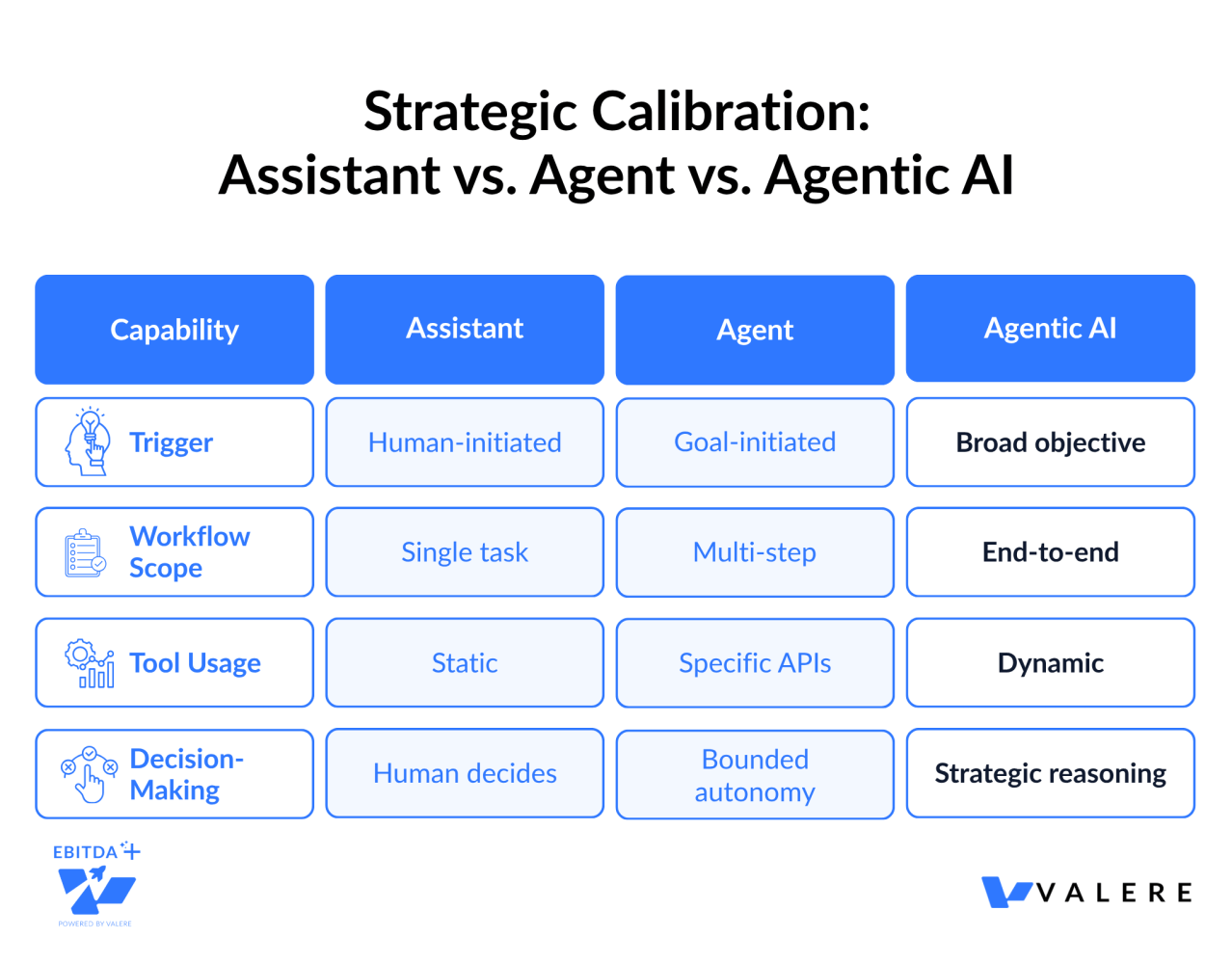
Picking the right tier per workflow is the first decision in any engagement. Many companies spend agentic budgets on problems an assistant would solve faster.
Where the Value Shows Up
We track roughly 45 ROI patterns. Agents earn their keep where workflows are high-volume, rules based, and span multiple systems.
Finance. A 401(k) provider had a manual rollover-package processing bottleneck. We replaced it with an Intelligent Document Processing pipeline. Roughly 100 packages a month now flow through under SEC fiduciary audit.
Sales and CRM. A B2B sales tech client needed to scale outbound without hiring an army. We built agents that pull from Snowflake, ZoomInfo, and HubSpot. They orchestrate compliant email outreach across roughly 250 inboxes. A three-person team now reaches over 250,000 contacts.
Customer Success. For one SaaS client, we built Conducto agents that recalculate health scores in real time. The agents match risk signals to specific intervention playbooks. The team stopped reacting to losses and started preventing them.
The New Human Operating Model
Most leadership teams underweight this part. It’s where the AI-first thesis either delivers EBITDA leverage or quietly fails.
Frontline: Reviewing Replaces Doing
Frontline operators move from doing the work to reviewing it. The job becomes catching cases where agent output needs correction or escalation. Pattern recognition replaces process execution. Done well, capacity per person multiplies. Done poorly, it creates a backlog of low-quality reviews and burns out the team.
Middle Management: Managers of Mixed Teams
Middle management reshapes more dramatically. Through 2026, Gartner expects 20% of organizations to use AI to flatten their structure. More than half of routine middle management roles either disappear or change shape. The roles that survive manage both digital and human workers. Allocation, governance, performance review, escalation logic. It looks closer to running an operations function than supervising headcount.
Senior Leadership: New Questions
Senior leaders face new questions. Which workflows fit agents. Where humans stay in the loop. How to compound capability without compounding risk. The executives treating this as an operating model question rather than a procurement question are the ones whose programs scale.
The median knowledge worker in a mature deployment now saves 6.4 hours a week, up from 3.9 the year before. The companies getting real EBITDA leverage redirect that capacity to higher-judgment work. They don’t let it backfill into meetings.
The Infrastructure Choices That Matter
Platforms
Where agents live is one of the more consequential architectural decisions. Salesforce Agentforce is deep and CRM-centric. Microsoft Copilot Studio plays the horizontal hand and connects across 1,300 systems, though Gartner reported only 6% of pilots reached scale by early 2026. ServiceNow Now Assist owns the back office.
Sometimes the right platform doesn’t exist yet. We built one government contracting client an AI-native SaaS platform that automates their full capture lifecycle. Reports that took senior managers four to six weeks now ship in about an hour.
Open Protocols Are Dissolving Integration Cost
Anthropic’s Model Context Protocol (MCP), launched late 2024, standardizes how agents connect to external tools. OpenAI, Microsoft, and Google adopted it by early 2025. The ecosystem hit 5,800 community servers by March 2026, cutting integration costs an estimated 60 to 70%. Google’s Agent-to-Agent (A2A) protocol lets agents collaborate across frameworks.
Build on open standards from day one. Lock in is easy to create and expensive to undo, especially in PE-backed contexts.
Governance, Digital HR, and Why Programs Stall
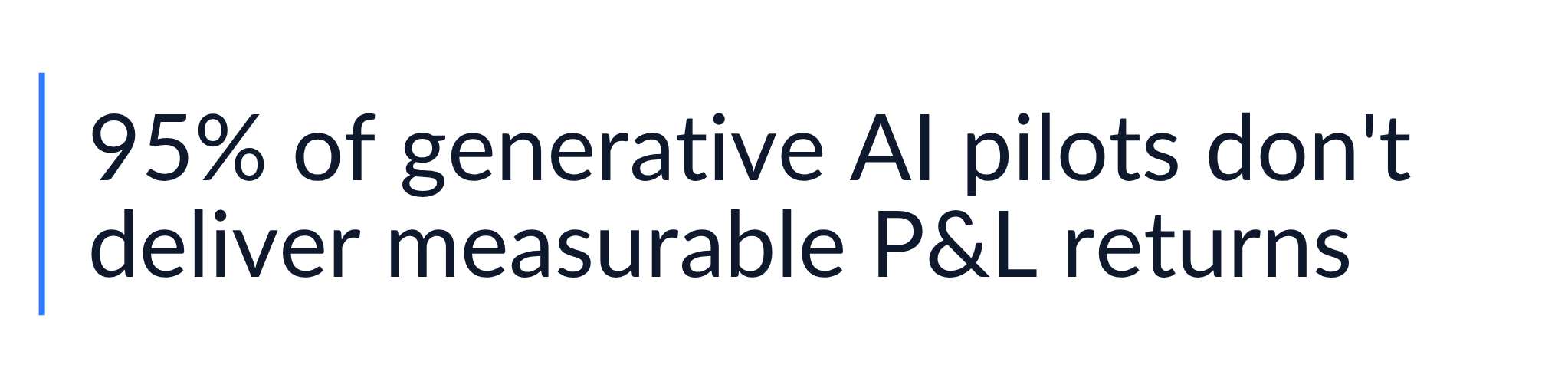
About 19% of agent rollouts never reach payback. Some 95% of generative AI pilots don’t deliver measurable P&L returns. The failure modes almost always come from governance gaps, not model limits.
The Threat That Matters Most
Agents move roughly 16x more data than human users, so traditional perimeter security doesn’t apply. Prompt injection is the acute risk. Indirect injection is the more dangerous version: an agent reads an external document with hidden instructions buried in it. Once a bad actor tricks an agent with database access, damage hits immediately.
A Workable Governance Model
Five components matter. Unique agent identity bound to organizational policy. Least privilege by default. Ephemeral credentials for high-risk work. Continuous observability. Immutable audit logs covering agent ID, originating user, tool invocations, and reasoning chain. That last one matters most. When a loan applicant disputes an AI-driven rejection, you need to reconstruct what the agent saw.
Digital HR for Digital Workers
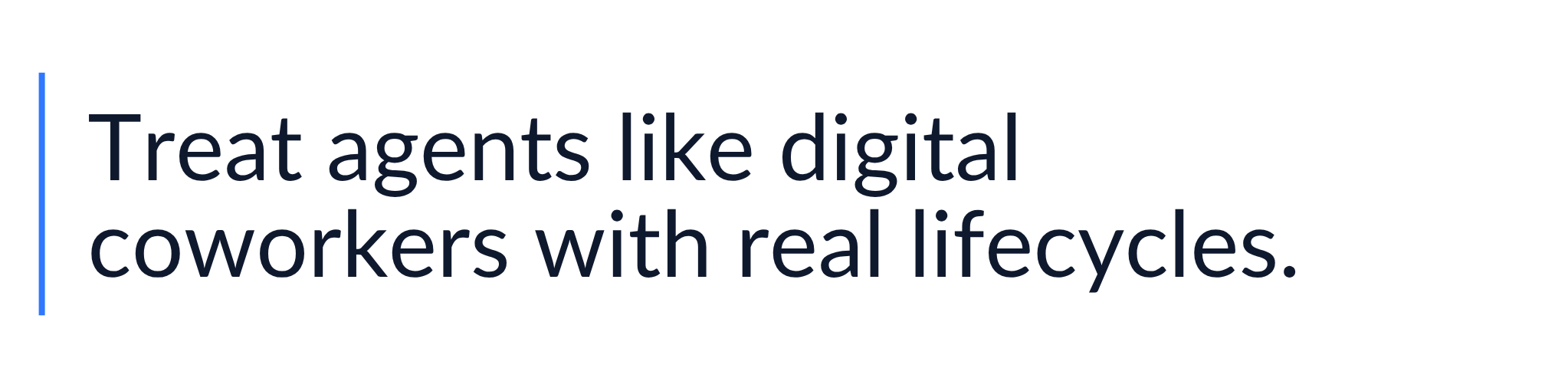
A handful of pilot agents work fine without formal management. A few hundred don’t. Our clients converge on the Digital HR model, treating agents like digital coworkers with real lifecycles. A new role appears: the AI Agent Supervisor. Responsibilities mirror an HR manager’s. Selecting models, defining digital job descriptions, monitoring accuracy and cost, decommissioning degraded agents.
Three Failure Modes
- AI washing. Companies announce AI-driven layoffs without mature applications ready. Forrester expects more than half of those layoffs to reverse quietly.
- Silent regression. Agent behavior shifts when models or prompts update. Without an evaluation budget (typically 18 to 24% of project spend), agents quietly turn inaccurate.
- The data quality trap. Preparation routinely consumes up to 80% of project effort. Skipping the readiness assessment is the most common reason transformations stall.
Measuring What Matters for EBITDA
Headcount reduction is the wrong frame. Gartner expects 50% of companies that cut customer service staff to rehire those roles by 2027. The real return comes from people amplification: more capacity for judgment work, lower cost per outcome, faster cycle times.
Four KPIs travel well. Agent Value Multiple (AVM) measures total value relative to total cost of ownership. Agent Cost per Completed Task (ACCT) tracks expense per successful completion. Containment Rate captures workflows resolved without escalation. Verification Latency is the canary metric. If review takes longer than the manual task did, the workflow creates friction rather than removing it.
How We Approach It: Build, Learn, Scale
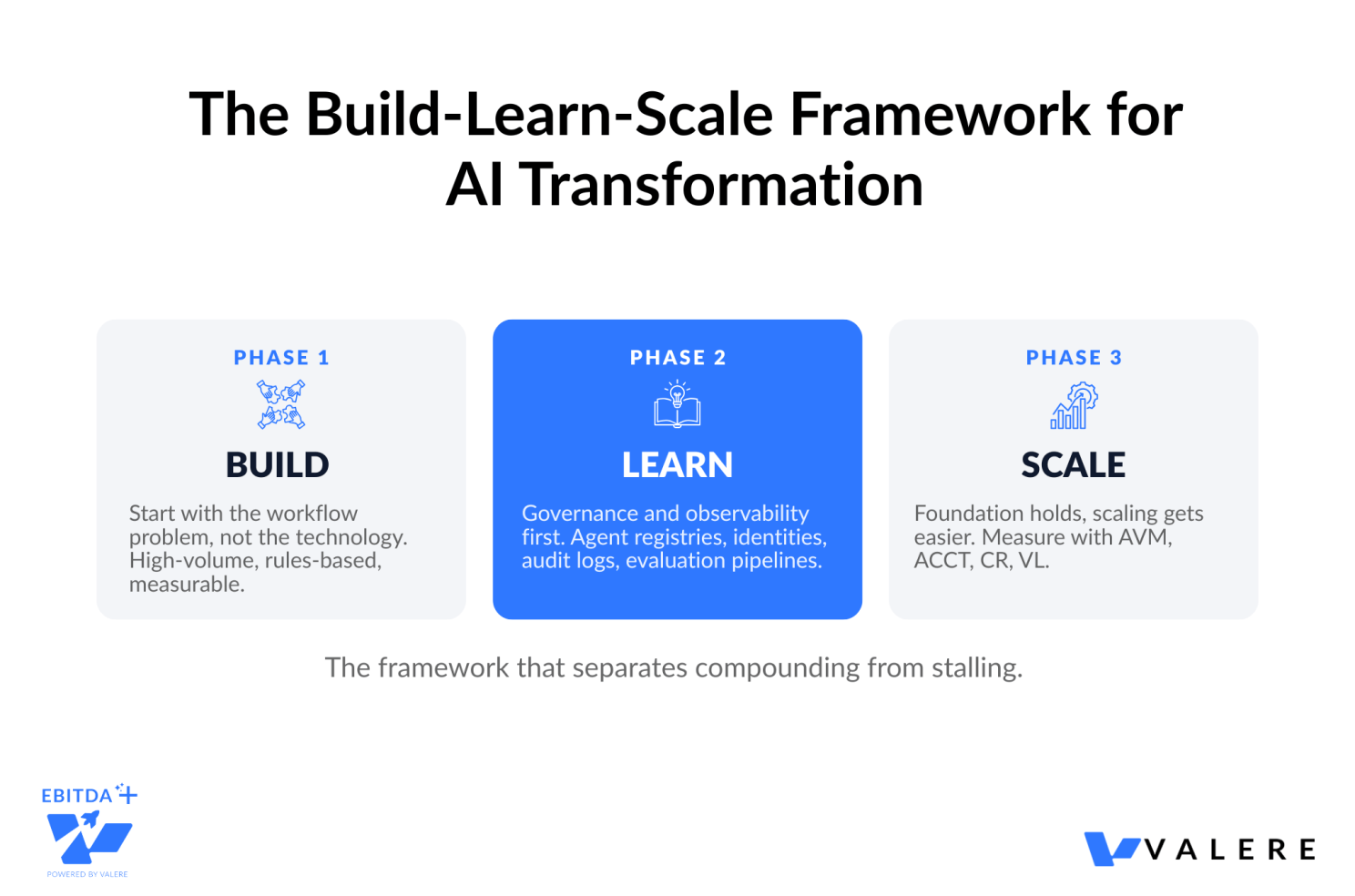
The framework is simple. The discipline behind it separates programs that compound from programs that stall.
Build. Start with the workflow problem, not the technology. The best early candidates are high-volume, rules based, and measurable. Working systems in weeks, not quarters.
Learn. Put governance and observability in early. Agent registries, unique identities, immutable audit logs, evaluation pipelines, and human in the loop patterns matched to each risk tier. Digital HR practices turn agents into manageable digital workers.
Scale. Scaling gets easier once the foundation holds. Conducto and Dactic, our internal frameworks for orchestrating agentic systems, earn their keep here. We measure with AVM, ACCT, containment rate, and verification latency.
The Operating Leverage Ahead
Managing a company will increasingly mean managing humans, software, and autonomous agents working together. The organizations that come out ahead won’t move fastest. They’ll build the best systems for supervision, coordination, and accountability. They’ll treat their digital workers with the same operational rigor as their human ones.
The technology is the easy part. The harder work is the operating model. Which workflows fit agents. Who supervises them. Where humans stay in the loop. The companies asking those questions early are the ones whose AI-first transformations actually deliver.
Build Your AI-First Operating Model with Valere
Ready to build an AI-first operating model that compounds EBITDA over time? Valere works with mid-market and PE-backed companies to design, build, and scale agentic systems that deliver measurable outcomes. Whether you are evaluating AI maturity across portfolio assets, preparing a company for transformation, or assessing a new acquisition target, Valere brings the expertise, platform, and partnership model to turn agentic potential into operating performance.
- An AI-First Readiness Assessment identifying where your current AI deployments lack the identity, governance, and orchestration controls needed to move from isolated pilots to a managed digital workforce layer
- A clear path from disconnected agent experiments to a governed agentic workforce layer that integrates with your existing operations, encodes your institutional knowledge, and compounds in accuracy with every workflow it runs
- A personalized value creation roadmap from isolated AI experiments to production grade agentic infrastructure with human in the loop governance, immutable audit trails, and proprietary frameworks like Conducto and Dactic that no competitor can replicate by licensing the same tools
Start building your AI-first operating model: https://www.valere.io/
About Valere
Valere is an award-winning AI value creation & delivery partner, providing end-to-end AI transformation & custom software solutions that transform companies into AI-first organizations through building, learning, and scaling. As an expert-vetted, top 1% agency on Upwork, Clutch, G2, and AWS, Valere serves as the trusted AI value creation partner for PE firms, mid-market companies, and Fortune 500 enterprises alike seeking comprehensive AI transformation that drives measurable ROI. With over 220 dedicated professionals and domain experts, we specialize in end-to-end AI-native solutions using our proven crawl-walk-run methodology, guiding organizations through every stage of their AI journey—from initial assessment and strategy to full-scale implementation and optimization.
About Alex
Alex Turgeon is President of Valere, serving as an embedded AI/ML strategic partner for private equity firms and their portfolio companies. He and his team operate as a vertically integrated AI solution provider throughout the PE value chain, delivering enterprise-grade solutions that enable greater operational control, cost reduction, and efficiency gains across the investment lifecycle. Connect with Alex to discuss how your organization can begin its transformation to the agent era.
Build Something Meaningful with Valere.
Frequently Asked Questions
What does AI-first mean for an operating model?
AI-first describes a company where autonomous AI handles entire workflows. Humans manage outcomes rather than execute steps. AI augmented adds AI to existing processes. AI-first redesigns processes around what AI can do. The framing maps directly to EBITDA leverage.
How do human roles change in an AI-first company?
Frontline operators shift from executing work to reviewing it. Middle managers move toward managing both human and digital workers. Senior leaders take on operating model questions. Headcount typically doesn’t drop in well-run programs. Capacity per person rises.
How should a company measure ROI on AI agents?
Headcount reduction is usually the wrong metric. More useful KPIs are Agent Value Multiple, Agent Cost per Completed Task, Containment Rate, and Verification Latency. These track operating leverage rather than cost cutting.
What are the biggest risks of deploying AI agents at scale?
Prompt injection through malicious external content is the acute technical risk. The bigger systemic risks are governance gaps: silent regression, poor data quality, over-broad permissions, and deploying faster than the organization can supervise.
Where should mid-market companies start?
Start with a high-volume, rules based workflow that spans multiple systems. Finance, sales, customer success, and HR usually offer the cleanest early candidates. Get governance in place before scaling. Adopt open standards from day one.