By Valere
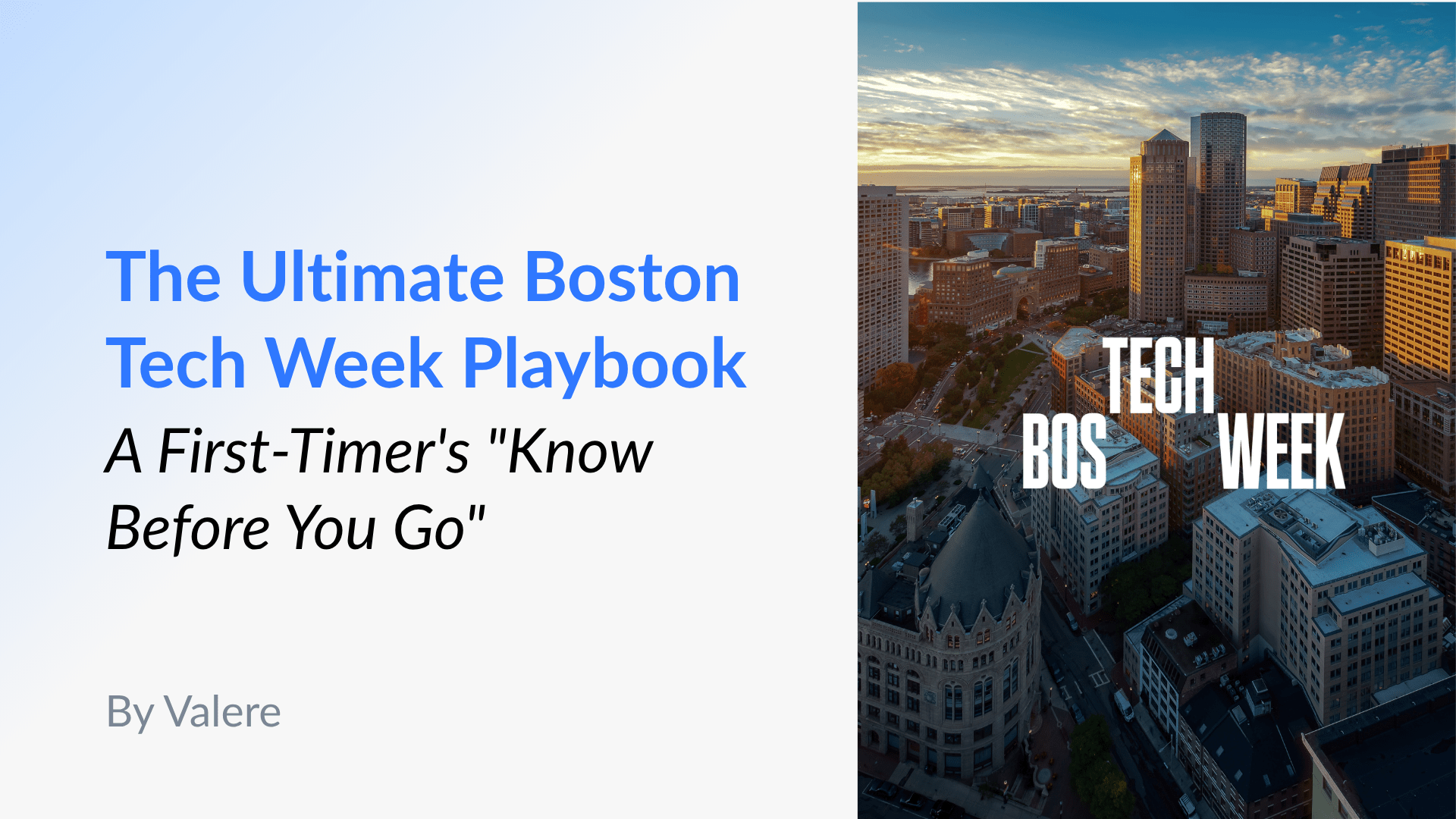
Tech Week is a citywide, decentralized series of independently hosted events presented by a16z. Boston is running its first one from May 26 to May 31, 2026, with more than 80 founding hosts on the calendar, including a16z, Anthropic, HubSpot, Klaviyo, IBM, WHOOP, Pillar VC, Founder Collective, MassRobotics, and The Engine, Built by MIT. There is no convention center, no master agenda, and no central registration. Attendees apply to individual events through the official Tech Week calendar, and hosts follow up on each registration directly.
For people who have done a Tech Week before, that format is familiar. For people attending their first one, it can feel like showing up to a party where everyone seems to already know the rules. Based on our practical experience attending Tech Weeks in other cities and tracking how the Boston schedule is shaping up, here is how we would approach it.
1. The Map Is the City, So Plan for That
Boston Tech Week events are spread across Cambridge, Kendall Square, the Seaport District, Back Bay, Beacon Hill, Charlestown, Somerville, Downtown, and a handful of smaller pockets like Chinatown and Brighton. There is no single venue.
Practically, that means a 12pm event in Charlestown followed by a 2pm event in Cambridge is going to absorb most of the window in between, especially during weekday traffic. Anyone we know who has done these well treats commute time as a real budget item, not an afterthought. Pre-loading transit options on your phone the night before tends to save you ten minutes when you actually need them.
Two early sessions worth knowing about for orientation: the Charles River networking run on Tuesday at 7:30am in Back Bay, and TechWalk at 8:30am on Beacon Hill. Both double as a way to learn the geography while meeting people.
2. Get Familiar with the T Before You Need It
Boston is one of the most walkable major cities in the US, but Tech Week stretches the geography enough that walking alone will not cut it. The MBTA, locally just called the T, is the fastest way to move between most of the venue clusters.
A few practical notes from our experience:
- The Red Line connects Cambridge and Kendall Square to South Station and Downtown. If you are stacking events between MIT-area venues and Downtown, this is your workhorse.
- The Silver Line is what gets you in and out of the Seaport District, and it also runs free from Logan Airport on the SL1 if you are flying in.
- The Green Line covers Back Bay, Copley, and Boylston, which is where a meaningful chunk of evening events tend to land.
- Pick up a CharlieCard at any major T station rather than tapping a credit card every time. It is faster and slightly cheaper per ride.
- The MBTA Go app and the Transit app both give you real-time arrival data. Trust the apps over the platform signs, especially during off-peak hours.
For shorter hops, Bluebikes is genuinely useful, particularly across the Longfellow or Mass Ave bridges between Cambridge and Boston proper. A 15-minute bike ride is often faster than waiting for a Red Line train plus the walk on either end.
Rideshare works but gets expensive fast during the morning and evening windows. If you are coming in from out of town and staying somewhere central, you may not need a car at all for the week. If you are commuting in from outside the core, the commuter rail into South Station or North Station is a cleaner option than driving and parking.
3. Apply to More Than You Think You Should
The most useful thing nobody tells first-timers is that hosts plan around attrition. Because attendees are stacking 2 or 3 events per day, RSVPs commonly overstate actual turnout. Tech Week hosts typically plan around 50% to 70% attrition, which is why a full or invite-only event today might have space tomorrow.
What this means in practice is that the worst thing you can do is self-select out. Apply to events that look full, follow up politely with hosts on events flagged as invite only, and check the calendar again the morning of, because cancellations move quickly. Some of the most useful rooms are ones you almost did not get into.
4. Lean Into What Boston Actually Is
Every Tech Week reflects the city it is held in. San Francisco skews AI and consumer. New York leans into fintech and media. Boston’s calendar is dense with biotech, healthtech, deep tech, robotics, and university programming, which lines up with the broader ecosystem here.
The official curated tracks worth filtering by are AI Infra, Hackathons, Bio+Health, Students, Engineers, Founders, Deep Tech & Robotics, and Investors. A few specific Tuesday events illustrate the flavor:
- MedTech AI Summit, hosted by Moonshot, Cambridge Consultants, and GT Law in the Seaport District
- Aging Code Summit 2026, hosted by Longevity Global, Dovetail Biopartners, and 3cubed.ai in Kendall Square
- Hard-Tech Innovation & MIT.nano, hosted by MIT.nano in Kendall Square
- AIxBIO Tech Talks: The Infrastructure Behind AI-Native Labs, hosted by Automata in Cambridge
- Physical AI Up Close with Pickle Robot in Charlestown
- The AI Scientist: From Lab Bench to Breakthrough, hosted by FoundersX Ventures in Cambridge
If you are coming in from out of town and trying to get a read on what makes Boston’s tech scene different, that first day is a useful sample.
5. Mornings and Hackathons Are Underrated
Evening happy hours absorb most of the attention, but in our experience the morning programming is where the real conversations happen. The crowd is smaller, more deliberate, and far more likely to remember you the next day. Boston’s calendar leans into this with several strong morning slots, including the Charles River networking run at 7:30am, Allocating to Atoms: A Breakfast for LPs in Deep Tech hosted by First Star Ventures at 8:30am in Cambridge, and Founders Breakfast: Boston Edition (invite only) hosted by Fidelity Private Shares, Puzzle, and HSBC at 9:00am Downtown.
If you build, the weekend hackathons are the highest-density way to get to know people quickly. The vibe coding + growth HACKATHON co-hosted by Girls into VC, Tufts, and Princeton begins Tuesday at 9:00am in Back Bay. Other build-focused sessions include Boston Protocol: Hacking Healthcare hosted by The FOMO Group in Cambridge and Building the Data Agent hosted by Probably.dev. Four hours of debugging next to someone teaches you more about them than four hours of small talk ever will.
6. Anchor Your Days Around Pillar Events
The most common first-timer mistake is trying to attend six events a day and being fried by Wednesday. A more sustainable pattern is to pick 2 or 3 anchor events per day and let the rest of the schedule fill in around them.
For Boston, anchor candidates worth knowing about include:
- The official a16z Boston Tech Week kickoff
- Becoming AI-First in 2026, hosted by Valere, 33eleven, and Orca Security at Workbar in Back Bay.
- Titans of Boston Tech: Today and Tomorrow, hosted by Rho, Flybridge, and Goodwin in Back Bay
- Ringing in the Inaugural Boston AI Tech Week, hosted by IBM, The Open Accelerator, Massachusetts AI Hub, and Red Hat in the Seaport District
- Building in Boston, featuring HubSpot Co-Founder Brian Halligan
Pick the anchors first. Build the rest of the day around them.
7. Leave White Space for the Stuff You Cannot Plan
The most useful Tech Week moments rarely happen on the official agenda. They happen at the side dinner someone mentions at lunch, the after-party that gets DM’d at 9pm, the one-on-one that runs an hour over because the conversation actually got somewhere.
Boston has a healthy slate of experiential events that tend to generate that kind of lingering interaction, including the AI Art Lab in Chinatown, the Tabs Truck stop with free bagels and swag in the Seaport District, and the Startup Science Fair: Innovation Showcase hosted by Greentown Labs, Studio 3e8, Laminar, and Transera in Somerville. Leave at least one window open per day. The events you find out about thirty minutes before they start are often the ones that pay off.
Don’t Skip the Tech Week Partner Offers
This is the section most people miss. Tech Week negotiates a set of partner offers that hosts and attendees can use during the week, and a few of them are genuinely worth the five minutes it takes to redeem.
The ones we would actually use:
- Klerk is offering up to 40% off hotels for Boston Tech Week, available for hosts and attendees for a limited time. If you have not booked yet, this is the first place to check. Boston hotel rates climb sharply during conference weeks, so the savings tend to compound.
- United Airlines is offering up to 10% off flights for Boston and NYC Tech Week travel with promo code ZSJA266125. Useful if you are flying in from outside the Northeast.
- Mostest is running white-glove event concierge support for $97, normally $195, which is mainly relevant if you are hosting an event but worth knowing.
- Shootday is offering 20% off any photo or video session for Tech Week 2026 hosts for hosts who want professional coverage.
- Free Bean is offering 15% off branded canned coffee with promo code FBTECHWEEK, and Wayo is offering 10% off the first merch order with code 26TECHWEEK10 for hosts producing swag on a tight timeline.
The full list lives at the Tech Week Host HQ. Even if you are attending rather than hosting, the Klerk and United offers alone can pay for most of your week.
Boston Tech Week FAQ
What is Boston Tech Week?
Boston Tech Week is a citywide series of independently hosted events presented by a16z, running May 26 through May 31, 2026. According to the official tech-week.com calendar, more than 80 founding hosts are participating, including a16z, Anthropic, HubSpot, Klaviyo, WHOOP, IBM, Pillar VC, and The Engine, Built by MIT. The week itself is free, but each event has its own application process and host. The format is sometimes described as an unconference because there is no central venue or unified agenda.
How do I register for events at Boston Tech Week?
Registration happens event by event through Partiful, the official RSVP platform listed on the Tech Week calendar. There is no master pass and no umbrella registration. Each host reviews applications independently, which means timing, profile, and event fit all factor into approval. A useful pattern from past Tech Weeks is to apply early and to apply to more events than you intend to attend, because hosts plan for high attrition.
Why does Tech Week use a decentralized format?
The unconference structure lets the host community shape the program rather than a single organizer. This is why Boston’s calendar reflects local strengths in biotech, deep tech, and academic research, rather than a generic tech agenda. From our perspective, the trade-off is straightforward: you get a more authentic cross-section of a city’s actual ecosystem, but you have to do more work to navigate it. People who treat the calendar as a research project tend to get more out of it than people who show up and improvise.
When should I start applying to events?
As early as possible, and then again later. Hosts release events on a rolling basis, so the calendar three weeks out is not the same as the one three days out. Checking back regularly catches both new listings and openings created by drop-offs on full events. The week of, refreshing Partiful on the morning of an event you were waitlisted for is often how people get in.
What kinds of events should I prioritize as a first-timer?
A reasonable mix is one anchor event per day, one curated track session aligned with your work, and one experiential or social event. Anchors give you visibility into where senior operators and investors are spending time. Track sessions like Bio+Health or Deep Tech & Robotics keep your time focused on relevant networks. Experiential events generate the kind of unstructured conversation that pure panels rarely produce.
How is Boston Tech Week different from other cities?
The clearest difference is the heavier weighting toward biotech, life sciences, and hard tech. The official calendar features dedicated Bio+Health and Deep Tech & Robotics tracks alongside the standard founder, investor, and engineer programming, with hosts like MIT.nano, Pickle Robot, Greentown Labs, MassRobotics, and Cartography Biosciences anchoring those areas. From our experience, that emphasis matters when you are choosing which Tech Week to attend. If your work is closer to atoms than to pure software, Boston is likely a better fit than the SF or NYC programs.