TL;DR
Most founders treat the in-house vs. agency decision as a cost question. It is an ownership question. The companies that get this wrong do not realize it until they are two years in and rebuilding something they already paid for once. This is one of those articles you want to read to the end.
Everyone Asks the Wrong Question First
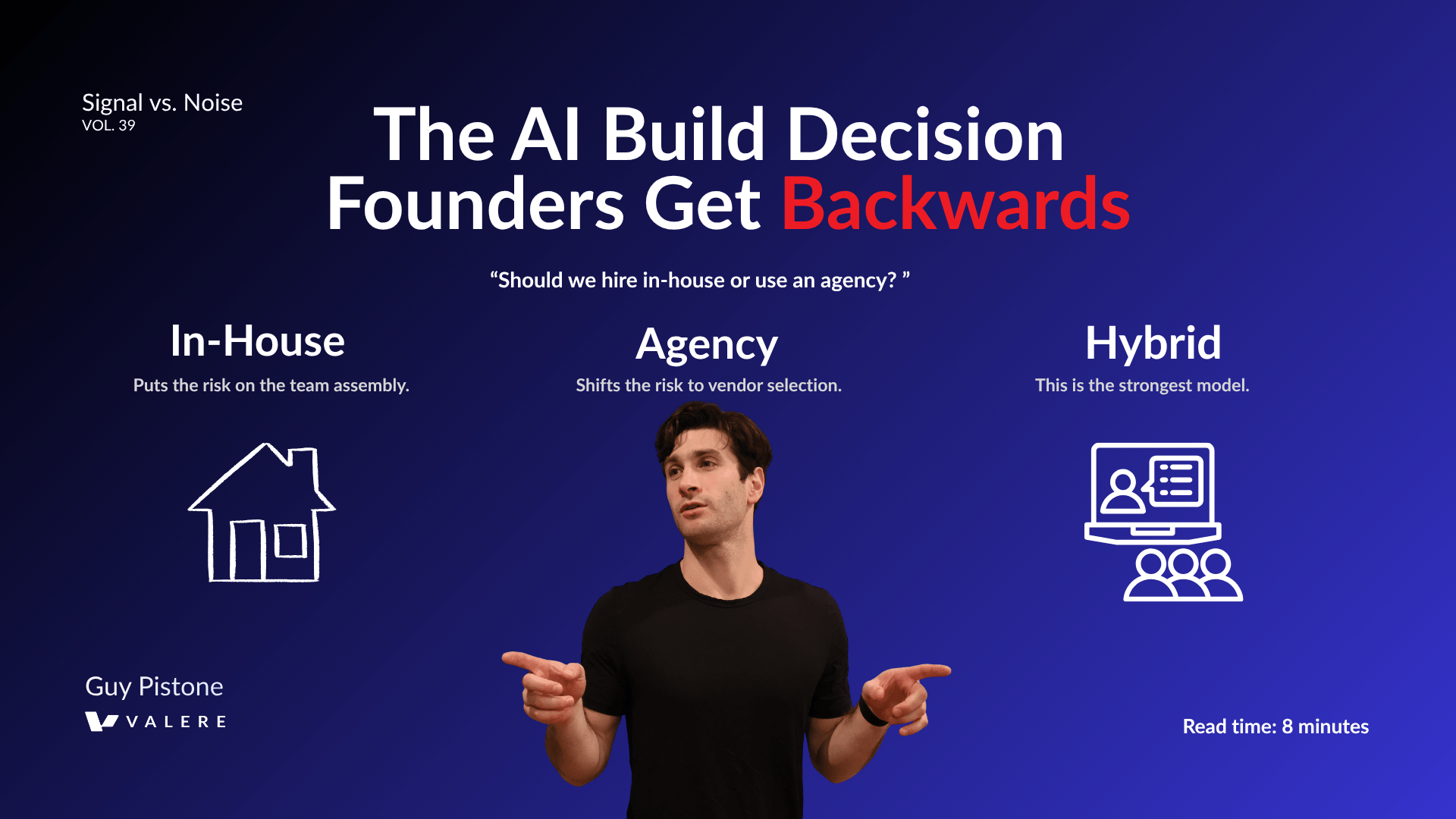
The most common question I get from founders building with AI is some version of this: should we hire in-house or use an agency?
Most treat it as a budget conversation (wrong). In-house is expensive upfront. Agencies feel cheaper and faster. The hybrid sits somewhere in the middle. Pick your number, pick your path. That framing gets the decision wrong from the start.
The real question is what you end up owning when the build is done. Cost is a variable inside that question, not the question itself.
I have been building software and AI products for over fifteen years, first as a founder shipping consumer apps, then running Valere through hundreds of client builds. The companies that struggle most are hardly ever the ones that overpaid. They are the ones that gave away the wrong things without realizing what they were handing over.
Have you ever thought about that?
The Asset Nobody Talks About in the Contract
Before we built Dactic for an internal initiative, I watched the same pattern repeat across client engagements. A company hires a talented agency, gets a working product, and feels good about the outcome. Two years later, they want to expand the system, change a core workflow, or bring development in-house. They pull back the hood and discover the architecture is someone else’s logic encoded in a way their team cannot fully read, modify, or scale without going back to the original vendor.
Your data model is the structure that encodes your business logic. Your architecture is the skeleton everything else runs on. If a third party owns both and your internal team does not understand them, you are a tenant in your own product (ouch).
Building Dactic internally and now watching it get licensed to other companies taught me the other side of this. When you own the architecture from the beginning, the product compounds. Features you did not anticipate become possible because the foundation was built with ownership in mind. That does not happen when you retrofit ownership after the fact. This is an ownership problem created on day one.
Think about how many times that shows up in the contract conversation…
Build a Prototype Before You Talk to Anyone
There is a step most founders skip or rush, and it costs them in every direction. Your trick to not getting screwed here: Build a rough prototype yourself before you engage a developer or an agency.
The goal is communication, not shipping. A founder who walks into a technical conversation with a working mockup gets a fundamentally different engagement than one who walks in with a slide deck. The spec gets tighter. The estimate gets more accurate. The agency has less room to interpret what you meant.
Vibe coding tools like Cursor, Bolt, Replit, etc., have made this accessible to non-technical founders in a way that genuinely changes the dynamic. You are generating a functional prototype without writing production code. A Stack Overflow developer survey found that 84% of developers were already using AI coding assistants in their workflow. The same capability that is accelerating professional developers is now available to founders who want to communicate what they are trying to build.
It also answers one of the most expensive questions in product development before real money is committed: Is this actually worth building?
In-House, Agency, Hybrid: What Each One Actually Costs You
These three paths carry different risk profiles. Understanding the risk, not just the price, is what makes the decision.
In-house puts the risk on the team assembly.
You are betting that people who have never worked together will ramp fast enough to hit your timeline, on a problem set they may not have solved before. That is a real risk. It is also the path that builds the most durable internal capability over time if you execute it well.
The agency path shifts the risk to vendor selection.
A good agency brings reps, meaning they have solved versions of your problem before and are not learning the fundamentals at your expense. A bad agency is the opposite of that. The variable is your due diligence, not their headcount.
Hybrid is where most mid-market companies land, and when configured correctly, it is the strongest model.
The configuration matters more than most people realize.
The instinct is to hire a strong front-end engineer in-house and contract the harder AI work. That is backwards. Own the back end, the data model and the architecture. Contract the front end and AI layer if you need to. The front end changes constantly: design systems evolve, interfaces get rebuilt, user experience gets iterated. You can replace that. The data model and architecture are the foundation. If someone else built them and your team does not fully understand them, you cannot operate independently.
Think of it like basketball roster construction. Championship teams are not built by signing everyone to one-year deals and hoping chemistry emerges. There is a core you own, your starting five, your system, your playbook, and a supporting cast you flex depending on what the season requires. The hybrid build model works the same way. Lock in the foundation. Stay flexible on everything built on top of it.
The Six Questions That Separate Good Agencies from Expensive Lessons
Most founders vet agencies the way they would evaluate a marketing firm: technical tests, demos of live solutions, portfolio, case studies, and references. That is necessary but not sufficient for an AI build.
Bring these six questions into the room:
- Walk me through a specific architecture decision you made on a past project, what you chose, what you considered, and what you would do differently now.
- What do you think we should own versus what is safe to contract out on a build like this?
- Which AI frameworks are you working with, and what are the tradeoffs between them for our use case specifically?
- Tell me about a project that did not go as planned. What happened and what changed in how you work as a result?
- Can I speak directly with the engineer who would lead our build, not the account lead, before we sign anything?
- When the engagement ends, what does our team need to understand to operate and evolve the system without you?
An agency with genuine reps will have specific, considered answers to all six. Period. An agency that is still developing its AI practice will default to generalities and struggle with questions three, five, and six.
The most expensive education a founder can fund is paying an agency to learn on their own build.
That line is not rhetorical. I have watched it happen more times than I can count, and it almost always comes down to skipping this conversation.
What Elete Taught Me That No Client Build Could
In 2019, I built Elete, one of the first AI-powered consumer sports apps on the Apple App Store. It reached 10,000 monthly active users and was acquired. The acquisition was a good outcome. But the build process was an education I could not have gotten any other way.
The thing that made Elete work was not the AI layer. It was that we owned the data model completely. Every decision about how user behavior was encoded, how the recommendation engine was structured, and how the system learned over time was ours. When we needed to iterate fast, we could. When an acquirer looked under the hood, there was nothing encumbered.
The companies that approached similar problems with contracted architecture learned a harder lesson. Some of them are still paying vendors for access to infrastructure they thought they owned.
The pattern holds whether you are building a consumer app, an internal operations tool, or an enterprise AI product. Founders who treat the build decision as an ownership question from the start end up with assets. Founders who treat it as a cost question end up with dependencies.
What do you need to control to operate and evolve this system three years from now? Answer that question before you answer the budget question.
So, which direction are you going?
Frequently Asked Questions
What is vibe coding and is it actually useful for non-technical founders?
Vibe coding refers to using AI-assisted development tools, Cursor, Bolt, and Replit, being the most commonly used, to generate functional prototypes without writing production-grade code. The output is not meant to be shipped. It is meant to make communication with a development team dramatically more precise. A 2023 Stack Overflow survey found that 44% of developers were already using AI coding assistants in their daily workflow. For non-technical founders, the practical value is that a working mockup compresses the gap between what they imagine and what they can actually spec, which reduces cost and misalignment risk before the first dollar of development is spent. It also pressure-tests whether an idea holds up under even basic implementation before a real budget is committed.
What does it mean to own your data model and architecture?
Owning your data model means your team understands and controls the structure that encodes your business logic at a database level. Owning your architecture means you understand how every component of the system connects, communicates, and scales. In practical terms, ownership means your internal team can make meaningful changes to the system without going back to the original vendor. When you do not own these, you cannot switch vendors without rebuilding, cannot bring development in-house without starting over, and cannot respond to security issues or scale requirements independently. A 2022 McKinsey analysis of digital transformation failures identified loss of technical ownership, specifically around data architecture, as one of the most common and costly outcomes of outsourced AI builds.
How much does it cost to build an AI product in 2025?
A meaningful MVP with AI functionality built through an agency typically runs between $75,000 and $250,000, depending on scope and whether the build is integrating existing models or developing proprietary ones. In-house builds carry higher upfront costs due to hiring, benefits, and ramp time, but lower long-term unit economics when the product is maintained and iterated over multiple years. A hybrid model, with one or two in-house back-end developers working alongside a contracted agency for front-end and AI layer work, often lands between $120,000 and $200,000 for the initial build with more predictable ongoing costs. These numbers shift based on the talent market, geographic considerations, and whether the company is starting from existing infrastructure or building from scratch.
How do I know if a prototype is ready to hand off to a development team?
A prototype is ready to hand off when it can answer three questions without requiring verbal explanation: what the product does, who it is for, and what happens when a user takes a specific action. It does not need to be polished or complete. It needs to be specific enough that a developer can disagree with a design decision rather than interpret an open-ended description. If handing the mockup to someone without context produces questions about fundamental functionality rather than implementation details, it needs more work. If it produces questions about how to build what is already clearly shown, it is ready.
What is the difference between an AI development agency and a traditional software agency?
The distinction that matters most in practice is whether the agency has shipped AI-specific products in production, not just integrated AI features into existing software. AI development involves different architectural decisions around model selection, data pipelines, prompt engineering, evaluation frameworks, and inference cost management than traditional software development does. An agency with genuine AI reps will have a point of view on these decisions and be able to explain the tradeoffs. An agency that has bolted AI capabilities onto a traditional software practice will often treat model selection as a commodity decision and underinvest in the data and evaluation infrastructure that determines whether the AI actually performs reliably at scale.
When should a company consider building an AI product in-house versus licensing an existing tool?
The decision comes down to whether the AI functionality is a differentiator or a utility. If the AI layer is what makes your product defensible, meaning it encodes proprietary data, proprietary workflows, or proprietary user behavior in a way competitors cannot easily replicate, building in-house or with a trusted agency where you retain ownership is worth the investment. If the AI functionality is a utility, a general-purpose summarization tool, a standard chatbot interface, a document parser, licensing an existing product and integrating it is almost always faster and cheaper. The mistake most companies make is treating differentiating AI as a commodity and buying a generic solution, then discovering two years later that the thing that should have been their moat is a vendor dependency.
Key Takeaways
- The in-house vs. agency decision is an ownership question. Cost is a variable inside that question, not the question itself.
- Build a prototype before you talk to anyone. It tightens the spec, improves estimates, and answers whether the idea is worth building before real money is committed.
- In the hybrid model, own the back end. The data model and architecture are core business assets. The front end is replaceable.
- Bring the six vetting questions into every agency conversation. The answers tell you whether you are hiring experience or funding education.
- The companies that struggle most are usually not the ones that overpaid. They are the ones that gave away the wrong things without realizing what they were handing over.
The build decision is not about finding the cheapest path to a working product. It is about making sure you still own the product when it is done.
If you need to talk through this topic more, DM me your questions.
Guy Pistone | CEO, Valere | AWS Premier Tier Partner
Resources & Sources
- Stack Overflow 2023 Developer Survey
- McKinsey State of AI 2023
- Cursor
- Bolt
- Replit
- Valere AI Implementation Services
- Valere Learning
- Dactic