Key Takeaways
- Software valuations have bifurcated into two distinct paths: accelerate growth through AI-native products or rebuild to true operating margins above 40%, with no viable middle ground remaining.
- The shift from seat-based licensing to consumption and outcome-based pricing is restructuring how software is built, sold, and valued across the entire sector.
- The limiting factor in AI transformation is rarely the technology itself; organizational clarity, knowledge capture, and process redesign determine whether AI investment produces real returns.
The Reckoning Has Already Started
The software industry is in the middle of a structural reset, and most leadership teams are moving slower than the market requires. Valuations are splitting. Business models are being repriced. The strategies that produced durable growth over the last decade are increasingly at odds with what investors, acquirers, and customers actually reward today.
This article lays out what that split looks like in practice: where the multiple compression is coming from, what the two viable paths forward actually demand, and why companies attempting to navigate both simultaneously are the most exposed. The client work referenced throughout comes from direct engagements across enterprise software, PE-backed platforms, and mid-market operators working through exactly these decisions right now.Software valuations have been stratifying for the past two years. The gap between companies commanding premium multiples and those stuck well below the median keeps widening. After peaking at median EV/Revenue multiples of 18.6x in 2021, the sector compressed to 6.1x in 2023 before stabilizing around 7.0 to 7.4x today.
That stabilization is deceptive. A real split is taking place beneath it. Companies commanding 9x+ multiples are pulling away from those unable to grow fast enough to justify a premium or cut deep enough to earn a fortress valuation. The comfortable middle is disappearing, and what replaces it is a decision every software CEO, board, and investor needs to make now.
The Adjusted Numbers No Longer Hold
For the better part of a decade, software companies got very good at one thing: appearing profitable without actually being profitable. Non-GAAP operating margins, adjusted EBITDA, and free cash flow figures quietly excluded the dilutive cost of stock-based compensation. This became the industry’s preferred language for communicating financial health to investors who, for a long time, were willing to go along with it.

The SBC Problem
In 2026, stock-based compensation as a percentage of revenue remains significant across the sector. SoundHound AI sits at 48%. Snowflake at 35%. Rubrik at 26%. Cloudflare at 21%. Once you treat SBC as the real expense it is, a transfer of value from shareholders to employees, much of the sector’s apparent profitability disappears. Nvidia recently stopped excluding SBC from its adjusted operating expenses. The rest of the industry is heading in the same direction: toward full transparency, whether companies choose it or not.
The implication is uncomfortable but straightforward. If growth is slowing and true margins are still deeply negative, a company has neither a growth story nor an efficiency story. Markets are increasingly unwilling to wait while leadership finds one.
The New Benchmarks
The Rule of 40, long the benchmark of SaaS health, is no longer a premium signal. It is a floor requirement for institutional relevance. Firms like Bessemer have moved to the Rule of X. This framework applies a 2 to 3x multiplier to revenue growth over margin improvement, reflecting the compounding value of top-line velocity in a market where growth endurance has already declined from 80% to 65% across the sector.
Grow fast or earn real money. There is not a third option.
The Two Paths
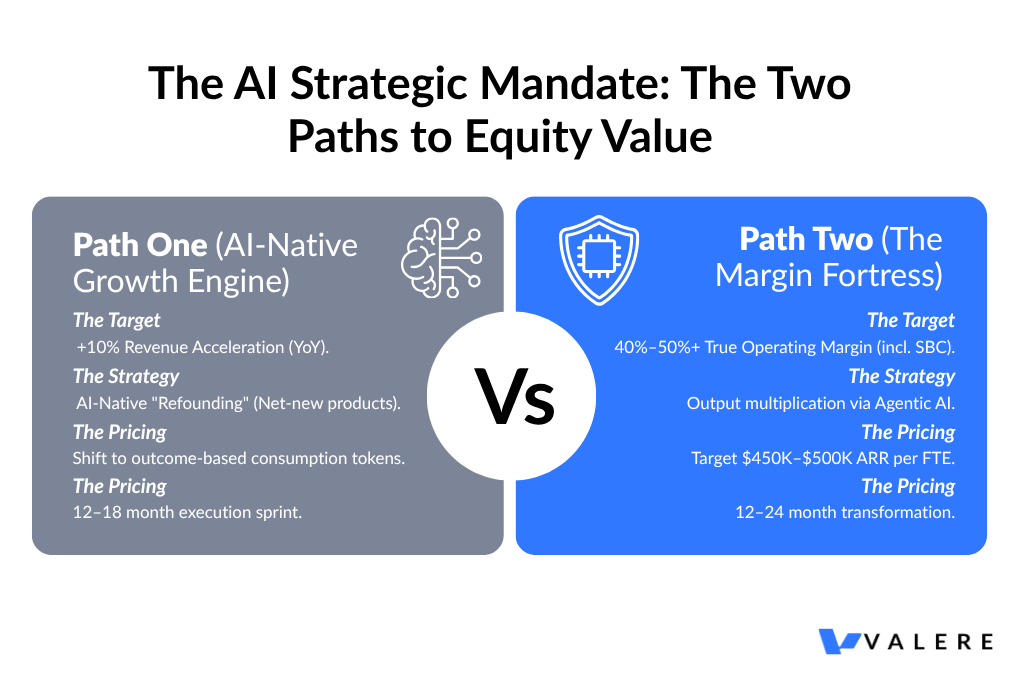
Market evidence keeps pointing to the same conclusion. Durable equity value creation in software now flows through one of two mandates.
Path One: Accelerate revenue growth by 10 or more percentage points year-over-year through genuinely new AI-native products, within 12 to 18 months.
Path Two: Rebuild to 40 to 50%+ true operating margins, inclusive of stock-based compensation, within 12 to 24 months.
These paths are not mutually exclusive in theory, but the execution window makes them so in practice. Management bandwidth, capital allocation, and organizational energy cannot stretch across both without producing half-measures on each. Companies trimming headcount by 8%, launching a cautious AI feature, and publishing an aspirational margin target face the most severe multiple compression. Both paths demand far more than most leadership teams currently appreciate.
Path One: The AI-Native Growth Engine
The first thing to understand about Path One is what it is not. It is not bolting a chatbot onto an existing product. It is not adding an AI copilot to the pricing page. It is not a press release about your AI roadmap.
Path One is a refounding. It means building new products capable of moving your total growth rate by 10 percentage points within 12 months. It also means rebuilding the organization around those products so that when product-market fit arrives, the company can actually capitalize on it.
What the Market Data Shows
The data on AI-native companies makes the urgency clear. AI-native startups are reaching $1M ARR 30% faster than top-quartile traditional SaaS benchmarks. They are reaching $30M ARR five times faster, in 20 months versus the traditional 100. Implementation timelines are 10x shorter. Costs in some verticals are 20x lower. These are structural advantages, not incremental ones, built on data flywheels, organizational agility, and architectures designed for the agentic era from the start.
Salesforce’s Agentforce offers a useful reference point from the incumbent side. By the end of fiscal 2026, the platform reached approximately $800M in ARR, up 169% year-over-year. It processed 19 trillion tokens and delivered 2.4 billion agentic work units across 29,000 signed deals. That is not a feature launch. That is a business model transformation from seat-based licensing to outcome-based consumption, priced in tokens and aligned to the workflows enterprise buyers actually care about now.
What a Real Refounding Looks Like
The distinction between a feature launch and a genuine refounding is something we have seen play out directly in our work. One enterprise software platform in the Microsoft licensing space had already invested in a chatbot prototype. It was built on fragile, Zapier-based automation that fell apart under the complexity of real enterprise queries. The temptation was to iterate on it. The right answer was to start over.
Rebuilding the product on an enterprise-grade AWS architecture and reorienting it entirely around enterprise buyer needs produced a 50% improvement in chatbot accuracy. It also unlocked a $100M+ revenue customer segment the platform had previously been unable to reach. That is Path One done properly: a transformation that changes who can buy from you and at what scale.
How to Structure the Execution
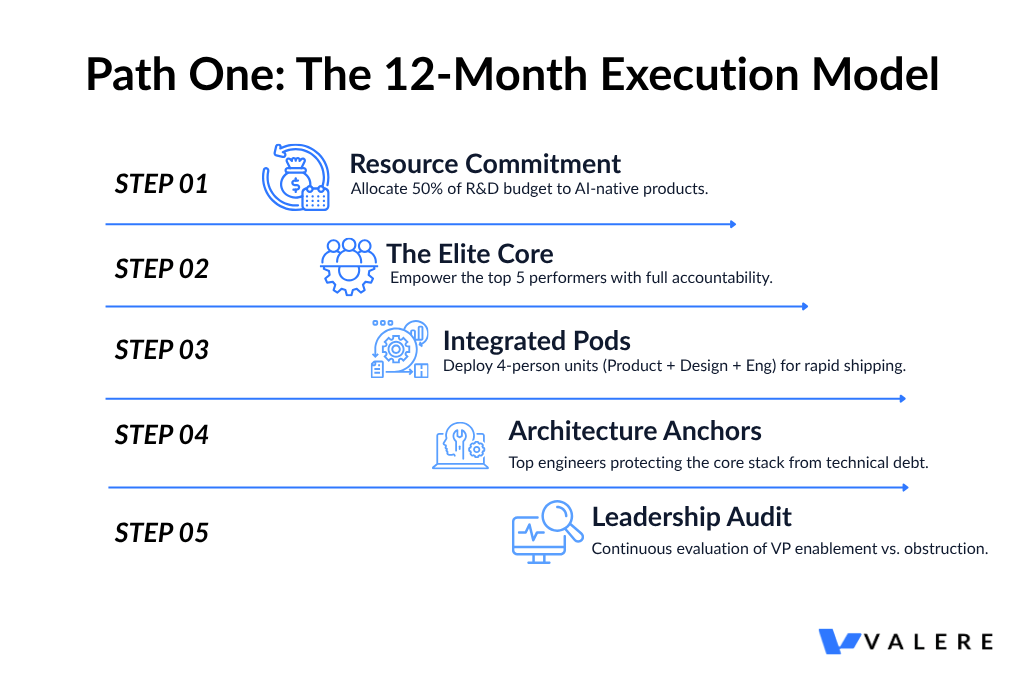
The companies that pull this off treat it as a 12-month sprint with a small, trusted team at the center. Find the five people in your organization who will outperform every expectation over the next year, regardless of title or seniority. Give them real scope and accountability. Watch closely to see which of your VPs enables them and which quietly gets in the way. Those observations will tell you most of what you need to know about which leaders to keep.
On the R&D side, allocating 50% of budget to net-new AI products tends to produce far better results than anything built across traditional silos. Organize teams into four-person pods that integrate design, product, and engineering into a single shipping unit. Keep your best engineers in the central architecture, focused on making sure the core stack can evolve as fast as the pods pushing the edges. Spreading top engineering talent across discovery pods is tempting but usually a mistake. It fragments your stack and creates technical debt that quietly buries early progress.
Repricing the Business Model
The business model also has to evolve. Seat-based pricing will not disappear overnight, but it will erode. Customers’ most visible source of AI savings is labor efficiency, and seats are exactly where they will look to cut first. The new growth is in tokens, consumption pricing, outcome-based contracts, and machine-driven workflows. If an AI agent cannot consume and pay for your product autonomously, you are not yet set up for Path One.
Path Two: The Margin Fortress
For companies where top-line reacceleration is not a realistic option, Path Two is not a consolation prize. Executed well, it produces businesses with the durability, pricing power, and cash generation to survive and compound through the next cycle.
But companies routinely misunderstand it. An 8 to 10% reduction in force is not Path Two. That is the weak form: trimming the edges while leaving the machine intact. The strong form is rebuilding the machine.
The Target Numbers
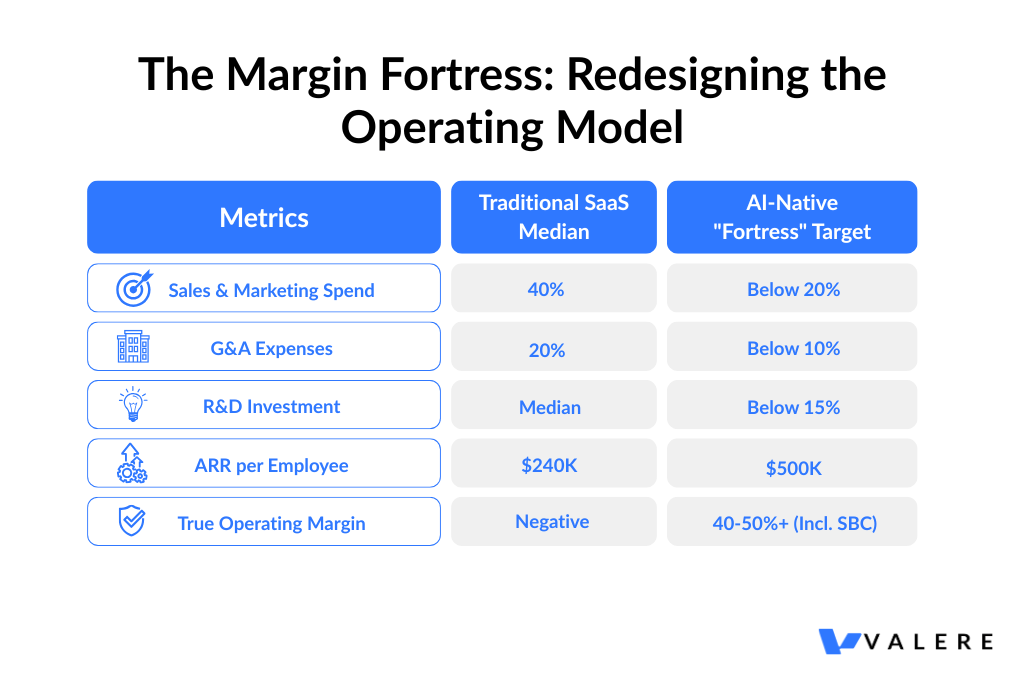
Reaching 40 to 50%+ true operating margins, inclusive of SBC, requires moving spend ratios dramatically across every function. The 2025 median for private SaaS companies shows Sales and Marketing consuming 37 to 47% of revenue and G&A consuming 19 to 24%. Path Two targets S&M below 20%, R&D below 15%, and G&A below 10%. At the same time, it requires pushing gross margins above 85% and net revenue retention above 115%.
Incremental adjustments will not get you there. It requires a coherent redesign across the full organization. AI is the primary mechanism that makes the required output-per-employee ratios achievable without gutting the business in the process.
Output Multiplication, Not Just Cost Cutting
A construction technology company we work with needed to scale its outbound email marketing significantly but could not justify the headcount to do it manually. Rather than hiring, we deployed Dactic to capture and codify successful messaging patterns from the team’s existing work, then built an orchestration layer using Conducto to execute those patterns at scale. Conducto agents now manage dynamic personalization, reply routing, and compliance monitoring across 210 to 300 inboxes. They handle over 250,000 contacts without adding a single person to a three-person team. That is an output-multiplication story, and it is exactly the mechanism through which Path Two margin targets become achievable without hollowing out organizational capacity.
The same principle applies on the revenue side. A government contracting firm we work with was losing significant sales capacity to manual opportunity research. Teams spent hours scanning procurement databases and cross-referencing agency budgets, often chasing leads that were already stale. We deployed Dactic to codify the firm’s accumulated knowledge about what makes a qualifying opportunity, then built agents to continuously scan SAM.gov, USAspending, and Navy budget databases around the clock. The agents score opportunities in real time and generate instant alerts when a match surfaces. Manual search time dropped by 80%, and the team now identifies high-value opportunities 30 to 90 days earlier than before. A lean sales team now produces what a much larger capture department used to.
Protecting the Revenue Base
Customer retention is the other half of the margin equation that too few Path Two plans address seriously. An automotive dealer intelligence platform we partner with was spending disproportionate CS capacity on reactive churn management, identifying at-risk accounts too late to intervene meaningfully. We used Dactic to conduct deep interviews with the CS team, surfacing implicit early warning signs of dealer churn that existed as tribal knowledge but had never been systematized.
Automated monitoring now tracks platform usage patterns in real time and continuously recalculates account health scores against those signals. The results: 15% of CS bandwidth freed from manual auditing, proactive intervention triggered 30 to 60 days before traditional churn indicators would have appeared, and a 20% reduction in early-stage churn. Margin expansion is partly about cost structure, but it equally depends on protecting the revenue base those margins rely on.
The PE Playbook as a Blueprint
The private equity playbook, historically dismissed by VC-backed founders as too efficiency-obsessed, turns out to be the right model for Path Two. Firms like Thoma Bravo and Vista Equity Partners have spent decades demonstrating that software can run as a precision instrument. Vista’s portfolio migrations from fragmented legacy platforms to unified, modern alternatives consistently produce 50 to 80% reductions in licensing and infrastructure costs. Zero-based budgeting delivers 15 to 20% OpEx reductions. Value-based pricing anchored in workflow ownership and switching costs adds 3 to 5% margin expansion almost immediately. Broadcom under Hock Tan remains the starkest public-market proof that radical cost discipline and product simplification are achievable and that the market rewards them.
The Engineer Productivity Ceiling Is Rising
AI accelerates all of it. Top operators already describe engineers managing 20 to 30 agents simultaneously, with order-of-magnitude productivity gains becoming the expectation rather than the exception. Path Two companies that invest aggressively in token spend per engineer, where $1,000 per month is closer to table stakes than extravagance, can ship more while significantly reducing headcount dependency. Median ARR per FTE at the $50M to $100M band sits at $200 to $240K today. With agentic tooling deployed properly, $450 to $500K is achievable within 18 months.
Know Where Your Moats Are Weakening
Be honest about which moats are actually weakening. Data alone is usually not the defensible position it once was. Integrations are easier to reproduce. Workflow and UI advantages erode when agents can move across systems. Migration is getting easier, not harder. The companies that succeed at Path Two know exactly where their pricing power lives, and they protect it while cutting everywhere else.
The No-Man’s Land Risk
The companies most at risk right now are not the ones boldly pursuing Path One or Path Two. They are the ones pursuing a diluted version of each, convinced that moderate growth and improving-but-not-true margins represent a defensible position.
They do not. The market is applying, and will continue to apply, multiple compression to exactly this category of company.
What the Research Says
McKinsey’s research reinforces the danger of overcorrecting toward margins at the expense of growth. Companies that prioritized margin between 2021 and 2023 while passing on investable growth left meaningful enterprise value on the table. A 6-point reinvestment in growth, even at lower efficiency, could have yielded a 9% EV uplift. The takeaway is not that Path Two is wrong. A company choosing Path Two should be genuinely unable to pursue Path One, not just reluctant.
The Competitive Pressure from Below
The rise of AI-native teams makes the urgency of commitment more acute. Small, highly capable groups are using AI to automate the more repetitive aspects of development. They compete in niche markets with a fraction of the overhead of established players. For a mid-sized company carrying high personnel costs, complex management layers, and a legacy tech stack, Path Two is not just a strategic option. It is a survival response to these low-cost, high-velocity entrants.

Service as Software: The Business Model Shift Underneath Everything
A fundamental change in how software is bought, sold, and valued runs through both paths. It affects the calculus of nearly every strategic decision right now.
The seat-based SaaS model rested on a simple premise: software delivers value to the humans who use it, so you charge per human. That premise is breaking down. AI agents now handle customer interactions, process transactions, generate outputs, and orchestrate workflows. Agents do not have seats. They consume tokens.
This is the shift to service as software: outcomes delivered autonomously, priced by consumption, and valued by the work completed rather than the license held.
What This Looks Like in Practice
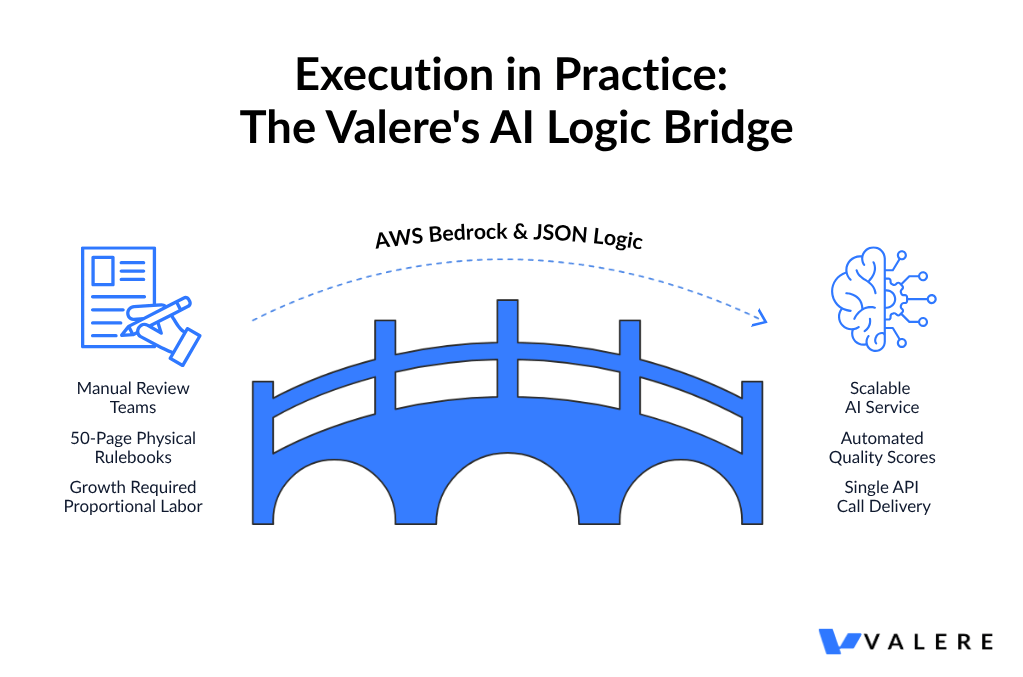
One of the clearest examples we have encountered is a content quality platform whose entire value proposition depended on human teams manually reviewing image and text annotations against a dense, 50-page rulebook. The work was genuinely valuable. The delivery mechanism was not scalable; every unit of growth required a proportional unit of labor.
We built an AI-powered logic bridge using AWS Bedrock that maps the full rulebook into precise JSON logic. The system now evaluates any annotation submission, generates a quality score, and produces a complete audit trail in a single API call. A fragmented, labor-intensive review process became a scalable, outcome-based software service. The software itself now handles rule application, exception handling, and quality assessment directly.
That is what service as software actually looks like: not AI-assisted humans working faster, but AI performing the work directly, with humans setting the parameters and reviewing the outputs.
The Downstream Implications
The downstream implications are significant. Customer success teams built around user adoption metrics become less relevant when the user is an agent. Sales motions built around named-user licensing need rethinking. Gross margin profiles shift as compute becomes a larger share of COGS. The pricing model has to be rebuilt from first principles. Companies that internalize this shift early will compound their advantages. Those that treat it as something to address later will find it arriving as a crisis.
Choose a Path and Execute It
The strategic inflection for software companies is real, and the window for sitting on the fence is closing. The question is not how to add AI to what you are already doing. It is which path you are on and whether you are executing it with the discipline the market now requires.
Put it plainly on the first page of the next board deck: are we growing 10 points faster through AI-native products, or rebuilding to 40 to 50% true margins?
What we have consistently found working through this with clients is that the AI capability itself is rarely the limiting factor. Organizational knowledge, process clarity, and willingness to redesign around outcomes rather than activities is where most of the real work happens. The enterprise licensing platform we rebuilt succeeded because we understood exactly what an enterprise buyer needed before writing a line of code. The opportunity scoring agents worked because we first spent time codifying decades of human judgment. The churn detection work moved the needle because we interviewed enough people on the ground to surface the warning signals no dashboard had ever tracked.
None of these required dramatically more capital or entirely different people. They required a clear-eyed choice about which path to take, the right architecture for getting there, and a genuine commitment to treating AI as a structural redesign rather than a feature update.
The divide in software is not temporary. It reflects a permanent shift in how software is built, delivered, and valued. The companies that emerge on the right side of it will be the ones that chose a direction and executed it with conviction.

Ready to Determine Which Path Is Right for Your Business?
The companies that successfully navigate this divide share one thing in common: they stopped debating which path to take and started executing with clarity and conviction. Whether that means accelerating growth through AI-native products or rebuilding to true operating margins, the window for half-measures is closing.
Valere works with software companies and PE-backed businesses at exactly this inflection point, from diagnosing where you sit today to building and scaling the systems that determine where you land. We bring the expertise, platform, and partnership model to turn strategic intent into measurable outcomes.
- A Path Clarity Assessment that identifies whether your business has the growth endurance for Path One or the cost structure and retention profile to execute Path Two, including where your current AI investments are generating real returns and where they are not
- A clear blueprint from disconnected AI pilots to a production-grade operating model that encodes your institutional knowledge, automates your highest-cost workflows, and compounds in output with every cycle it runs
- A personalized value creation roadmap covering the knowledge capture, agent orchestration, and organizational redesign needed to move from cautious experimentation to AI as a structural competitive advantage
Start the conversation: https://www.valere.io/
Frequently Asked Questions
How do mid-market software companies typically start with AI implementation?
Most mid-market software teams start by identifying where they are losing the most productive capacity: manual review processes, repetitive outbound, reactive customer success workflows. The companies that see the most durable results begin with knowledge capture work before building any automation. The underlying judgment in those workflows is usually more complex than it appears. Starting with agentic tooling before codifying the decision logic tends to produce agents that perform well in demos and poorly in production.
What does an AI readiness assessment typically include for a software company?
A thorough readiness assessment covers four things: the current cost and output structure of the workflows most likely to be automated; the state of existing data and knowledge documentation; the organizational capacity to absorb change without disrupting the core business; and an honest look at which path is actually executable given the company’s current position. Most assessments that skip the last question produce technically valid recommendations that never get implemented.
How do you evaluate whether to pursue revenue acceleration or margin improvement first?
The answer usually comes down to growth endurance. If net revenue retention is above 115% and the market genuinely supports 10+ percentage points of growth acceleration through AI-native products within 18 months, Path One tends to be the higher-value choice. If growth has already decelerated and NRR is under 110%, Path Two is typically more honest. Most companies assume they can pursue both simultaneously. The evidence suggests that committing to one path produces significantly better outcomes than a divided effort.
What is the difference between AI strategy and AI execution?
AI strategy identifies which workflows and business model changes represent the highest-value targets for transformation. AI execution gets those changes into production without disrupting the business while they are being built. Most of the gap between companies that generate meaningful AI ROI and those that do not comes down to execution: the knowledge capture work, the architecture decisions, and the organizational redesign. Strategy without execution infrastructure tends to produce well-reasoned slide decks and very little else.
How do PE-backed software companies typically approach AI transformation differently than VC-backed ones?
PE-backed software companies tend to move faster on the margin side because the path to exit is more clearly defined and the tolerance for extended investment cycles is lower. The firms with the strongest outcomes apply PE-style discipline to cost structure while simultaneously investing in the agent infrastructure that allows remaining headcount to operate at significantly higher output. The combination of zero-based budgeting and aggressive token spend per engineer tends to produce better results than either approach on its own.